
[Paper Review] Act3D: 3D Feature Field Transformers for Multi-Task Robotic Manipulation
Act3D proposes a 3D feature field transformer policy that predicts continuous-resolution 3D action maps for multi-task robotic manipulation using a single RGB-D image and language instructions. By employing coarse-to-fine 3D point sampling with relative positional embeddings and vision-language pretraining, Act3D achieves state-of-the-art performance on RLBench and generalizes robustly across camera viewpoints, achieving 74.2% success rate under viewpoint variation compared to 20.4% for HiveFormer.
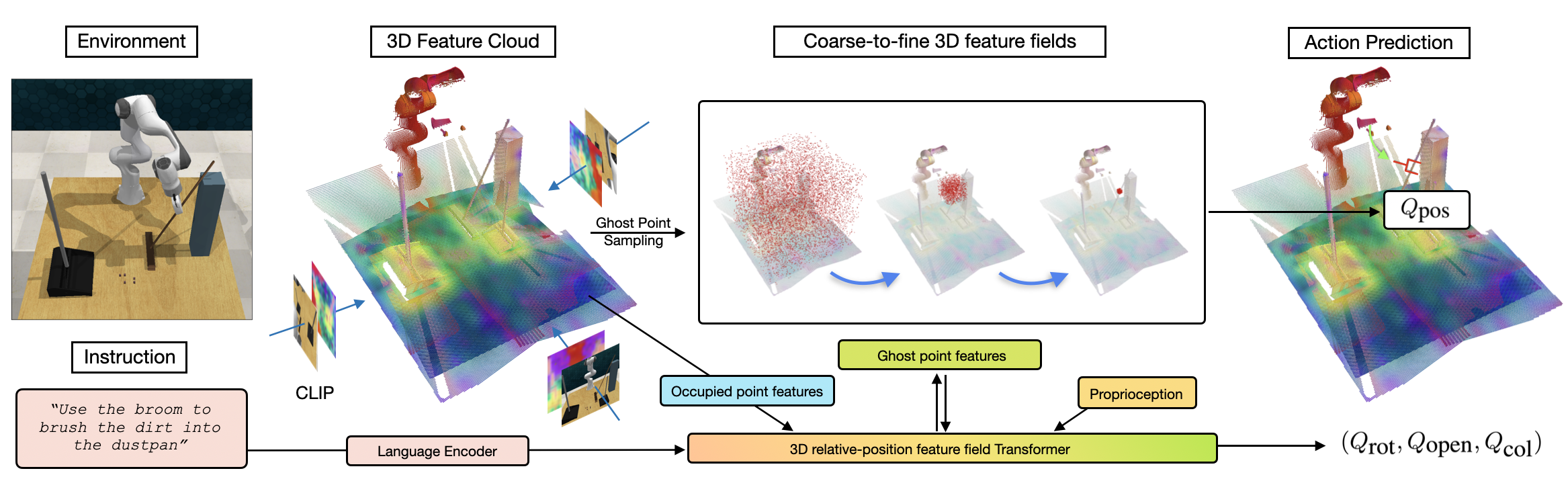
3D perceptual representations are well suited for robot manipulation as they easily encode occlusions and simplify spatial reasoning. Many manipulation tasks require high spatial precision in end-effector pose prediction, which typically demands high-resolution 3D feature grids that are computationally expensive to process. As a result, most manipulation policies operate directly in 2D, foregoing 3D inductive biases. In this paper, we introduce Act3D, a manipulation policy transformer that represents the robot's workspace using a 3D feature field with adaptive resolutions dependent on the task at hand. The model lifts 2D pre-trained features to 3D using sensed depth, and attends to them to compute features for sampled 3D points. It samples 3D point grids in a coarse to fine manner, featurizes them using relative-position attention, and selects where to focus the next round of point sampling. In this way, it efficiently computes 3D action maps of high spatial resolution. Act3D sets a new state-of-the-art in RL-Bench, an established manipulation benchmark, where it achieves 10% absolute improvement over the previous SOTA 2D multi-view policy on 74 RLBench tasks and 22% absolute improvement with 3x less compute over the previous SOTA 3D policy. We quantify the importance of relative spatial attention, large-scale vision-language pre-trained 2D backbones, and weight tying across coarse-to-fine attentions in ablative experiments. Code and videos are available on our project website: https://act3d.github.io/.
Motivation & Objective
- Address the challenge of generalizing robot manipulation policies across diverse tasks and viewpoints using minimal demonstrations.
- Overcome limitations of 2D multi-view methods that regress offsets and fail under viewpoint changes.
- Enable high-precision, continuous-resolution 3D action prediction for complex manipulation tasks using a single RGB-D camera.
- Improve zero-shot generalization and robustness to depth noise and viewpoint shifts through 3D feature field modeling and vision-language alignment.
- Develop a unified framework that supports multi-task learning with language-conditioned policies across diverse object types and interactions.
Proposed method
- Represent the 3D scene as a continuous-resolution feature field via coarse-to-fine 3D point sampling, where each point is attended to using relative 3D positional embeddings.
- Use a vision-language transformer backbone with CLIP-pretrained ResNet50 features to condition action predictions on natural language instructions.
- Implement weight tying across coarse-to-fine sampling stages and attend to local fine-grained visual features to improve localization accuracy.
- Apply spatially adaptive computation by sampling ghost points in 3D space, allowing dynamic trade-offs between inference cost and performance.
- Train the model to predict actions as 3D detection outputs, with infinite resolution via continuous 3D feature fields, enabling precise action localization.
- Leverage multi-view consistency and data augmentations such as random crops to improve robustness, while avoiding detrimental perturbations like yaw rotation.
Experimental results
Research questions
- RQ1Can a 3D feature field transformer with coarse-to-fine sampling achieve superior generalization to viewpoint changes compared to 2D multi-view regression methods?
- RQ2How does relative 3D positional encoding and weight tying across sampling stages affect policy performance and generalization?
- RQ3To what extent does pre-training 2D visual features with CLIP improve zero-shot success in multi-task language-conditioned manipulation?
- RQ4How does the number of sampled ghost points influence the trade-off between inference cost and action prediction accuracy?
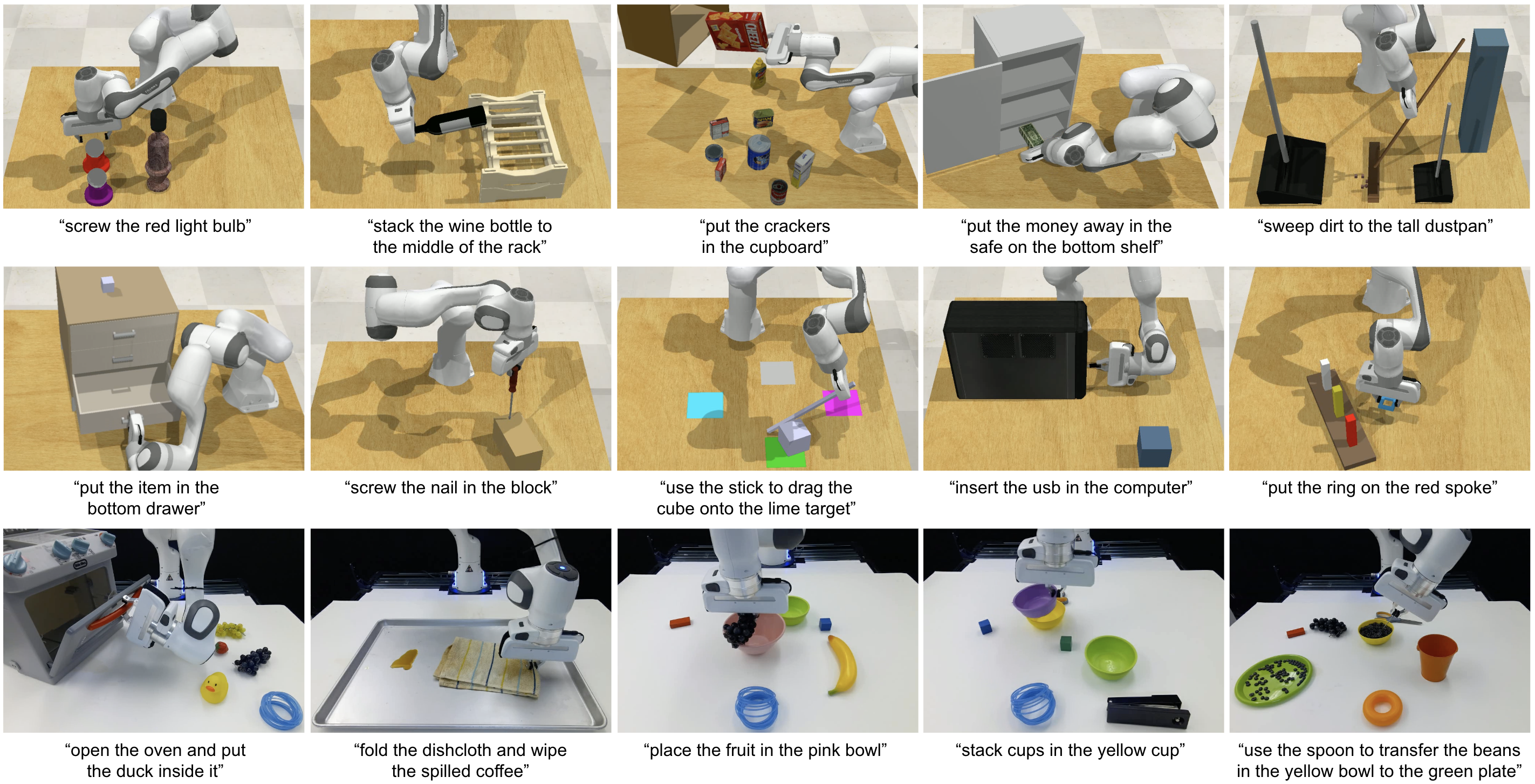
- RQ5Can a single 3D detection-based policy generalize across diverse manipulation tasks—including liquid, articulated, and deformable objects—using only a few kinesthetic demonstrations?
Key findings
- Act3D achieves 74.2% success rate under camera viewpoint variation, a 24% relative drop, compared to HiveFormer’s 20.4% (77% relative drop), demonstrating superior robustness to viewpoint changes.
- Removing weight tying or relative 3D positional embeddings causes 17.5% and 42.7% performance drops, respectively, highlighting their critical role in generalization.
- Using only two sampling stages instead of three leads to a 4.5% performance drop, confirming the necessity of full coarse-to-fine refinement.
- Attending to global coarse features across all stages instead of local fine features causes an 8.3% performance drop, underscoring the importance of local attention in fine stages.
- Increasing ghost point sampling from 1,000 to 10,000 boosts performance by 4.9%, showing that higher sampling density improves accuracy with marginal cost increase.
- CLIP-pretrained ResNet50 features improve success rate by 8.7% over ImageNet-pretrained features in the multi-task setting, especially when language instructions are critical.
Read this paper
Open the full text in the Nubint reader and ask about any passage as you read.
Read this paper on NubintThis review was generated by AI from the original paper. Please check the paper before citing it.