
[Paper Review] ACTION++: Improving Semi-supervised Medical Image Segmentation with Adaptive Anatomical Contrast
ACTION++ improves semi-supervised medical image segmentation in long-tailed datasets by introducing adaptive anatomical contrastive learning and a dynamic temperature scheduler. It enhances feature space balance between head and tail classes through online matching to uniformly distributed class centers and a cosine-scheduled temperature, achieving state-of-the-art performance on ACDC and LA benchmarks with significant gains in Dice and surface distance metrics.
Medical data often exhibits long-tail distributions with heavy class imbalance, which naturally leads to difficulty in classifying the minority classes (i.e., boundary regions or rare objects). Recent work has significantly improved semi-supervised medical image segmentation in long-tailed scenarios by equipping them with unsupervised contrastive criteria. However, it remains unclear how well they will perform in the labeled portion of data where class distribution is also highly imbalanced. In this work, we present ACTION++, an improved contrastive learning framework with adaptive anatomical contrast for semi-supervised medical segmentation. Specifically, we propose an adaptive supervised contrastive loss, where we first compute the optimal locations of class centers uniformly distributed on the embedding space (i.e., off-line), and then perform online contrastive matching training by encouraging different class features to adaptively match these distinct and uniformly distributed class centers. Moreover, we argue that blindly adopting a constant temperature $τ$ in the contrastive loss on long-tailed medical data is not optimal, and propose to use a dynamic $τ$ via a simple cosine schedule to yield better separation between majority and minority classes. Empirically, we evaluate ACTION++ on ACDC and LA benchmarks and show that it achieves state-of-the-art across two semi-supervised settings. Theoretically, we analyze the performance of adaptive anatomical contrast and confirm its superiority in label efficiency.
Motivation & Objective
- Address class imbalance in labeled medical image data, which is often overlooked in contrastive learning despite its prevalence in real-world clinical data.
- Improve semi-supervised segmentation performance by enhancing both supervised and unsupervised contrastive learning in long-tailed distributions.
- Develop a method that balances representation learning for both majority (head) and minority (tail) classes to improve generalization.
- Investigate the impact of a constant temperature hyperparameter in contrastive loss on long-tailed medical data and propose a dynamic alternative.
- Theoretical and empirical validation of label efficiency and robustness in low-supervision regimes.
Proposed method
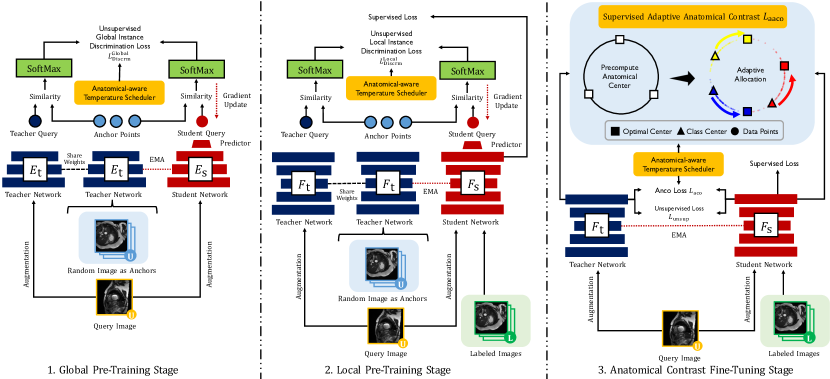
- Propose supervised adaptive anatomical contrastive learning (SAACL), where optimal class centers are pre-computed and uniformly distributed in the embedding space to guide online feature matching.
- Introduce a dynamic temperature scheduler using a cosine schedule to adaptively adjust the contrastive loss temperature, improving separation between head and tail classes.
- Use a learnable temperature range (τ⁻ = 0.1, τ⁺ = 1.0) with a cosine decay over training iterations to balance group-level and instance-level discrimination.
- Integrate SAACL and dynamic temperature scheduling into a two-stage training pipeline: global/local pre-training followed by adaptive contrastive fine-tuning.
- Apply the method within a semi-supervised framework using both labeled and unlabeled data, leveraging self-supervised contrastive objectives on unlabeled data and adaptive supervised contrast on labeled data.

Experimental results
Research questions
- RQ1Can adaptive supervised contrastive learning improve segmentation performance on long-tailed medical image data by preventing bias toward dominant classes?
- RQ2Does a dynamic temperature schedule in contrastive learning lead to better feature separation between head and tail classes compared to a constant temperature?
- RQ3How does the proposed method perform under low-supervision settings, and does it improve label efficiency compared to prior methods?
- RQ4What is the impact of uniformly distributed class centers on the embedding space in guiding feature learning during semi-supervised training?
- RQ5Can the combination of adaptive anatomical contrast and dynamic temperature scheduling yield consistent improvements across diverse medical image segmentation benchmarks?
Key findings
- ACTION++ achieved a Dice score of 93.1% on the LA dataset with 10% labeled data, outperforming the previous SOTA method (ACTION) by 0.4 percentage points.
- On the ACDC dataset with 10% labels, ACTION++ achieved a Dice score of 91.9% for the average structure, surpassing the previous SOTA by 0.7 percentage points.
- The model showed significant improvement in boundary segmentation, particularly for challenging regions like RV and Myo, with a 0.818 mm ASD on ACDC (10% labels), outperforming prior methods.
- Ablation studies confirmed that both SAACL and the dynamic temperature scheduler are essential, with SAACL alone improving DSC to 89.9% and reducing ASD to 1.74 voxels on LA (10% labels).
- The method demonstrated superior label efficiency, with theoretical analysis confirming its robustness in low-supervision regimes.
Read this paper
Open the full text in the Nubint reader and ask about any passage as you read.
Read this paper on NubintThis review was generated by AI from the original paper. Please check the paper before citing it.