
[Paper Review] Active flow control for three-dimensional cylinders through deep reinforcement learning
The paper demonstrates successful drag reduction of a 3D cylinder using multi-agent deep reinforcement learning (MARL) to control multiple zero-net-mass-flux synthetic jets on the cylinder surface, coupled to a CFD solver via PPO.
This paper presents for the first time successful results of active flow control with multiple independently controlled zero-net-mass-flux synthetic jets. The jets are placed on a three-dimensional cylinder along its span with the aim of reducing the drag coefficient. The method is based on a deep-reinforcement-learning framework that couples a computational-fluid-dynamics solver with an agent using the proximal-policy-optimization algorithm. We implement a multi-agent reinforcement-learning framework which offers numerous advantages: it exploits local invariants, makes the control adaptable to different geometries, facilitates transfer learning and cross-application of agents and results in significant training speedup. In this contribution we report significant drag reduction after applying the DRL-based control in three different configurations of the problem.
Motivation & Objective
- Extend DRL-based active flow control from 2D to 3D cylinders with multiple surface actuators.
- Leverage multi-agent local observations to manage high-dimensional jet-control without prohibitive training costs.
- Evaluate drag-reduction performance across a range of Reynolds numbers and geometrical configurations.
- Provide a MARL benchmark for 3D wake control and insights into actuator placement and observation choices.
Proposed method
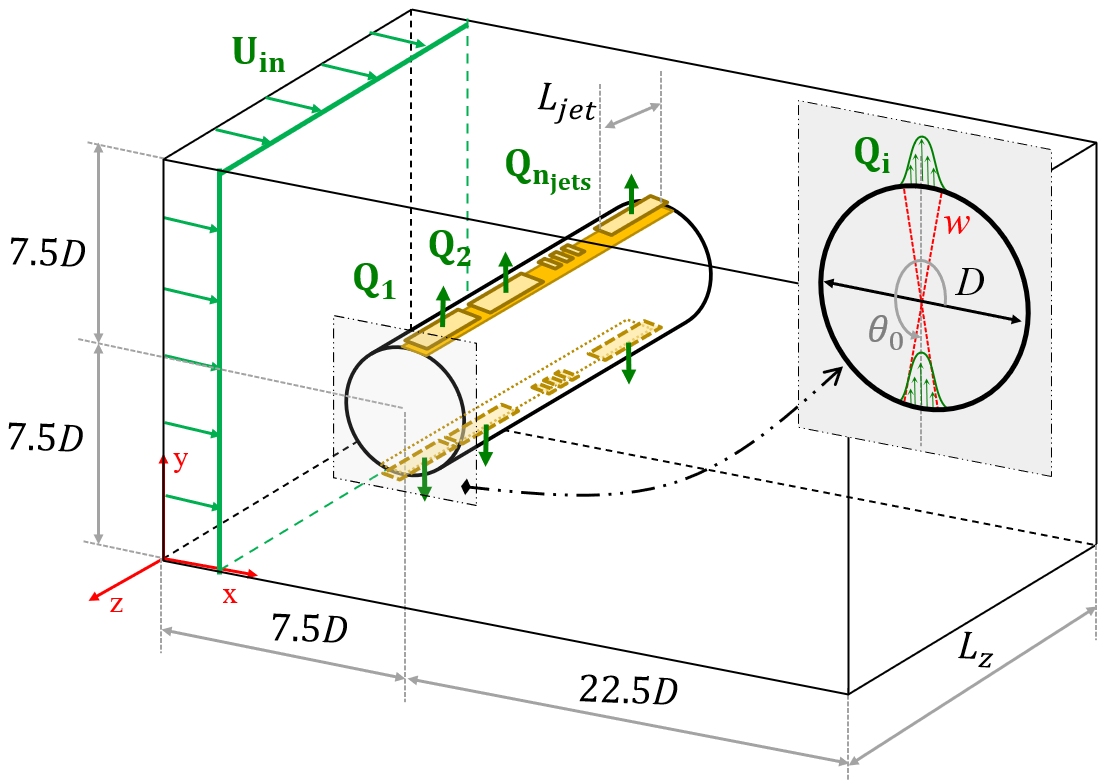
- Couple Alya CFD solver (finite-element Navier–Stokes) with a multi-agent PPO framework.
- Deploy multiple independent agents sharing neural-network weights to control spanwise jets with mass-flow rate Q.
- Define local and global rewards based on drag reduction and lift penalties, balanced by a beta parameter (β=0.8).
- Observe wake state using slices of 85 probes per pseudo-environment, with optional neighboring probes to form 255-probe observations.
- Use Q scaling with Q_max3D = 2 * Q_max2D to map policy outputs to jet actuation, and enforce opposite jet actions to ensure zero net mass flow per environment.
Experimental results
Research questions
- RQ1Can MARL with locally operating agents control multiple surface jets on a 3D cylinder to reduce drag across a range of Reynolds numbers?
- RQ2How does incorporating neighboring wake observations and different spanwise domain sizes affect learning and performance?
- RQ3What drag-reduction performance can be achieved in 3D compared to 2D benchmarks, and how does wake dynamics influence policy strategies?
Key findings
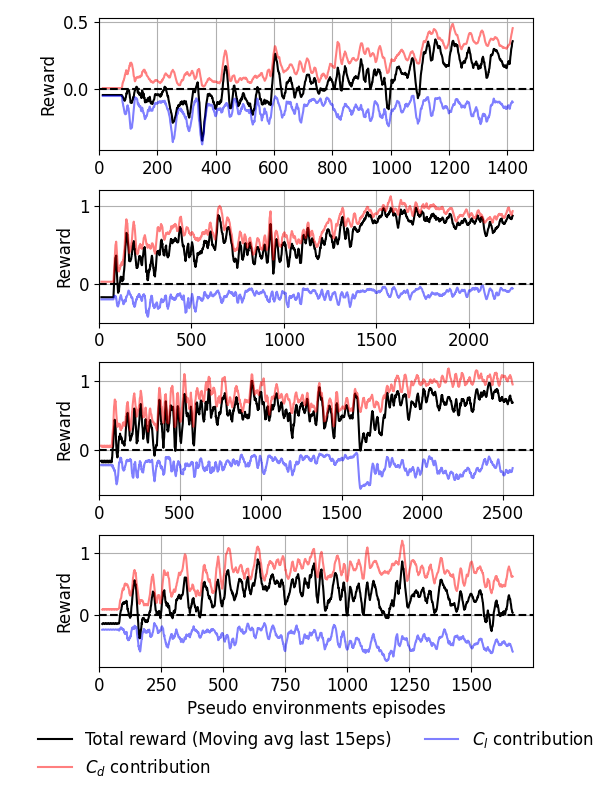
- MARL achieves significant drag reductions in 3D cylinder cases at Re = 100, 200, 300, 400 with values 9.4%, 17.2%, 6.7%, and 9.9% (Ljet/D = 1).
- With shorter jets (Ljet/D = 0.4), drag reductions are 4.3%, 11.0%, 10.8%, and 15.0% (local observation) and 8.0%, 12.7%, 15.2%, 11.0% (neighbors observed).
- 3D results show more consistent drag-reduction performance at higher Re than their 2D counterparts, despite some Re-dependent variations.
- The DRL control attenuates vortex-shedding strength and delays wake reattachment, indicating a wake-stabilizing influence from actuation.
- Policies exhibit an extruded, synchronized jet strategy across the span, with potential benefits from varying jet length and observation granularity for higher Re.
- The MARL framework enables training in pseudo-environments with shared weights, speeding up learning and allowing transfer to different cylinder geometries in concept.
Read this paper
Open the full text in the Nubint reader and ask about any passage as you read.
Read this paper on NubintThis review was generated by AI from the original paper. Please check the paper before citing it.