
[Paper Review] Active galactic nuclei with high-resolution X-ray spectroscopy
This paper reviews the transformative potential of high-resolution X-ray spectroscopy—enabled by XRISM, Athena, and Arcus—for advancing our understanding of active galactic nuclei (AGN), particularly in probing ionized winds (warm absorbers, ultrafast outflows), relativistic iron emission from the accretion disc and torus, and AGN feedback mechanisms. It emphasizes how upcoming missions will resolve long-standing uncertainties in wind kinematics, ionization structure, and black hole accretion physics through improved spectral resolution and sensitivity.
The imminent launch of XRISM will usher in an era of high-resolution X-ray spectroscopy. For active galactic nuclei (AGN) this is an exciting epoch that is full of massive potential for uncovering the ins and outs of supermassive black hole accretion. In this work, we review AGN research topics that are certain to advance in the coming years with XRISM and prognosticate the possibilities with Athena and Arcus. Specifically, our discussion focuses on: (i) the relatively slow moving ionised winds known as warm absorbers and obscurers; (ii) the iron emitting from different regions of the inner and outer disc, broad line region, and torus; and (iii) the ultrafast outflows that may be the key to understanding AGN feedback.
Motivation & Objective
- To assess how high-resolution X-ray spectroscopy will advance the study of AGN accretion physics and feedback mechanisms.
- To identify key AGN phenomena—such as warm absorbers, ultrafast outflows, and relativistic iron lines—that will be illuminated by upcoming missions.
- To outline the scientific potential of XRISM, Athena, and Arcus in resolving the ionization structure, kinematics, and driving mechanisms of AGN winds.
- To establish a roadmap for using high-resolution X-ray data to constrain black hole mass, accretion rate, and wind feedback efficiency.
- To highlight the importance of multi-mission synergy in achieving a comprehensive view of AGN structure and evolution.
Proposed method
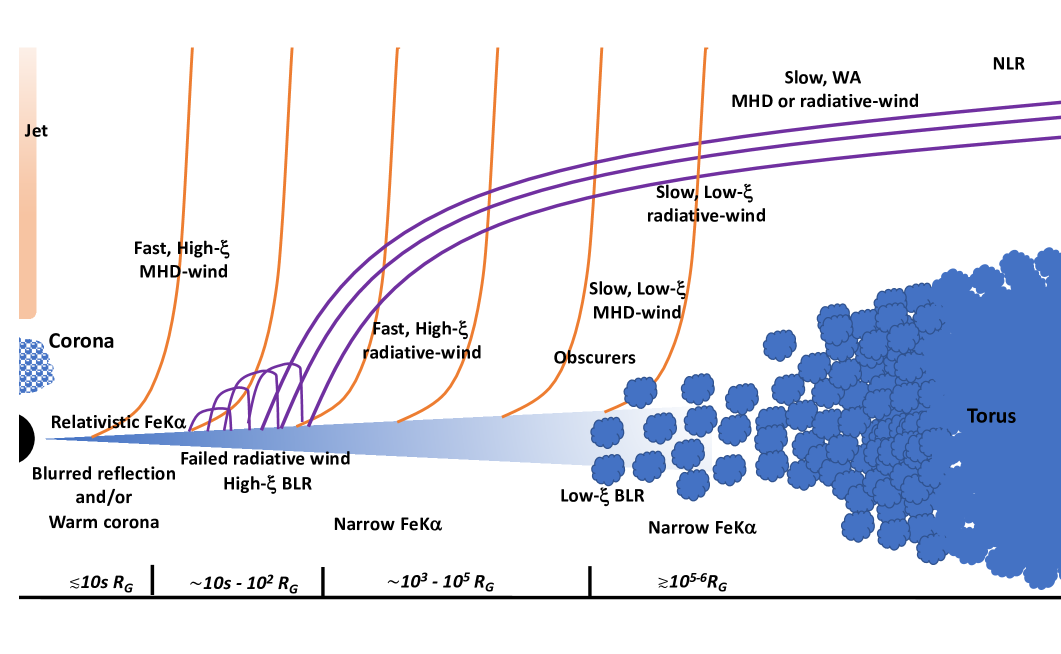
- Utilizing high-resolution X-ray spectroscopy to analyze X-ray emission lines, particularly the relativistic Fe Kα line, from the inner disc, broad-line region, and torus.
- Modeling ionized winds using photoionization and MHD-driven wind simulations to interpret observed line profiles and ionization states.
- Applying reverberation mapping techniques to link X-ray variability with emission line response, enabling constraints on black hole mass and geometry.
- Employing line profile fitting to infer wind velocity, ionization, and density structure, using the Doppler shift and broadening of spectral lines.
- Using the Eddington ratio as a key parameter to correlate wind properties with accretion state and feedback efficiency.
- Leveraging future missions' sensitivity and resolution to extend demographic studies of winds and iron emission across a wider range of AGN.
Experimental results
Research questions
- RQ1How do the kinematics and ionization structure of warm absorbers and ultrafast outflows vary with Eddington ratio and viewing angle?
- RQ2What is the origin and spatial distribution of the relativistic Fe Kα emission line in AGN, and how does it relate to the inner disc, broad-line region, and torus?
- RQ3To what extent do ultrafast outflows contribute to AGN feedback, and how does their efficiency depend on accretion state?
- RQ4Can high-resolution spectroscopy resolve the geometry and ionization structure of the inner disc and wind, including potential warping due to spin-disc misalignment?
- RQ5How will the sensitivity and resolution of XRISM, Athena, and Arcus improve our ability to measure wind mass outflow rates and feedback luminosities?
Key findings
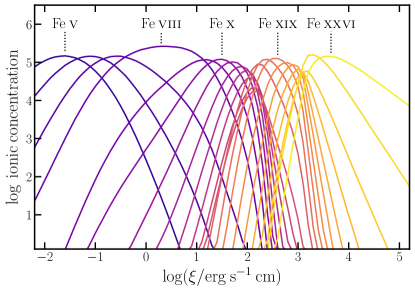
- XRISM is expected to extend the range of ionization parameters over which absorption measure distributions (AMDs) can be constructed by two orders of magnitude in bright Seyfert galaxies.
- XRISM will enable the measurement of ionization timescales, allowing direct constraints on gas density and the radial distance of wind components from the central engine.
- High-resolution spectroscopy with XRISM may reveal narrow Fe Kα emission lines in bright Seyferts, providing independent constraints on the location of the reflecting material relative to the broad-line region and torus.
- The combination of X-ray and UV spectroscopy from missions like Arcus will allow pristine line profile measurements, enabling density diagnostics and time-resolved spectroscopy.
- Athena will extend detailed wind and reflection studies to quasars at moderate redshifts and to AGN with lower Eddington ratios, enabling a broader demographic understanding of feedback mechanisms.
- Reverberation mapping with high-resolution X-ray data may offer independent constraints on black hole mass and the geometry of the innermost accretion structures, including potential disc warping.
Read this paper
Open the full text in the Nubint reader and ask about any passage as you read.
Read this paper on NubintThis review was generated by AI from the original paper. Please check the paper before citing it.