
[Paper Review] Active Learning for Abstractive Text Summarization
This paper proposes In-Domain Diversity Sampling (IDDS), the first effective active learning query strategy for abstractive text summarization (ATS), which selects diverse, semantically distinct instances from unlabeled data while maintaining domain relevance. Unlike uncertainty-based methods that degrade performance, IDDS improves ROUGE scores and consistency over random sampling, with self-learning further boosting results by up to 58% in ROUGE gains.
Construction of human-curated annotated datasets for abstractive text summarization (ATS) is very time-consuming and expensive because creating each instance requires a human annotator to read a long document and compose a shorter summary that would preserve the key information relayed by the original document. Active Learning (AL) is a technique developed to reduce the amount of annotation required to achieve a certain level of machine learning model performance. In information extraction and text classification, AL can reduce the amount of labor up to multiple times. Despite its potential for aiding expensive annotation, as far as we know, there were no effective AL query strategies for ATS. This stems from the fact that many AL strategies rely on uncertainty estimation, while as we show in our work, uncertain instances are usually noisy, and selecting them can degrade the model performance compared to passive annotation. We address this problem by proposing the first effective query strategy for AL in ATS based on diversity principles. We show that given a certain annotation budget, using our strategy in AL annotation helps to improve the model performance in terms of ROUGE and consistency scores. Additionally, we analyze the effect of self-learning and show that it can further increase the performance of the model.
Motivation & Objective
- To address the high cost of human-annotated datasets in abstractive text summarization (ATS), where creating each summary is time-intensive.
- To investigate why traditional uncertainty-based active learning (AL) strategies fail in ATS, despite success in other NLP tasks.
- To develop a new AL query strategy that improves model performance without relying on uncertainty estimates.
- To evaluate the impact of self-learning in combination with AL for ATS, especially on datasets with short summaries.
- To demonstrate that diversity-based sampling can outperform random and uncertainty-based sampling in ATS.
Proposed method
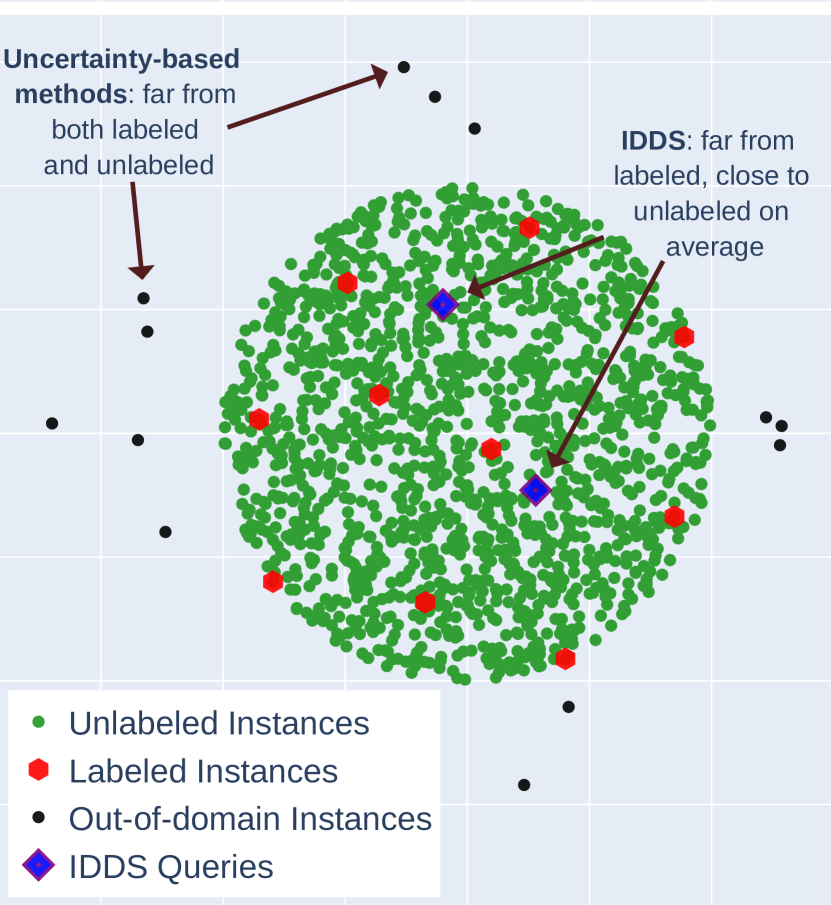
- Proposes In-Domain Diversity Sampling (IDDS), a query strategy that selects instances with high similarity to the unlabeled pool and low similarity to already annotated documents.
- Uses sentence embeddings from a pre-trained model (e.g., BERT) to compute semantic similarity between documents.
- Selects instances that are diverse relative to the already labeled set but representative of the core domain distribution.
- Employs a diversity objective function that maximizes inter-instance dissimilarity while preserving domain relevance.
- Combines IDDS with self-learning by generating synthetic summaries using a model fine-tuned on human-annotated data and adding them to the training set.
- Uses ROUGE and SummaC-based consistency scores to evaluate model performance across AL iterations.
Experimental results
Research questions
- RQ1Can active learning improve abstractive text summarization performance with reduced annotation cost?
- RQ2Why do uncertainty-based query strategies fail in ATS compared to other NLP tasks?
- RQ3Can diversity-based sampling outperform random sampling and uncertainty-based strategies in ATS?
- RQ4Does self-learning enhance model performance when combined with active learning in ATS?
- RQ5How does the combination of IDDS and self-learning affect ROUGE and consistency scores?
Key findings
- IDDS significantly outperforms random sampling in ROUGE scores across all evaluated datasets (AESLC, Gigaword, WikiHow).
- Uncertainty-based query strategies, such as NSP, perform worse than random sampling, degrading model performance due to noisy predictions.
- IDDS improves summary consistency, as measured by SummaC, especially on the AESLC dataset, where it achieves the highest consistency scores.
- Self-learning boosts model performance, particularly on datasets with short summaries, increasing ROUGE scores by up to 58% when combined with IDDS.
- The IDDS strategy is computationally efficient, with low query duration, making it suitable for interactive active learning workflows.
- On WikiHow, no clear trend in consistency was observed, likely due to low-quality model-generated summaries affecting SummaC scores.

Read this paper
Open the full text in the Nubint reader and ask about any passage as you read.
Read this paper on NubintThis review was generated by AI from the original paper. Please check the paper before citing it.