
[Paper Review] Active Learning in Symbolic Regression with Physical Constraints
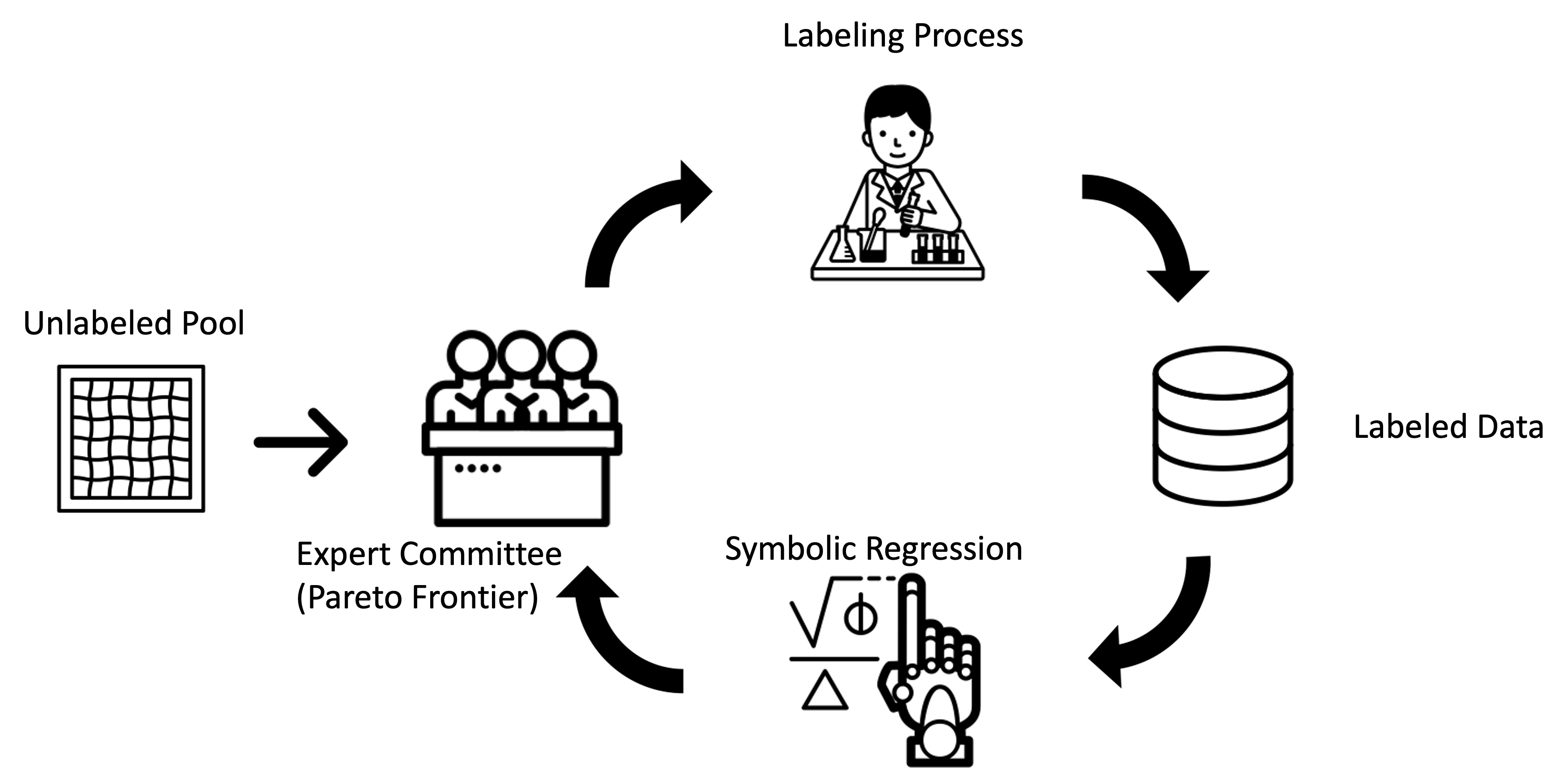
This paper proposes an active learning framework for symbolic regression that combines Query by Committee (QBC) with physical constraints to reduce data requirements and improve equation discovery. By using the Pareto frontier of candidate equations to guide data selection and incorporating soft physical constraints—especially symmetry—as regularization, the method achieves state-of-the-art performance in rediscovering known equations with significantly fewer data points than prior methods like AI Feynman.
Evolutionary symbolic regression (SR) fits a symbolic equation to data, which gives a concise interpretable model. We explore using SR as a method to propose which data to gather in an active learning setting with physical constraints. SR with active learning proposes which experiments to do next. Active learning is done with query by committee, where the Pareto frontier of equations is the committee. The physical constraints improve proposed equations in very low data settings. These approaches reduce the data required for SR and achieves state of the art results in data required to rediscover known equations.
Motivation & Objective
- To reduce the number of data points required for symbolic regression to rediscover known scientific equations.
- To improve symbolic regression performance in low-data and noisy settings using active learning.
- To integrate physical constraints as regularization to guide search toward physically meaningful equations.
- To evaluate the impact of different types of physical constraints on symbolic regression performance.
- To benchmark the method against state-of-the-art approaches like AI Feynman on the Feynman dataset.
Proposed method
- Employs Query by Committee (QBC) with the Pareto frontier of evolved equations as the committee to select the most informative next data points.
- Uses genetic algorithms with binary tree representations to evolve candidate symbolic equations.
- Incorporates soft physical constraints—divergence, asymptote, monotonicity, positivity, and symmetry—into the loss function as regularization terms.
- Applies constraints such as symmetry and unit correctness to guide the search toward physically plausible solutions.
- Uses the Feynman dataset as a benchmark for evaluating equation rediscovery under varying data and noise conditions.
- Performs ablation studies to compare constrained vs. unconstrained optimization across multiple equations and noise levels.
Experimental results
Research questions
- RQ1Can QBC-based active learning reduce the number of data points required for symbolic regression to rediscover known equations?
- RQ2How do different types of physical constraints (e.g., symmetry, divergence) affect the performance of symbolic regression in low-data regimes?
- RQ3Does incorporating soft physical constraints improve robustness to noise in symbolic regression?
- RQ4How does the proposed method compare to state-of-the-art approaches like AI Feynman in terms of data efficiency and rediscovery rate?
- RQ5Under what conditions do physical constraints hinder rather than help the symbolic regression process?
Key findings
- The proposed method achieved a 10% increase in rediscovery rate for the gravitational force equation when using divergence constraints, outperforming non-constrained regression.
- Symmetry constraints improved rediscovery performance on the distance formula, with a p-value of 0.061 in the noiseless case, indicating a statistically marginal but meaningful improvement.
- In high-noise conditions (noise level 0.1), constrained optimization successfully rediscovered the distance formula in 139 runs, while unconstrained optimization failed entirely.
- Contrary to expectations, asymptote and monotonicity constraints reduced performance, suggesting that not all physical constraints are beneficial and may misguide the search.
- The method demonstrated resilience to noise, with constrained optimization outperforming unconstrained methods even in noisy settings, particularly for complex equations.
- The integration of QBC and physical constraints enabled state-of-the-art data efficiency, surpassing AI Feynman in the number of data points required to rediscover known equations.
Read this paper
Open the full text in the Nubint reader and ask about any passage as you read.
Read this paper on NubintThis review was generated by AI from the original paper. Please check the paper before citing it.