
[Paper Review] Adapted Large Language Models Can Outperform Medical Experts in Clinical Text Summarization
The study shows that adapted large language models (LLMs) can match or exceed medical expert summaries across multiple clinical summarization tasks, using both in-context learning and fine-tuning methods, with a safety analysis included.
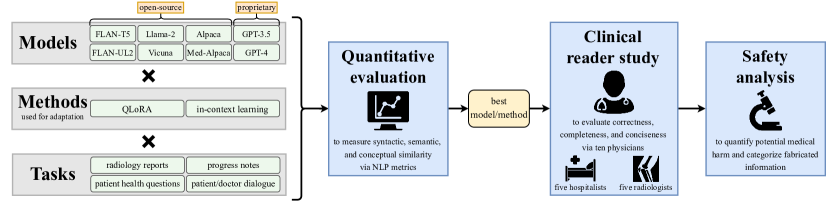
Analyzing vast textual data and summarizing key information from electronic health records imposes a substantial burden on how clinicians allocate their time. Although large language models (LLMs) have shown promise in natural language processing (NLP), their effectiveness on a diverse range of clinical summarization tasks remains unproven. In this study, we apply adaptation methods to eight LLMs, spanning four distinct clinical summarization tasks: radiology reports, patient questions, progress notes, and doctor-patient dialogue. Quantitative assessments with syntactic, semantic, and conceptual NLP metrics reveal trade-offs between models and adaptation methods. A clinical reader study with ten physicians evaluates summary completeness, correctness, and conciseness; in a majority of cases, summaries from our best adapted LLMs are either equivalent (45%) or superior (36%) compared to summaries from medical experts. The ensuing safety analysis highlights challenges faced by both LLMs and medical experts, as we connect errors to potential medical harm and categorize types of fabricated information. Our research provides evidence of LLMs outperforming medical experts in clinical text summarization across multiple tasks. This suggests that integrating LLMs into clinical workflows could alleviate documentation burden, allowing clinicians to focus more on patient care.
Motivation & Objective
- Reduce clinician documentation burden by evaluating whether adapted LLMs can produce high-quality clinical summaries.
- Assess the performance trade-offs across model types, adaptation methods, and tasks.
- Establish whether LLM-generated summaries are non-inferior or superior to medical expert summaries.
- Explore safety implications and error types that could cause harm in clinical use.
Proposed method
- Evaluate eight LLMs (open-source seq2seq and autoregressive, plus proprietary) on four clinical summarization tasks using six datasets.
- Apply two adaptation methods: in-context learning (ICL) with nearest-neighbor retrieved examples and quantized low-rank adaptation (QLoRA) fine-tuning.
- Tune prompts to include task-specific expertise and length constraints; set model temperature to 0.1.
- Use NLP metrics (BLEU, ROUGE-L, BERTScore, MEDCON) and QuickUMLS-based concept checks for evaluation.
- Conduct a clinical reader study with ten physicians to compare best model summaries against medical expert summaries.
- Perform a safety analysis linking errors to potential harm and categorize fabricated information.
Experimental results
Research questions
- RQ1Can adapted LLMs generate clinical summaries that are non-inferior or superior to medical experts across multiple clinical tasks?
- RQ2Which combination of model type and adaptation method yields the best performance on radiology, patient questions, progress notes, and dialogue summarization?
- RQ3How do NLP metric scores correlate with clinician reader preferences across tasks?
- RQ4What are the safety considerations and error types (including potential harm and fabrication) associated with LLM-generated clinical summaries?
Key findings
- Best-performing setup: GPT-4 with in-context learning often outperforms medical expert summaries in completeness and correctness.
- Adaptation method choices show trade-offs; in-context learning can match or exceed fine-tuned models with sufficient in-context examples.
- Open-source models with QLoRA can outperform some baselines, but proprietary models (GPT-3.5, GPT-4) generally achieve stronger results with sufficient in-context examples.
- Clinical reader study: model summaries were preferred or non-inferior in 81% of cases (45% non-inferior, 36% preferred) vs medical experts in radiology, patient questions, and progress notes.
- Safety analysis reveals challenges for both LLMs and medical experts; errors are linked to potential medical harm and fabrication types are categorized.

Read this paper
Open the full text in the Nubint reader and ask about any passage as you read.
Read this paper on NubintThis review was generated by AI from the original paper. Please check the paper before citing it.