
[Paper Review] Adapting LLMs for Efficient Context Processing through Soft Prompt Compression
This paper proposes SoftPromptComp, a framework that compresses long contexts in LLMs by combining natural language summarization with trainable soft prompts to create compact, semantically rich representations. By dynamically compressing input context and optimizing information retention via a weighting mechanism, the method reduces processing time by up to 80.1% while maintaining or improving model performance across multiple NLP tasks.
The rapid advancement of Large Language Models (LLMs) has inaugurated a transformative epoch in natural language processing, fostering unprecedented proficiency in text generation, comprehension, and contextual scrutiny. Nevertheless, effectively handling extensive contexts, crucial for myriad applications, poses a formidable obstacle owing to the intrinsic constraints of the models' context window sizes and the computational burdens entailed by their operations. This investigation presents an innovative framework that strategically tailors LLMs for streamlined context processing by harnessing the synergies among natural language summarization, soft prompt compression, and augmented utility preservation mechanisms. Our methodology, dubbed SoftPromptComp, amalgamates natural language prompts extracted from summarization methodologies with dynamically generated soft prompts to forge a concise yet semantically robust depiction of protracted contexts. This depiction undergoes further refinement via a weighting mechanism optimizing information retention and utility for subsequent tasks. We substantiate that our framework markedly diminishes computational overhead and enhances LLMs' efficacy across various benchmarks, while upholding or even augmenting the caliber of the produced content. By amalgamating soft prompt compression with sophisticated summarization, SoftPromptComp confronts the dual challenges of managing lengthy contexts and ensuring model scalability. Our findings point towards a propitious trajectory for augmenting LLMs' applicability and efficiency, rendering them more versatile and pragmatic for real-world applications. This research enriches the ongoing discourse on optimizing language models, providing insights into the potency of soft prompts and summarization techniques as pivotal instruments for the forthcoming generation of NLP solutions.
Motivation & Objective
- To address the computational inefficiency and context window limitations of LLMs when processing long documents.
- To enhance model efficiency without sacrificing performance on downstream NLP tasks.
- To develop a method that preserves semantic utility and transferability of long contexts through compressed, trainable soft prompts.
- To enable scalable deployment of LLMs in real-world applications requiring high throughput and low latency.
- To integrate soft prompt compression with natural language summarization for improved context management.
Proposed method
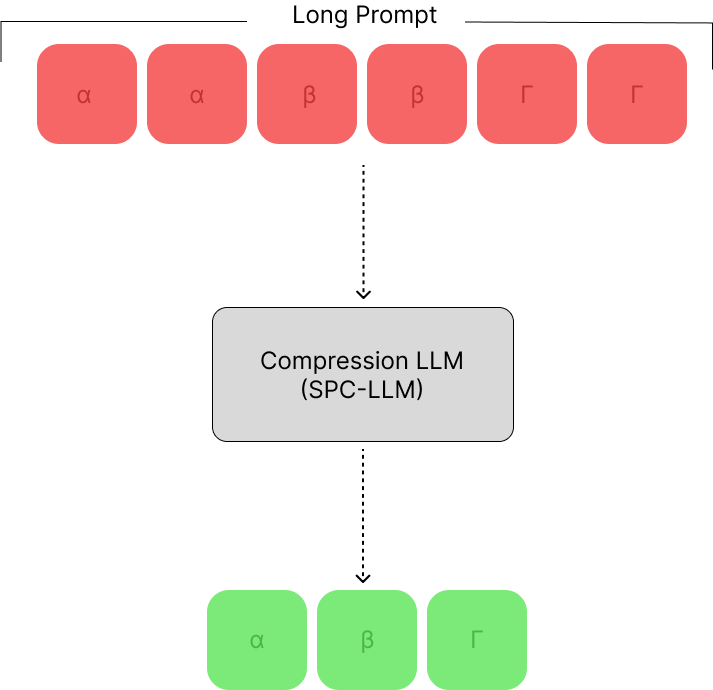
- The framework uses pre-trained summarization models to distill long input texts into concise, content-rich natural language summaries.
- These summaries are then embedded as trainable soft prompts, which are differentiable parameters optimized during fine-tuning.
- A dynamic weighting mechanism is applied to prioritize salient information and balance utility and compression.
- The compressed soft prompt representation is injected into the LLM’s input sequence, effectively extending its effective context window.
- The method is trained end-to-end using a combination of summarization loss and downstream task loss to preserve semantic fidelity and task performance.
- The framework is evaluated across diverse NLP benchmarks including SQuAD2.0, CNN/Daily Mail, SST-2, and AG News.
Experimental results
Research questions
- RQ1Can soft prompt compression combined with natural language summarization effectively reduce LLM inference time while preserving context quality?
- RQ2To what extent can compressed soft prompts maintain or improve downstream task performance compared to full-context inputs?
- RQ3How does the weighting mechanism impact information retention and model utility in compressed representations?
- RQ4Can the framework generalize across diverse NLP tasks such as question answering, sentiment analysis, and text classification?
- RQ5What is the trade-off between context compression ratio and performance degradation across different datasets?
Key findings
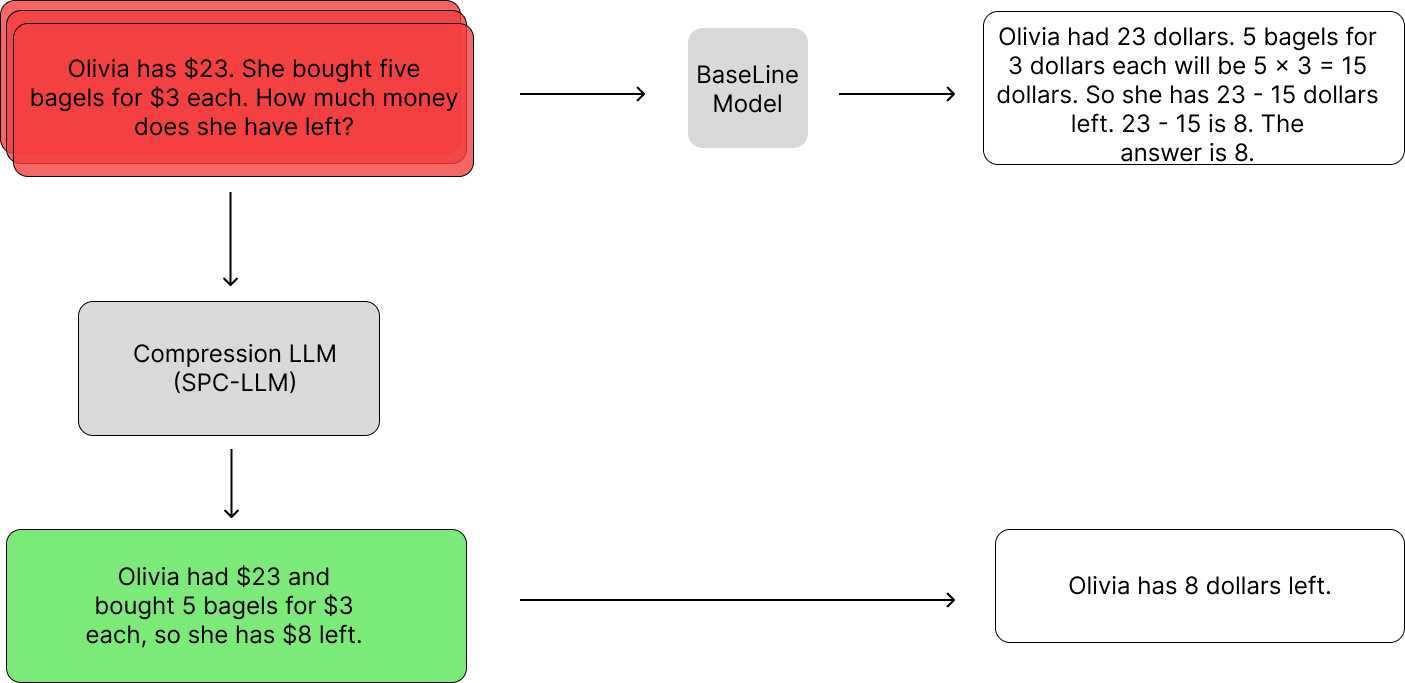
- Processing time was reduced by up to 80.1% on the SQuAD2.0 dataset, with similar gains observed on CNN/Daily Mail, SST-2, and AG News.
- The method maintained or improved model performance across all evaluated benchmarks, indicating strong utility preservation despite compression.
- The soft prompt compression framework achieved significant computational savings without requiring architectural changes to the base LLM.
- The integration of summarization with soft prompts enabled effective context management while preserving semantic richness and task relevance.
- The weighting mechanism effectively prioritized key information, enhancing both compression efficiency and downstream performance.
- The approach demonstrated strong generalization across multiple NLP tasks, including question answering, sentiment analysis, and text classification.
Better researchstarts right now
From reading papers to final review, dramatically reduce your research time.
No credit card · Free plan available
This review was created by AI and reviewed by human editors.