
[Paper Review] Adaptive coding efficiency in recurrent cortical circuits via gain control
This paper proposes that adaptive coding efficiency in recurrent cortical circuits arises from single-neuron gain modulation, not synaptic weight changes. By deriving an adaptive efficient coding objective that balances stimulus fidelity and metabolic cost, the model shows that gain adjustments propagate through recurrent networks to explain diverse adaptation effects—tuning curve shifts, response decorrelation, and response range changes—using only O(N) parameters, offering a fast, reversible, and metabolically efficient mechanism for population-level sensory adaptation.
Sensory systems across all modalities and species exhibit adaptation to continuously changing input statistics. Individual neurons have been shown to modulate their response gains so as to maximize information transmission in different stimulus contexts. Experimental measurements have revealed additional, nuanced sensory adaptation effects including changes in response maxima and minima, tuning curve repulsion from the adapter stimulus, and stimulus-driven response decorrelation. Existing explanations of these phenomena rely on changes in inter-neuronal synaptic efficacy, which, while more flexible, are unlikely to operate as rapidly or reversibly as single neuron gain modulations. Using published V1 population adaptation data, we show that propagation of single neuron gain changes in a recurrent network is sufficient to capture the entire set of observed adaptation effects. We propose a novel adaptive efficient coding objective with which single neuron gains are modulated, maximizing the fidelity of the stimulus representation while minimizing overall activity in the network. From this objective, we analytically derive a set of gains that optimize the trade-off between preserving information about the stimulus and conserving metabolic resources. Our model generalizes well-established concepts of single neuron adaptive gain control to recurrent populations, and parsimoniously explains experimental adaptation data.
Motivation & Objective
- To explain complex neural population adaptation effects—such as response maxima/minima shifts, tuning curve repulsion, and stimulus-driven decorrelation—using a single, biologically plausible mechanism.
- To address the limitation of existing models that rely on rapid, reversible synaptic weight changes, which are metabolically costly and unstable over short timescales.
- To propose a normative framework where single-neuron gains are adaptively adjusted to maximize coding efficiency under metabolic and homeostatic constraints.
- To demonstrate that recurrent network dynamics can propagate single-neuron gain changes to produce population-level adaptation effects observed in V1 data.
- To provide a parsimonious alternative to synaptic plasticity-based models by showing that O(N) gain parameters can reproduce O(N²) synaptic weight adaptation effects.
Proposed method
- Formulate a recurrent neural network (RNN) with all-to-all lateral connectivity, where each neuron receives feedforward drive modulated by a scalar gain and recurrent input from other neurons.
- Define a novel adaptive efficient coding objective that optimizes the trade-off between stimulus representation fidelity and total network activity (metabolic cost).
- Derive analytical expressions for optimal single-neuron gains that minimize the objective function, enabling closed-form solutions for gain adjustments under changing input statistics.
- Simulate the model using published V1 population data from cat visual cortex, where stimuli are drawn from either uniform or biased orientation ensembles.
- Compare model predictions to experimental data, focusing on tuning curve shifts, response decorrelation, and changes in response range (maxima/minima).
- Validate the model’s robustness by showing that different recurrent connectivity structures (W) can yield qualitatively similar adaptation effects, indicating functional invariance to specific connectivity patterns.

Experimental results
Research questions
- RQ1Can single-neuron gain modulation in a recurrent network explain the full set of observed neural adaptation phenomena in V1, including tuning curve repulsion and response decorrelation?
- RQ2Is it possible to achieve efficient coding in neural populations using only gain adjustments, without altering synaptic weights, and still match experimental data?
- RQ3How does the proposed adaptive efficient coding objective balance stimulus fidelity and metabolic cost in recurrent circuits?
- RQ4What are the implications of this mechanism for the stability and reversibility of cortical adaptation, especially given the timescale of hundreds of milliseconds?
- RQ5Can this model account for adaptation effects across different stimulus ensembles (e.g., uniform vs. biased orientation distributions) without requiring synaptic plasticity?
Key findings
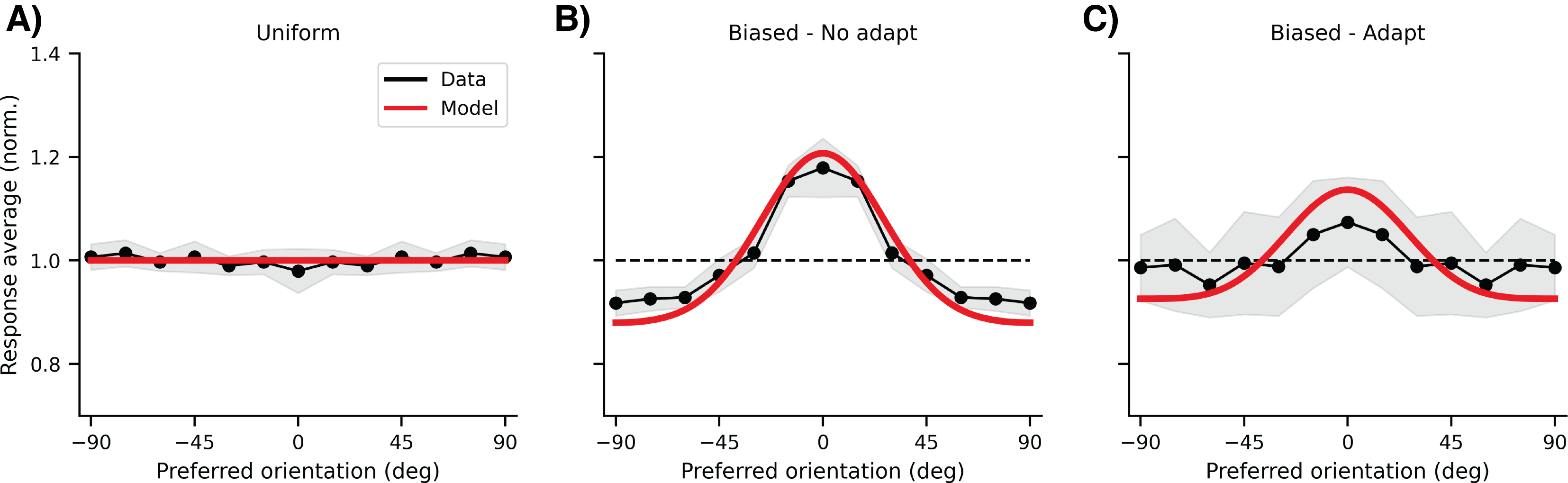
- The model successfully reproduces all major adaptation effects observed in cat V1: reduced response maxima and minima, tuning curve repulsion, and stimulus-driven response decorrelation.
- Adaptive gain control, when propagated through recurrent connectivity, generates response decorrelation that matches experimental measurements in both uniform and biased stimulus conditions.
- The derived gain control mechanism achieves optimal trade-offs between coding fidelity and metabolic cost, as formalized in the adaptive efficient coding objective.
- The model explains adaptation effects using only O(N) adaptive parameters (gains), in contrast to O(N²) synaptic weight changes in prior models, making it more metabolically efficient and stable.
- Experimental validation shows strong quantitative agreement between model predictions and published V1 population recordings, particularly in tuning curve shifts and response range adjustments.
- The model remains robust across different recurrent connectivity patterns (W), indicating that the core mechanism is functionally independent of specific anatomical connectivity, supporting generalizability.
Better researchstarts right now
From reading papers to final review, dramatically reduce your research time.
No credit card · Free plan available
This review was created by AI and reviewed by human editors.