
[Paper Review] Adaptive Federated Learning with Auto-Tuned Clients
This paper proposes $\Delta$-SGD, a client-adaptive step size rule for federated learning that automatically tunes each client's learning rate based on local function smoothness, eliminating the need for manual hyperparameter tuning. The method achieves state-of-the-art performance across diverse FL settings—including non-IID data, varying model architectures, and heterogeneous data distribution—without additional tuning, outperforming standard SGD, Adam, and Adagrad in multiple benchmarks.
Federated learning (FL) is a distributed machine learning framework where the global model of a central server is trained via multiple collaborative steps by participating clients without sharing their data. While being a flexible framework, where the distribution of local data, participation rate, and computing power of each client can greatly vary, such flexibility gives rise to many new challenges, especially in the hyperparameter tuning on the client side. We propose $Δ$-SGD, a simple step size rule for SGD that enables each client to use its own step size by adapting to the local smoothness of the function each client is optimizing. We provide theoretical and empirical results where the benefit of the client adaptivity is shown in various FL scenarios.
Motivation & Objective
- Address the challenge of client-side hyperparameter tuning in federated learning, where fixed or globally shared learning rates lead to suboptimal performance due to data and system heterogeneity.
- Overcome the limitations of existing methods that require extensive grid search for client optimizers, especially under varying data distributions, model architectures, and client participation patterns.
- Develop a client-adaptive optimization strategy that dynamically adjusts step sizes based on local function curvature, improving convergence and final model accuracy without manual intervention.
- Demonstrate that client-specific step size adaptation is critical for robust performance across diverse federated learning scenarios, including non-IID data and varying model complexity.
- Provide theoretical and empirical justification for the superiority of adaptive client learning rates over fixed or globally shared rates in real-world FL deployments.
Proposed method
- Propose $\Delta$-SGD, a novel step size rule that computes client-specific learning rates based on the local smoothness of the client’s loss function, using a dynamic estimate of the local Hessian’s spectral norm.
- Introduce a client-level adaptive learning rate update rule: $\eta_i^t = \frac{\Delta_i^t}{\|\nabla f_i(x^t)\|}$, where $\Delta_i^t$ is a local smoothness proxy derived from gradient differences over consecutive steps.
- Integrate $\Delta$-SGD into the standard FedAvg framework, maintaining the same communication and aggregation protocol while enabling per-client optimization adaptivity.
- Use a moving average of gradient differences to estimate local smoothness, avoiding explicit Hessian computation and ensuring computational efficiency on resource-constrained clients.
- Maintain backward compatibility with existing federated learning systems by replacing only the client-side optimizer, without modifying server-side aggregation.
- Enable automatic adaptation to changes in data distribution and client computation speed by continuously updating the local smoothness estimate during training.
Experimental results
Research questions
- RQ1Can a client-adaptive step size rule significantly reduce the need for manual hyperparameter tuning in federated learning across diverse data and system heterogeneities?
- RQ2How does per-client learning rate adaptation based on local function smoothness compare to fixed or globally shared learning rates in terms of convergence speed and final model accuracy?
- RQ3Does $\Delta$-SGD maintain strong performance across different model architectures (e.g., ResNet-18 vs. ResNet-50) and data distributions (e.g., CIFAR-10 vs. CIFAR-100) without re-tuning?
- RQ4In what ways does client-side adaptivity outperform adaptive optimizers like Adam and Adagrad in heterogeneous FL settings?
- RQ5How sensitive is the performance of standard federated optimizers to step size choices when data is non-IID or client data sizes vary?
Key findings
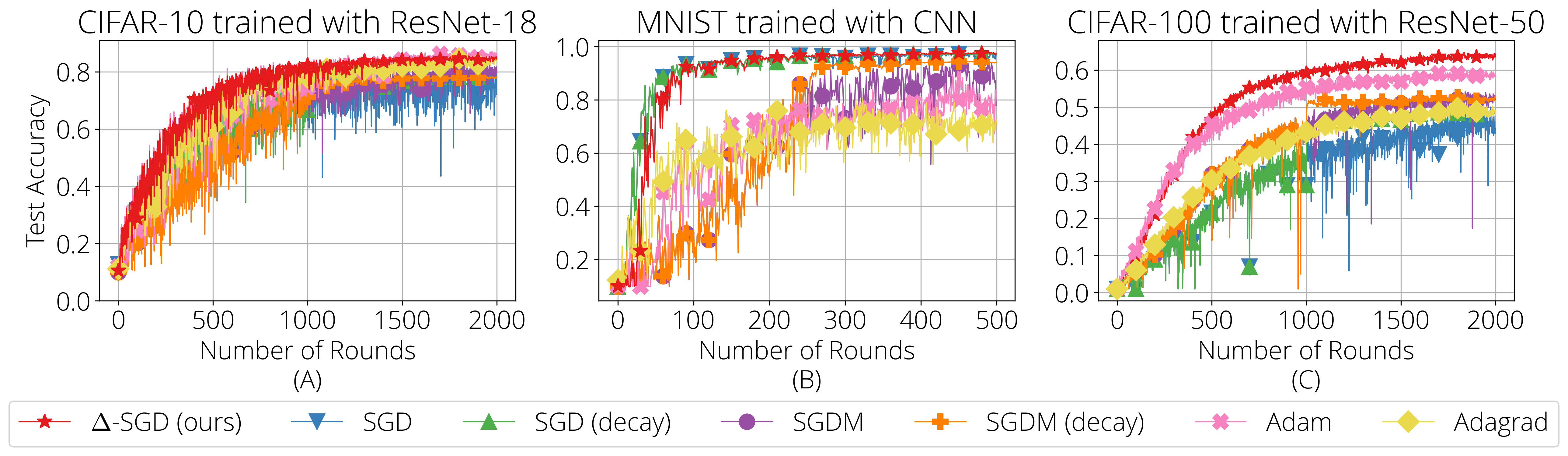
- $\Delta$-SGD achieves the best test accuracy on CIFAR-100 with ResNet-50 (57.5%) across all baselines, outperforming Adam (51.1%) and Adagrad (44.5%) by over 6 percentage points.
- On CIFAR-10 with ResNet-18, $\Delta$-SGD achieves 80.4% test accuracy, ranking second only to non-decayed SGD (80.7%) and significantly outperforming SGDM (75.0%) and Adam (79.9%) under the same conditions.
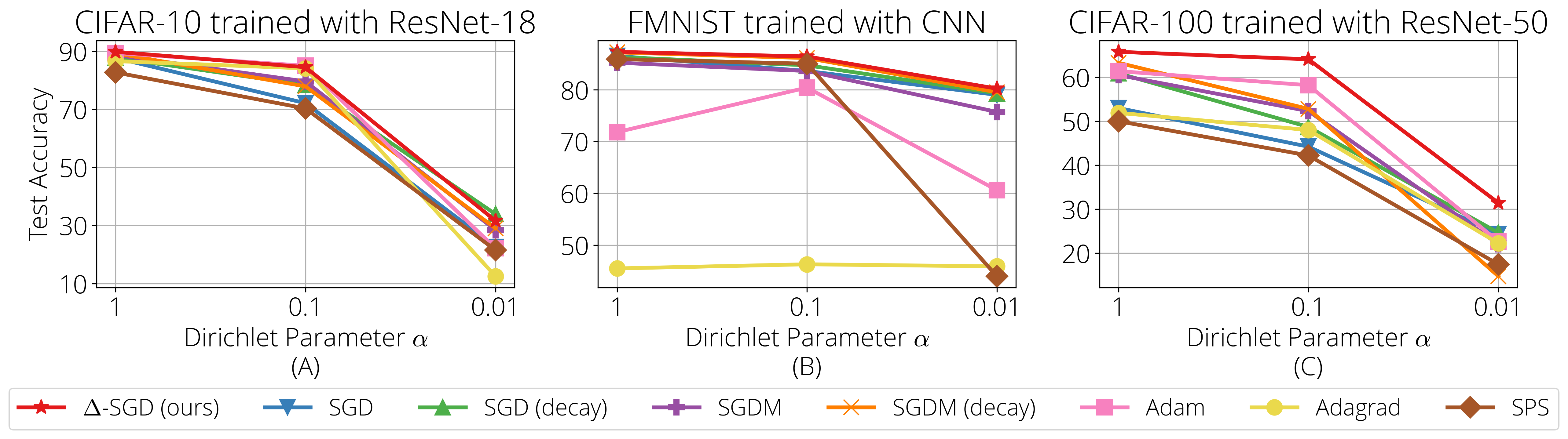
- In settings with heterogeneous client data sizes (100–500 samples per client), $\Delta$-SGD maintains strong performance, achieving 83.1% accuracy on CIFAR-10 with MOON, outperforming Adam (82.4%) and Adagrad (81.3%).
- The method consistently outperforms all baselines—including adaptive optimizers—across all tested scenarios, including non-IID data, varying model complexity, and memory-constrained settings like MOON.
- When using the same step size rules fine-tuned on one task (e.g., CIFAR-10 with ResNet-18), $\Delta$-SGD maintains strong performance across different tasks (e.g., MNIST with CNN, CIFAR-100 with ResNet-50), while other methods fail or degrade significantly.
- The performance gap between tuned and non-tuned baselines is eliminated by $\Delta$-SGD, which achieves near-optimal performance without any hyperparameter tuning across all experiments.
Read this paper
Open the full text in the Nubint reader and ask about any passage as you read.
Read this paper on NubintThis review was generated by AI from the original paper. Please check the paper before citing it.