
[Paper Review] Adaptive Few-Shot Learning Algorithm for Rare Sound Event Detection
This paper proposes a task-adaptive module for few-shot sound event detection that enhances metric-based few-shot learning by modeling inter-class differences and intra-class commonalities across all support examples, improving feature representation adaptability. The method achieves state-of-the-art performance, with +6.8% and +5.9% accuracy gains on ESC-50 and noiseESC-50 under 5-way 1-shot settings, respectively.
Sound event detection is to infer the event by understanding the surrounding environmental sounds. Due to the scarcity of rare sound events, it becomes challenging for the well-trained detectors which have learned too much prior knowledge. Meanwhile, few-shot learning methods promise a good generalization ability when facing a new limited-data task. Recent approaches have achieved promising results in this field. However, these approaches treat each support example independently, ignoring the information of other examples from the whole task. Because of this, most of previous methods are constrained to generate a same feature embedding for all test-time tasks, which is not adaptive to each inputted data. In this work, we propose a novel task-adaptive module which is easy to plant into any metric-based few-shot learning frameworks. The module could identify the task-relevant feature dimension. Incorporating our module improves the performance considerably on two datasets over baseline methods, especially for the transductive propagation network. Such as +6.8% for 5-way 1-shot accuracy on ESC-50, and +5.9% on noiseESC-50. We investigate our approach in the domain-mismatch setting and also achieve better results than previous methods.
Motivation & Objective
- Address the challenge of rare sound event detection due to limited labeled data and overfitting in models trained on abundant base classes.
- Overcome the limitation of existing metric-based few-shot learning frameworks that treat support examples independently, ignoring inter-example relationships.
- Improve generalization in low-data regimes by identifying task-specific, discriminative features through joint modeling of all support examples.
- Enhance model robustness under domain mismatch by integrating domain-invariant representations and attention mechanisms.
- Develop a plug-in module compatible with existing few-shot learning frameworks to boost performance without architectural overhaul.
Proposed method
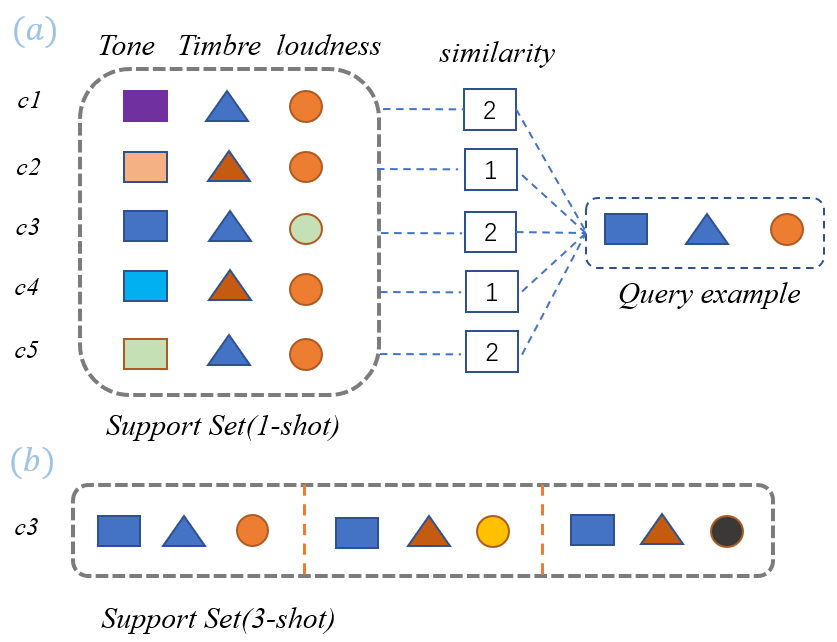
- Introduce a task-adaptive extractor (TAE) that aggregates information from all support examples in a task to identify commonalities within classes and differences across classes.
- Design a projector head that learns cross-class distinguishing features by attending to the entire support set, enabling adaptive feature weighting per input query.
- Incorporate a sound event-oriented data augmentation strategy to increase training diversity and mitigate data scarcity.
- Integrate an attention mechanism into the feature encoder to capture temporal and channel-wise context in raw audio embeddings.
- Combine the task-adaptive module with metric-based frameworks like Prototypical Networks and TPN, enabling end-to-end training with minimal modification.
- Apply domain adaptation (DA) and temporal/channel-aware augmentation to improve generalization in domain-mismatched settings.
Experimental results
Research questions
- RQ1Can modeling inter-support-example relationships improve few-shot sound event detection beyond independent similarity computation?
- RQ2How does the task-adaptive module enhance feature representation by capturing intra-class commonality and inter-class uniqueness?
- RQ3To what extent does the proposed method generalize under domain mismatch, where training and test data come from different distributions?
- RQ4Does the integration of attention and data augmentation lead to consistent performance gains across diverse benchmarks like ESC-50 and noiseESC-50?
- RQ5Why does the model underperform in multi-shot settings despite strong performance in 1-shot, and what are the limitations in fast adaptation?
Key findings
- The proposed method achieves a +6.8% improvement in 5-way 1-shot accuracy on the ESC-50 dataset compared to the baseline ProtoNet.
- On the noiseESC-50 dataset, the method improves 5-way 1-shot accuracy by +5.9% over the baseline, demonstrating robustness to noisy audio.
- In domain mismatch settings, the TA+ProtoNet+DA model achieves an AUC of 0.779 for music and 0.705 for animals, outperforming all baselines.
- The attention mechanism enables better localization of short events like 'gun shot' and reduces false negatives for brief events compared to non-attention models.
- The model with temporal and channel-aware data augmentation achieves the highest AUC (0.857 for music, 0.768 for animals) in domain mismatch evaluation.
- Visual analysis confirms that the attention mechanism correctly identifies relevant support examples, while non-attention models often pick incorrect matches due to silence or background similarity.

Read this paper
Open the full text in the Nubint reader and ask about any passage as you read.
Read this paper on NubintThis review was generated by AI from the original paper. Please check the paper before citing it.