
[Paper Review] Adaptive Force-based Control for Legged Robots
This paper presents a novel adaptive force-based control framework for legged robots that integrates $L_1$ adaptive control into quadratic programming (QP)-based force control to handle significant model uncertainty. The method enables the 12-kg Unitree A1 robot to walk stably on rough terrain while carrying up to 6 kg (50% of body weight) and stand with up to 11 kg (92% of body weight) load, outperforming non-adaptive controllers that fail at 3–6 kg due to model uncertainty.
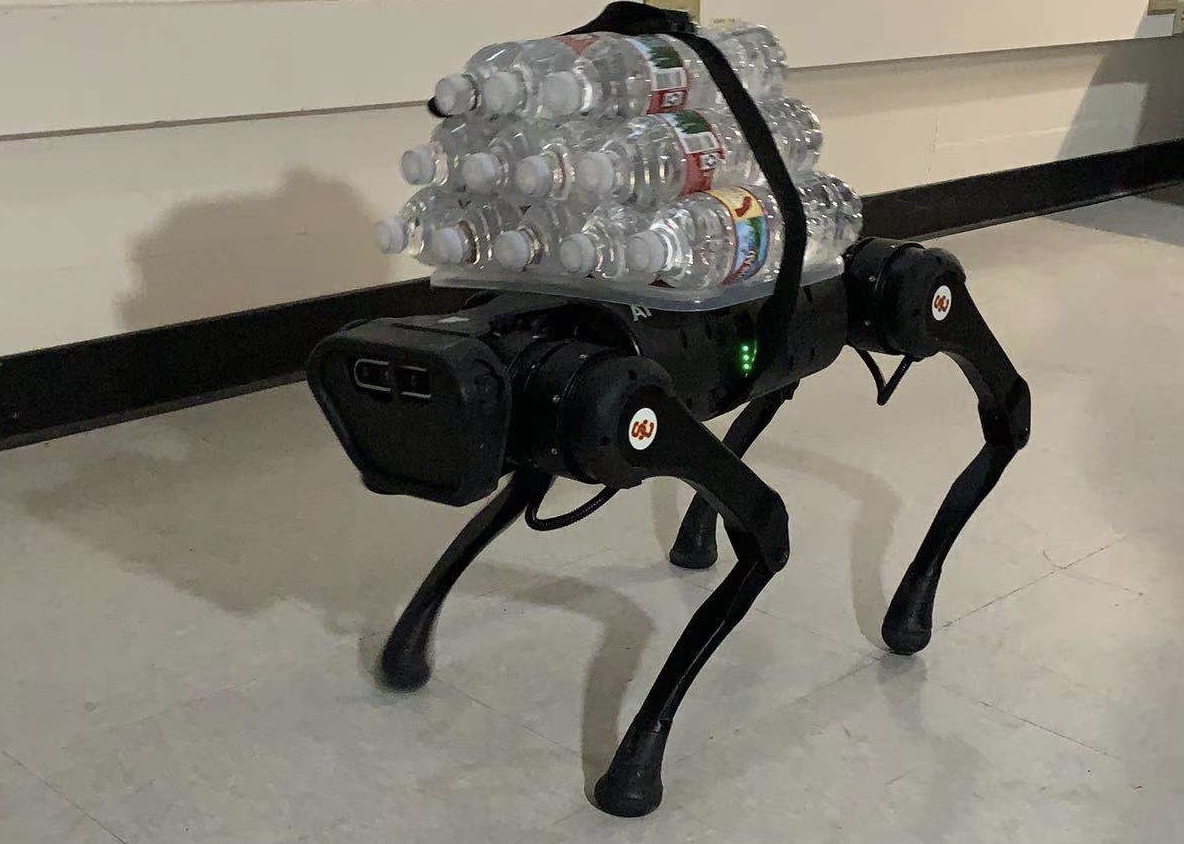
Adaptive control can address model uncertainty in control systems. However, it is preliminarily designed for tracking control. Recent advancements in the control of quadruped robots show that force control can effectively realize agile and robust locomotion. In this paper, we present a novel adaptive force-based control framework for legged robots. We introduce a new architecture in our proposed approach to incorporate adaptive control into quadratic programming (QP) force control. Since our approach is based on force control, it also retains the advantages of the baseline framework, such as robustness to uneven terrain, controllable friction constraints, or soft impacts. Our method is successfully validated in both simulation and hardware experiments. While the baseline QP control has shown a significant degradation in the body tracking error with a small load, our proposed adaptive force-based control can enable the 12-kg Unitree A1 robot to walk on rough terrains while carrying a heavy load of up to 6 kg (50% of the robot weight). When standing with four legs, our proposed adaptive control can even allow the robot to carry up to 11 kg of load (92% of the robot weight) with less than 5-cm tracking error in the robot height.
Motivation & Objective
- To address model uncertainty in legged robot control, especially under unknown and time-varying loads.
- To extend adaptive control—previously used in trajectory tracking—into force-based control for dynamic legged robots.
- To preserve the robustness and flexibility of QP-based force control while enabling adaptation to system dynamics uncertainty.
- To ensure stability under external disturbances and model inaccuracies through rigorous theoretical analysis.
- To validate the framework in both high-fidelity simulation and real-world hardware experiments on the Unitree A1 robot.
Proposed method
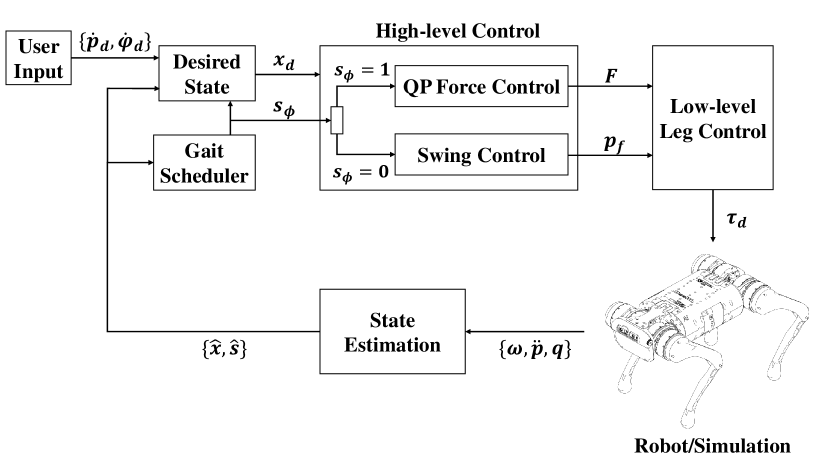
- Introduces a new control architecture that embeds $L_1$ adaptive control within a QP-based force control framework to handle dynamic model uncertainty.
- Uses a low-pass filter in the adaptation law to ensure smooth control inputs and robustness, enabling stable performance under disturbances.
- Employs a control Lyapunov function (CLF)-based reference model to define a stable nonlinear reference trajectory for adaptation.
- Derives an adaptive control law that adjusts the force commands in real time based on estimated system uncertainty, maintaining force tracking and stability.
- Applies Input-to-State Stability (ISS) analysis to prove the closed-loop system remains stable under bounded disturbances and model errors.
- Integrates the adaptive mechanism into the QP optimization layer, allowing real-time adaptation while preserving constraints on friction and impact forces.
Experimental results
Research questions
- RQ1Can adaptive control be successfully extended from trajectory tracking to force-based control in legged robots?
- RQ2How can $L_1$ adaptive control be integrated into a QP-based force control framework to maintain stability and performance under model uncertainty?
- RQ3What is the maximum load a quadruped robot can carry while maintaining balance and tracking accuracy using adaptive force control?
- RQ4How does the proposed method compare to non-adaptive QP control under unknown and time-varying loading conditions?
- RQ5Can the adaptive force control framework maintain robustness on uneven terrain and during soft impacts?
Key findings
- The adaptive force-based controller enabled the 12-kg Unitree A1 robot to walk stably on rough terrain while carrying a 6-kg load (50% of body weight), whereas the non-adaptive baseline failed at 3 kg.
- With the adaptive controller, the robot successfully stood with an 11-kg load (92% of body weight), maintaining a height tracking error of less than 5 cm, while the non-adaptive controller failed to stand at 6 kg.
- In simulation, the robot climbed an uneven, steep slope with a 6-kg load and unknown disturbances, achieving stable performance with minimal tracking error.
- The adaptive controller achieved less than 3 cm tracking error in robot height and less than 8° error in pitch angle during standing with 11 kg load.
- The experimental results confirmed input-to-state stability (ISS), as the system remained bounded under disturbances despite small constant tracking errors.
- The framework successfully preserved the advantages of baseline force control, including robustness to uneven terrain, controllable friction constraints, and soft impact handling.
Better researchstarts right now
From reading papers to final review, dramatically reduce your research time.
No credit card · Free plan available
This review was created by AI and reviewed by human editors.