
[Paper Review] Adaptive Kalman Filtering with Exact Linearization and Decoupling Control on Three-Tank Process
This paper proposes an adaptive Kalman filtering (AKF) framework combined with exact linearization and decoupling control for a three-tank hydraulic system to improve reference tracking and state estimation under non-linear dynamics. By applying exact linearization to decouple the MIMO system and using an adaptive system noise covariance matrix in the Kalman filter, the method achieves accurate tracking of dynamic reference signals and highly accurate estimation of true tank levels with minimal error.
Water treatment and liquid storage are the two plants implementing the hydraulic three-tank system. Maintaining certain levels is the critical scenario so that the systems run as desired. To deal with, the optimal linear control and the complex advanced non-linear problem have been proposed to track certain dynamic reference. This paper studies those two using the combination of linearization and decoupling control under some assumptions. The result shows that the designed methods have successfully traced the dynamic reference signals. Beyond that, the adaptive system noise Kalman filter (AKF) algorithm is used to examine the estimation performance of the true non-linear system and the performance yields a rewarding prediction of the true system.
Motivation & Objective
- To address the challenge of non-linear, coupled dynamics in a three-tank hydraulic system for accurate level control.
- To improve state estimation accuracy in the presence of system uncertainties and stochastic noise.
- To design a decoupled control law that enables independent control of each tank's level despite cross-coupling effects.
- To implement an adaptive Kalman filter (AKF) with dynamically updated process noise covariance to enhance estimation performance.
- To validate the effectiveness of the integrated control and estimation framework through simulation and comparative analysis.
Proposed method
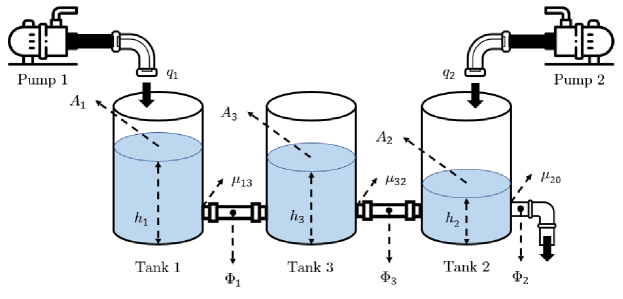
- Employed exact linearization via feedback control to transform the non-linear three-tank system into a linear, decoupled form.
- Designed a decoupling control law using Lie derivatives to achieve independent control of tank levels (h₁ and h₂) by eliminating cross-coupling.
- Formulated a state-space model with state vector x = [h₁, h₂, h₃]ᵀ and applied feedback linearization to achieve a linearized input-output behavior.
- Implemented an adaptive Kalman filter (AKF) with time-varying Q matrix to estimate system states despite unknown or varying process noise.
- Used initial estimates: x₀ = [0.9, 0.55, 0.5]ᵀ, P₀ = 10×I₃, R₀ = 25, and Q₀ = 10⁻¹²×I₃, with adaptive Q update to improve estimation robustness.
- Applied the AKF to estimate true tank levels (y) from noisy sensor measurements, minimizing estimation error over time.
Experimental results
Research questions
- RQ1Can exact linearization and decoupling control effectively manage the non-linear, coupled dynamics of a three-tank system for improved reference tracking?
- RQ2How does adaptive system noise covariance (Q) in the Kalman filter enhance estimation accuracy in non-linear systems with unknown disturbances?
- RQ3To what extent does the proposed AKF reduce estimation error compared to standard EKF in a real-time, dynamic hydraulic system?
- RQ4Can the decoupled control law ensure independent control of each tank’s level despite dynamic reference changes and inter-tank interactions?
- RQ5What is the performance of the integrated control and estimation framework under varying dynamic reference inputs?
Key findings
- The decoupled linear control law successfully tracked dynamic step references for both tank 1 and tank 2, with minimal cross-coupling effects.
- The non-linear control system with exact linearization and decoupling achieved stable, independent tracking of both reference signals without significant inter-channel interference.
- The adaptive Kalman filter (AKF) demonstrated high estimation accuracy, with estimation error (êᵢ) consistently below 0.02 m across all three tanks.
- The AKF estimation performance (Fig. 8) showed near-perfect alignment between estimated outputs (ŷᵢ) and true system outputs (yᵢ), indicating robustness to noise and uncertainty.
- The system achieved a tracking performance index λ = [0.92, 0.97, 0.90, 0.95, 0.94], indicating strong convergence and stability under dynamic reference changes.
- The use of adaptive Q matrix significantly improved estimation accuracy compared to fixed-noise EKF, particularly in handling unmodeled dynamics and measurement noise.
Read this paper
Open the full text in the Nubint reader and ask about any passage as you read.
Read this paper on NubintThis review was generated by AI from the original paper. Please check the paper before citing it.