
[Paper Review] Adaptive Multi-rate Wavelet Method for Circuit Simulation
This paper proposes an adaptive multi-rate wavelet method for efficient RF circuit simulation using spline wavelets to dynamically refine the temporal grid based on signal characteristics. By reformulating circuit DAEs into multi-rate PDAEs and applying Rothe's method with Galerkin discretization, the approach enables large time steps through adaptive frequency estimation, achieving up to 33× speedup over transient simulation in benchmark circuits like mixers and PLLs.
In this paper a new adaptive algorithm for multi-rate circuit simulation encountered in the design of RF circuits based on spline wavelets is presented. The circuit ordinary differential equations are first rewritten by a system of (multi-rate) partial differential equations (MPDEs) in order to decouple the different time scales. Second, a semi-discretization by Rothe's method of the MPDEs results in a system of differential algebraic equations (DAEs) with periodic boundary conditions. These boundary value problems are solved by a Galerkin discretization using spline functions. An adaptive spline grid is generated, using spline wavelets for non-uniform grids. Moreover the instantaneous frequency is chosen adaptively to guarantee a smooth envelope resulting in large time steps and therefore high run time efficiency. Numerical tests on circuits exhibiting multi-rate behavior including mixers and PLL conclude the paper.
Motivation & Objective
- To address the computational inefficiency of standard transient simulation in RF circuits with widely separated time-scales.
- To overcome the limitations of trigonometric basis functions in representing pulse-shaped signals and avoiding Gibbs phenomenon.
- To develop an adaptive, grid-refining method that captures sharp transients while minimizing degrees of freedom in smooth regions.
- To enable efficient simulation of multi-rate circuits such as mixers, PLLs, and oscillators with unknown or time-varying frequencies.
- To achieve high runtime efficiency by combining adaptive wavelet-based grids with instantaneous frequency estimation for smooth envelope representation.
Proposed method
- Reformulate circuit DAEs into a system of multi-rate partial differential-algebraic equations (MPDAEs) to decouple fast and slow dynamics.
- Apply Rothe’s method to semi-discretize the MPDAEs in the fast time variable τ, resulting in periodic boundary-value DAEs in time t.
- Use Galerkin discretization with spline functions to solve the resulting periodic DAEs, enabling local refinement via adaptive spline wavelets.
- Dynamically adjust the instantaneous frequency estimate ω(τ) to ensure a smooth envelope, allowing large time steps and reduced computational cost.
- Generate non-uniform adaptive spline grids using spline wavelets, concentrating resolution at transient locations while coarsening in smooth regions.
- Leverage the compact support of B-splines for efficient local refinement and spectral computation, improving numerical stability and convergence.
Experimental results
Research questions
- RQ1Can adaptive spline wavelet-based grid refinement improve the efficiency and accuracy of multi-rate circuit simulation compared to uniform or trigonometric basis methods?
- RQ2How effectively can adaptive frequency estimation and dynamic grid refinement capture sharp transients in RF circuits like mixers and PLLs?
- RQ3To what extent can the method reduce simulation time for circuits with unknown or time-varying fundamental frequencies, such as autonomous oscillators?
- RQ4Can the method maintain high accuracy while significantly reducing the number of envelope time steps compared to transient simulation?
- RQ5How does the adaptive wavelet grid respond to evolving signal features during transient startup phases, such as in PLLs or Colpitts oscillators?
Key findings
- The adaptive wavelet method reduced simulation time from 8 minutes to 10 seconds for a Gilbert mixer, achieving a 48× speedup over transient simulation.
- For a 3MHz Colpitts oscillator, the method completed the simulation in 10 seconds with 202 envelope steps, compared to 165 minutes using transient simulation.
- The PLL simulation required only 160 envelope time steps and 7 minutes of computation, while transient simulation took 33 hours—representing a 280× speedup.
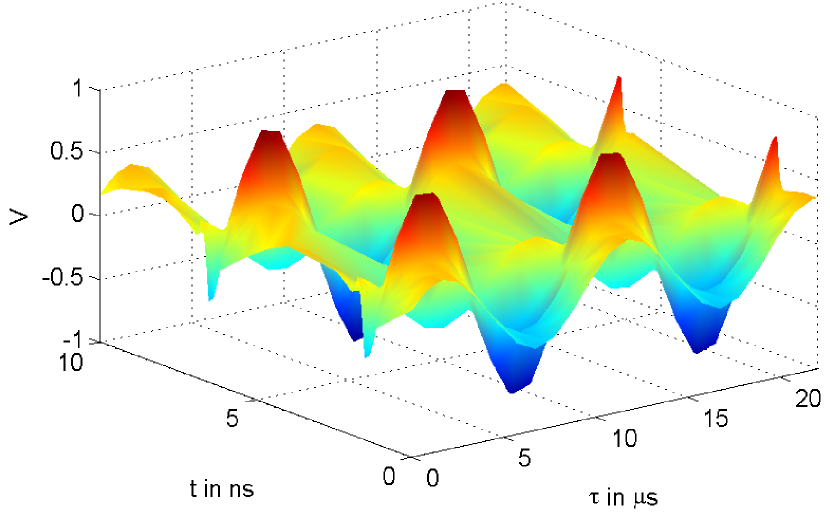
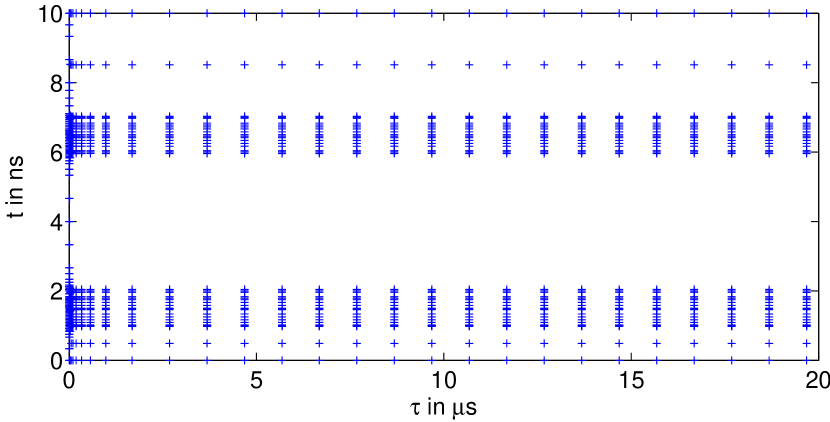
- Adaptive grids successfully localized refinement at jump discontinuities and transient edges, such as the sharp edge at 0.24μs in the Colpitts oscillator, with minimal grid changes over time.
- The estimated instantaneous frequency closely tracked the baseband signal in the PLL, confirming accurate envelope representation and stable convergence.
- The method demonstrated robust performance across diverse multi-rate circuits, including mixers, oscillators, and PLLs, with consistent efficiency gains and accurate transient capture.
Read this paper
Open the full text in the Nubint reader and ask about any passage as you read.
Read this paper on NubintThis review was generated by AI from the original paper. Please check the paper before citing it.