
[Paper Review] Adaptive Policy Learning for Offline-to-Online Reinforcement Learning
This paper proposes Adaptive Policy Learning (APL), a framework that adaptively combines offline and online reinforcement learning by applying pessimistic updates to offline data and optimistic/greedy updates to online data. The method achieves high sample efficiency, learning expert policies even from poor-quality offline datasets—outperforming prior offline-to-online methods with only 20% of the online interactions.
Conventional reinforcement learning (RL) needs an environment to collect fresh data, which is impractical when online interactions are costly. Offline RL provides an alternative solution by directly learning from the previously collected dataset. However, it will yield unsatisfactory performance if the quality of the offline datasets is poor. In this paper, we consider an offline-to-online setting where the agent is first learned from the offline dataset and then trained online, and propose a framework called Adaptive Policy Learning for effectively taking advantage of offline and online data. Specifically, we explicitly consider the difference between the online and offline data and apply an adaptive update scheme accordingly, that is, a pessimistic update strategy for the offline dataset and an optimistic/greedy update scheme for the online dataset. Such a simple and effective method provides a way to mix the offline and online RL and achieve the best of both worlds. We further provide two detailed algorithms for implementing the framework through embedding value or policy-based RL algorithms into it. Finally, we conduct extensive experiments on popular continuous control tasks, and results show that our algorithm can learn the expert policy with high sample efficiency even when the quality of offline dataset is poor, e.g., random dataset.
Motivation & Objective
- To address the limitations of offline reinforcement learning when datasets are of poor quality or lack coverage of optimal actions.
- To improve sample efficiency in offline-to-online RL by leveraging the complementary strengths of offline and online data.
- To design a unified framework that adapts update strategies based on data source (offline vs. online) without requiring extensive hyperparameter tuning.
- To demonstrate that combining offline data diversity with online policy improvement leads to superior performance in continuous control tasks.
Proposed method
- The APL framework uses a two-level replay buffer to distinguish between offline and online data, enabling source-specific update strategies.
- It applies a pessimistic update strategy to offline data to mitigate distribution shift and avoid overfitting to out-of-distribution actions.
- It employs an optimistic or greedy update strategy for online data to accelerate convergence and improve policy performance.
- The framework is implemented via two algorithms: a value-based method (GCQL) and a policy-based method (GCQL-i2e5), both embedding SOTA offline and online RL techniques.
- An online-offline replay buffer (OORB) is introduced to dynamically manage data flow, with a threshold $ p $ determining data selection based on policy similarity.
- The adaptive update mechanism uses a weighting factor $ \mathcal{W} $ that varies based on data source, enabling dynamic balance between offline and online learning.
Experimental results
Research questions
- RQ1Can a unified framework effectively combine offline and online reinforcement learning by adapting update strategies to data source?
- RQ2How does the performance of offline-to-online RL depend on the quality of the offline dataset, and can the framework maintain high sample efficiency even with random or suboptimal data?
- RQ3What is the relative contribution of online buffer and greedy update strategy in stabilizing learning and improving performance?
- RQ4How sensitive is the framework to hyperparameters such as initial training steps, offline update frequency, and OORB threshold?
Key findings
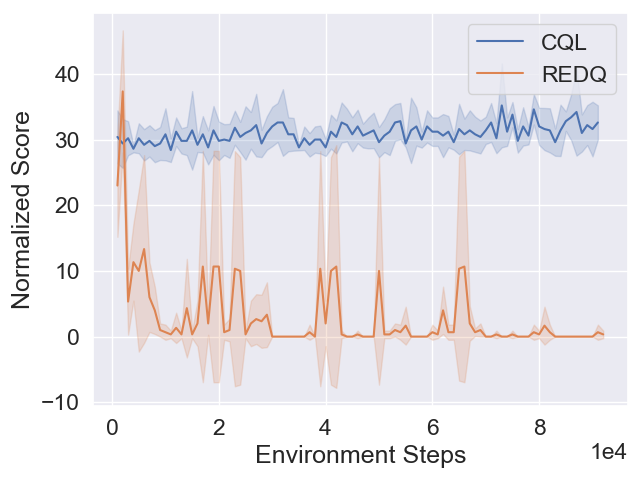
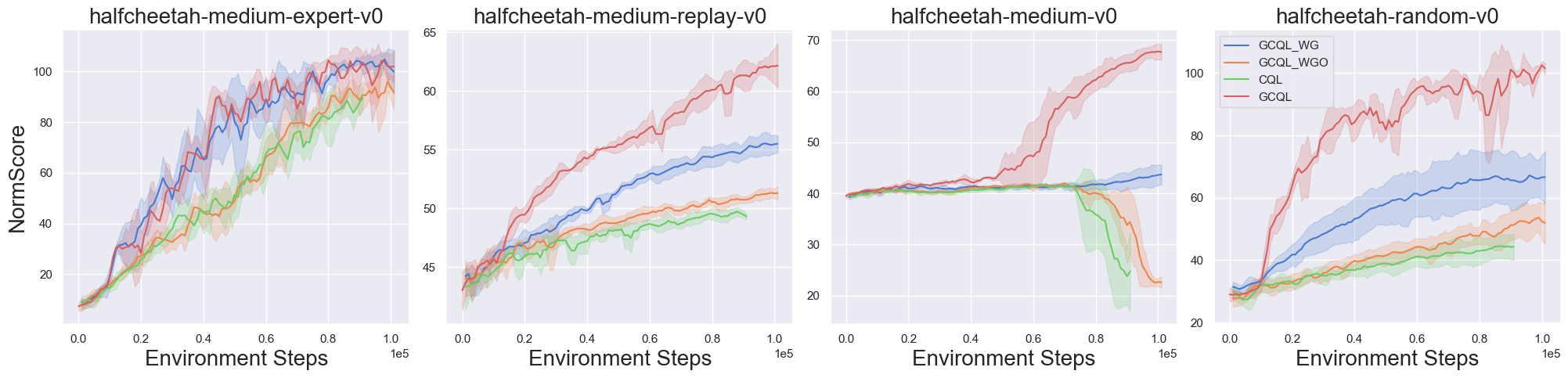
- The APL framework achieves expert-level performance on MuJoCo continuous control tasks even when the offline dataset is random, demonstrating robustness to poor data quality.
- With only 20% of the online interactions used, the proposed method outperforms the prior state-of-the-art offline-to-online method (Nair et al., 2020) in sample efficiency.
- The ablation study confirms that both the online buffer and the greedy update strategy are critical: removing either leads to significant performance drops, especially on medium and random datasets.
- The OORB threshold $ p $ has a notable impact on performance, with $ p = 0.5 $ yielding the best overall results across datasets, indicating balanced utilization of online and offline data is optimal.
- The method is relatively insensitive to $ T_{\text{initial}} $ and $ T_{\text{off}} $, suggesting robustness to default hyperparameter settings in most scenarios.
- The value-based and policy-based implementations of APL (GCQL and GCQL-i2e5) both show strong performance, confirming the framework's compatibility with diverse RL algorithms.
Read this paper
Open the full text in the Nubint reader and ask about any passage as you read.
Read this paper on NubintThis review was generated by AI from the original paper. Please check the paper before citing it.