
[Paper Review] Adaptive-TMLE for the Average Treatment Effect based on Randomized Controlled Trial Augmented with Real-World Data
This paper proposes Adaptive-TMLE (A-TMLE), a targeted minimum loss-based estimation framework that integrates randomized controlled trial (RCT) and real-world data (RWD) to estimate the average treatment effect (ATE) with improved efficiency. By adaptively learning the bias function from RWD and leveraging double robustness, A-TMLE achieves $√n$-consistency and asymptotic normality, with finite-sample efficiency matching that of an oracle estimator, outperforming existing methods in simulations with lower mean-squared error and narrower confidence intervals.
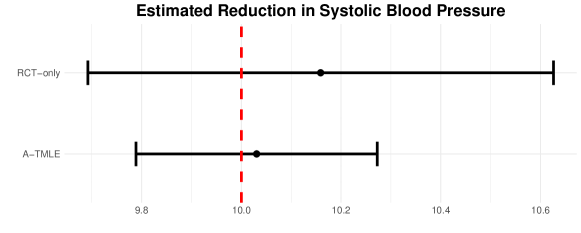
We consider the problem of estimating the average treatment effect (ATE) when both randomized control trial (RCT) data and external real-world data (RWD) are available. We decompose the ATE estimand as the difference between a pooled-ATE estimand that integrates RCT and RWD and a bias estimand that captures the conditional effect of RCT enrollment on the outcome. We introduce an adaptive targeted maximum likelihood estimation (A-TMLE) framework to estimate them. We prove that the A-TMLE estimator is root-n-consistent and asymptotically normal. Moreover, in finite sample, it achieves the super-efficiency one would obtain had one known the oracle model for the conditional effect of the RCT enrollment on the outcome. Consequently, the smaller and more parsimonious the working model of the bias induced by the RWD is, the greater our estimator's efficiency, while our estimator will always be at least as efficient as an efficient estimator that uses the RCT data only. A-TMLE outperforms existing methods in simulations by having smaller mean-squared-error and 95% confidence intervals. We apply A-TMLE to augment the DEVOTE trial with external data from the Optum Clinformatics Data Mart, demonstrating its potential to establish treatment superiority in noninferiority trials. A-TMLE could utilize external RWD to help improve the power of randomized trials without biasing the estimates of intervention effects. This approach could allow for smaller, faster trials, decreasing the time until patients can receive effective treatments.
Motivation & Objective
- To address the challenge of improving estimation efficiency of the average treatment effect (ATE) when combining RCT and real-world data (RWD), which often differ in population characteristics and may violate positivity or exchangeability assumptions.
- To develop a method that leverages RWD to enhance precision without introducing bias, particularly when the RCT enrollment status affects outcomes beyond observed covariates.
- To construct an estimator that is both asymptotically normal and super-efficient in finite samples, achieving the efficiency of an oracle estimator under the true bias model.
- To provide a data-adaptive framework that regularizes estimation via bias-variance trade-off, ensuring robustness while maximizing efficiency gains from RWD.
Proposed method
- The method decomposes the ATE into a pooled-ATE estimand (combining RCT and RWD) and a bias estimand capturing the conditional effect of RCT enrollment on outcomes.
- It introduces an adaptive targeted minimum loss-based estimation (A-TMLE) framework that data-adaptively selects a working model for the bias function using cross-validation or similar model selection.
- A-TMLE targets the initial estimator of the outcome regression ($\bar{Q}$) using a clever covariate derived from the influence function, ensuring double robustness and asymptotic normality.
- The estimator uses a one-step update based on the empirical mean of the efficient influence function, with no iterative updates required, resulting in a closed-form solution.
- The method ensures that the influence function of the A-TMLE equals the efficient influence function under the true bias model, achieving super-efficiency in finite samples.
- It maintains the robustness of standard TMLE by preserving asymptotic normality and consistency even when the working model is misspecified, provided the model selection is sensible.
Experimental results
Research questions
- RQ1Can real-world data be used to improve the efficiency of ATE estimation from RCTs without introducing bias?
- RQ2How can the conditional effect of RCT enrollment on outcomes be modeled and estimated to correct for selection bias in data fusion?
- RQ3What is the finite-sample performance of an estimator that adaptively learns the bias function from RWD while preserving double robustness?
- RQ4Does A-TMLE achieve super-efficiency relative to an oracle model that knows the true bias function?
- RQ5Can A-TMLE maintain asymptotic normality and consistency while improving efficiency beyond RCT-only estimators?
Key findings
- A-TMLE is $\sqrt{n}$-consistent and asymptotically normal, ensuring valid inference under standard regularity conditions.
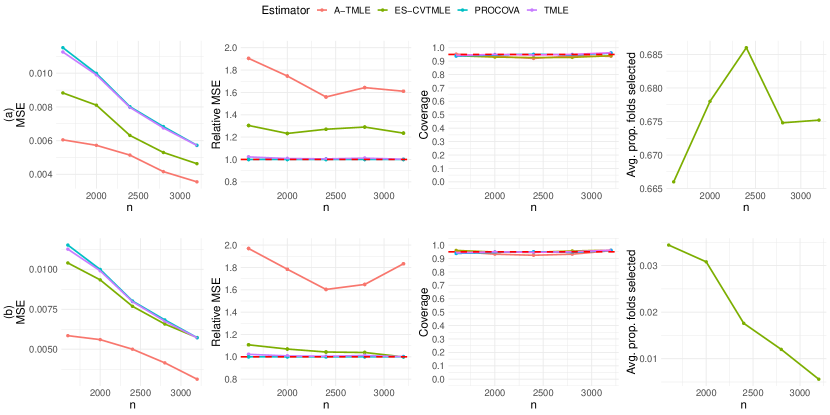
- In finite samples, A-TMLE achieves super-efficiency equal to that of an oracle estimator that knows the true bias model, meaning it matches the best possible efficiency achievable with perfect knowledge of the bias function.
- The method outperforms existing approaches in simulations, demonstrating lower mean-squared error and narrower 95% confidence intervals.
- The efficiency gain is proportional to the complexity of the true bias function: the more complex the impact of RCT enrollment on outcomes, the greater the efficiency improvement.
- Even when the bias is large but easily approximated by a function of covariates and treatment, A-TMLE achieves substantial efficiency gains.
- A-TMLE is always at least as efficient as an RCT-only efficient estimator, and it can fully leverage RWD to improve precision without compromising robustness.
Read this paper
Open the full text in the Nubint reader and ask about any passage as you read.
Read this paper on NubintThis review was generated by AI from the original paper. Please check the paper before citing it.