
[Paper Review] Addressing the speed-accuracy simulation trade-off for adaptive spiking neurons
This paper proposes an algorithmic reformulation of the adaptive leaky integrate-and-fire (ALIF) spiking neuron model that reduces sequential simulation complexity from O(T) to O(T/TR), enabling up to 53× faster training and 40× faster inference while maintaining high accuracy. By leveraging the absolute refractory period (ARP), the method allows efficient GPU parallelization, significantly accelerating both training and fitting of biologically realistic neural models with sub-millisecond time resolution.
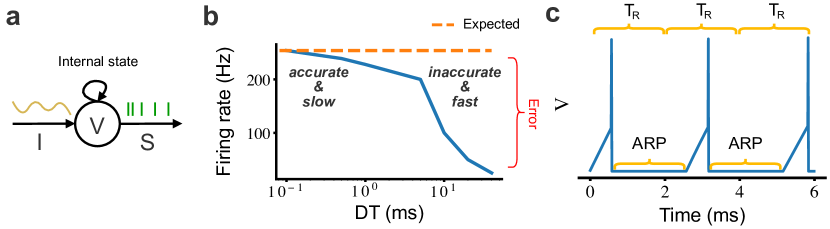
The adaptive leaky integrate-and-fire (ALIF) model is fundamental within computational neuroscience and has been instrumental in studying our brains $ extit{in silico}$. Due to the sequential nature of simulating these neural models, a commonly faced issue is the speed-accuracy trade-off: either accurately simulate a neuron using a small discretisation time-step (DT), which is slow, or more quickly simulate a neuron using a larger DT and incur a loss in simulation accuracy. Here we provide a solution to this dilemma, by algorithmically reinterpreting the ALIF model, reducing the sequential simulation complexity and permitting a more efficient parallelisation on GPUs. We computationally validate our implementation to obtain over a $50 imes$ training speedup using small DTs on synthetic benchmarks. We also obtained a comparable performance to the standard ALIF implementation on different supervised classification tasks - yet in a fraction of the training time. Lastly, we showcase how our model makes it possible to quickly and accurately fit real electrophysiological recordings of cortical neurons, where very fine sub-millisecond DTs are crucial for capturing exact spike timing.
Motivation & Objective
- To address the long-standing speed-accuracy trade-off in simulating adaptive spiking neurons, particularly for fine discretization time-steps (DT) required in biological modeling.
- To reduce the sequential computational complexity of ALIF neuron simulation, which currently limits training and inference speed on GPUs.
- To enable fast, accurate fitting of real electrophysiological recordings using sub-millisecond DTs, crucial for capturing precise spike timing.
- To develop a method that maintains simulation fidelity while drastically reducing training and inference time, especially for large-scale SNNs and data fitting tasks.
Proposed method
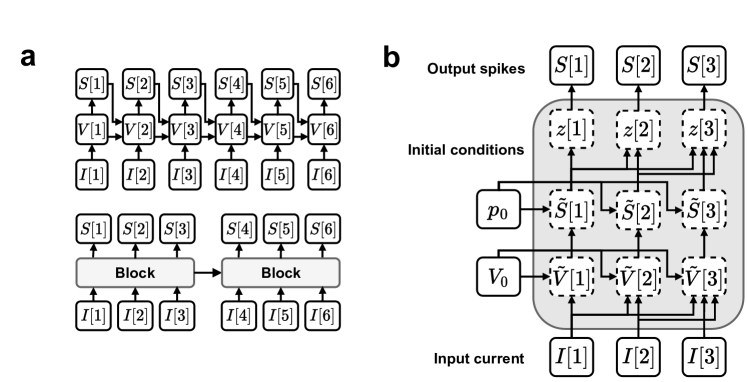
- Reformulate the ALIF model by introducing a constant sequential complexity O(1) over the absolute refractory period (ARP) length TR, reducing overall complexity to O(T/TR) for simulation length T.
- Exploit the biological constraint that neurons cannot fire twice within the ARP to enable parallel processing of time steps beyond the refractory window.
- Implement the reformulated ALIF model using GPU-accelerated operations, allowing efficient batch processing of neurons and layers.
- Use surrogate gradient descent for training, ensuring compatibility with standard deep learning workflows while achieving high speedups.
- Define the ARP as a learnable or fixed hyperparameter, enabling trade-offs between speed, accuracy, and biological realism.
- Validate the method using synthetic benchmarks, supervised classification tasks, and real cortical neuron recordings from mouse V1.
Experimental results
Research questions
- RQ1Can the sequential simulation complexity of ALIF neurons be reduced without sacrificing simulation accuracy, especially at fine time resolutions?
- RQ2Does leveraging the absolute refractory period enable significant speedups in training and inference of spiking neural networks on GPUs?
- RQ3Can the reformulated ALIF model achieve comparable classification performance to the standard ALIF model while reducing training time by over 50×?
- RQ4Is the method capable of accurately fitting real electrophysiological recordings with sub-millisecond time resolution, where spike timing precision is critical?
- RQ5How does the choice of ARP length affect the trade-off between training speed, simulation accuracy, and biological plausibility?
Key findings
- The proposed method achieved up to 53× speedup in training and 40× speedup in inference over the standard ALIF model, with identical classification accuracy on temporal spiking classification datasets.
- For real cortical neuron recordings from mouse V1, the method achieved a similar fit quality (ETV ≈ 0.80) as the standard model using DT = 0.1 ms, but reduced average fitting time from 108.4 s to 15.5 s per neuron.
- The method maintained high accuracy even when using large, non-physiological ARP values (e.g., 4 ms), demonstrating robustness and flexibility in hyperparameter tuning.
- Fitting accuracy dropped significantly when increasing DT from 0.1 ms to 4 ms (ETV from 0.80 to 0.66), but remained stable when increasing ARP at fixed DT = 0.1 ms, confirming the method's resilience to ARP variation.
- The model enabled accurate fitting of heterogeneous membrane time constants in V1 neurons, suggesting multi-timescale processing in visual cortex, with minimal computational cost.
Read this paper
Open the full text in the Nubint reader and ask about any passage as you read.
Read this paper on NubintThis review was generated by AI from the original paper. Please check the paper before citing it.