
[Paper Review] Advancements in Federated Learning: Models, Methods, and Privacy
This paper surveys advancements in federated learning, detailing architectures (centralized, decentralized, clustered), FedOpt algorithms, federated base models, and privacy/security considerations for real-world deployment.
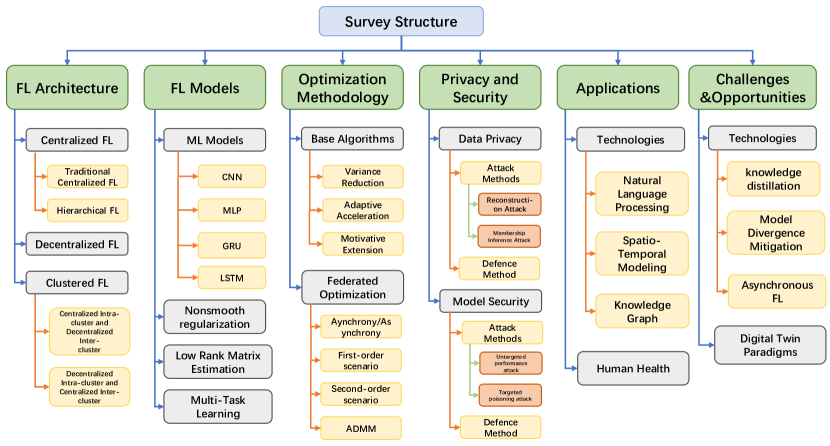
Federated learning (FL) is a promising technique for addressing the rising privacy and security issues. Its main ingredient is to cooperatively learn the model among the distributed clients without uploading any sensitive data. In this paper, we conducted a thorough review of the related works, following the development context and deeply mining the key technologies behind FL from both theoretical and practical perspectives. Specifically, we first classify the existing works in FL architecture based on the network topology of FL systems with detailed analysis and summarization. Next, we abstract the current application problems, summarize the general techniques and frame the application problems into the general paradigm of FL base models. Moreover, we provide our proposed solutions for model training via FL. We have summarized and analyzed the existing FedOpt algorithms, and deeply revealed the algorithmic development principles of many first-order algorithms in depth, proposing a more generalized algorithm design framework. Based on these frameworks, we have instantiated FedOpt algorithms. As privacy and security is the fundamental requirement in FL, we provide the existing attack scenarios and the defense methods. To the best of our knowledge, we are among the first tier to review the theoretical methodology and propose our strategies since there are very few works surveying the theoretical approaches. Our survey targets motivating the development of high-performance, privacy-preserving, and secure methods to integrate FL into real-world applications.
Motivation & Objective
- Provide a comprehensive taxonomy of FL architectures (centralized, decentralized, clustered) and discuss their trade-offs.
- Abstract common application problems and map them to federated base models and training procedures.
- Review FedOpt algorithms (first- and second-order, ADMM-based) and propose a generalized design framework for algorithm development.
- Analyze privacy and security threats in FL and survey defense mechanisms.
- Highlight challenges and opportunities for integrating FL into real-world applications.
Proposed method
- Classify FL architectures by network topology (centralized, decentralized, clustered) and analyze their properties and references.
- Abstract application problems into a general federated base model framework and discuss corresponding training procedures (e.g., local updates + global aggregation).
- Review FedOpt algorithms (first-order, second-order, ADMM-based) and present a generalized local/global acceleration design framework.
- Describe attack scenarios and defense methods to address privacy and security in FL.
- Provide a synthesis of FL applications, theoretical approaches, and future directions.”],
- research_questions":[
Experimental results
Research questions
- RQ1How to abstract problems from a specified actual application and propose solutions for FL?
- RQ2How to deploy multiple (semi-) decentralized parameter servers to establish a (semi-) decentralized FL system?
- RQ3How to build an efficient, secure, trustworthy, and scalable FL system?
Key findings
- FL architecture research spans centralized, decentralized, and clustered topologies, with clustering offering trade-offs between performance and privacy.
- The authors provide a federated base model abstraction and map common ML tasks (e.g., non-smooth regularization, multi-task learning, matrix factorization) to FL settings.
- FedOpt algorithms dominate current FL optimization research; the authors present a generalized framework for first-order, second-order, and ADMM-based approaches with local/global acceleration patterns.
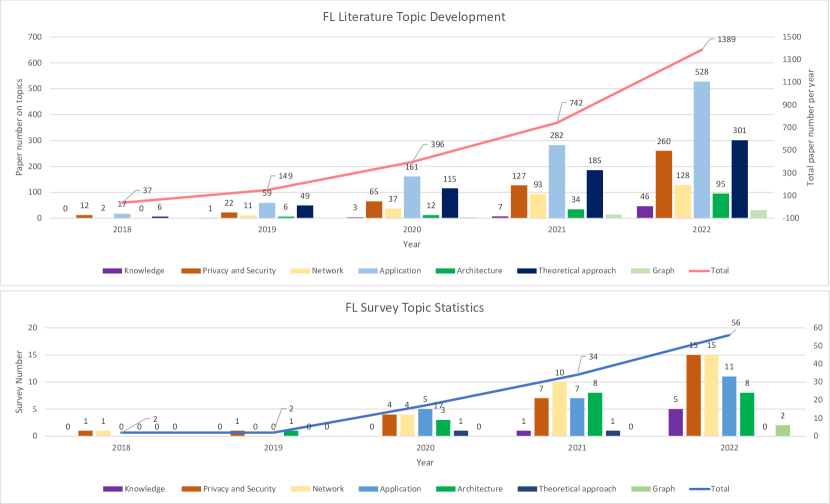
- There is rapid growth in FL research, with 1,389 FL papers in 2022, indicating accelerating industry adoption and need for standardized practices.
- The survey highlights a lack of theoretical-oriented FL surveys and emphasizes the need for high-performance, privacy-preserving, and secure FL for real-world deployment.
- The work provides a structured methodology for designing scalable and secure FL systems and reviews privacy/security threat models and defenses.
Read this paper
Open the full text in the Nubint reader and ask about any passage as you read.
Read this paper on NubintThis review was generated by AI from the original paper. Please check the paper before citing it.