
[Paper Review] Advances in apparent conceptual physics reasoning in GPT-4
The paper assesses GPT-4’s performance on the Force Concept Inventory (FCI), showing near-expert level conceptual physics reasoning with GPT-4, and contrasts it with GPT-3.5, while discussing limitations and educational implications.
ChatGPT is built on a large language model trained on an enormous corpus of human text to emulate human conversation. Despite lacking any explicit programming regarding the laws of physics, recent work has demonstrated that GPT-3.5 could pass an introductory physics course at some nominal level and register something close to a minimal understanding of Newtonian Mechanics on the Force Concept Inventory. This work replicates those results and also demonstrates that the latest version, GPT-4, has reached a much higher mark in the latter context. Indeed, its responses come quite close to perfectly demonstrating expert-level competence, with a few very notable exceptions and limitations. We briefly comment on the implications of this for the future of physics education and pedagogy.
Motivation & Objective
- Evaluate GPT-4’s ability to demonstrate conceptual Newtonian physics understanding using the Force Concept Inventory (FCI).
- Compare GPT-4 performance to GPT-3.5 and to human student benchmarks.
- Investigate stability and reasoning quality of model responses under prompts and perturbations.
Proposed method
- Modify FCI items for text-only prompts while preserving core physics tasks.
- Administer 30 FCI items to GPT-3.5 (after Feb 20) and GPT-4 (after Mar 16) with prompts requesting answer and brief explanation.
- Assess performance on answer choices and analyze free-response explanations for correctness and reasoning.
- Evaluate response stability by regenerating answers and perturbing input text.
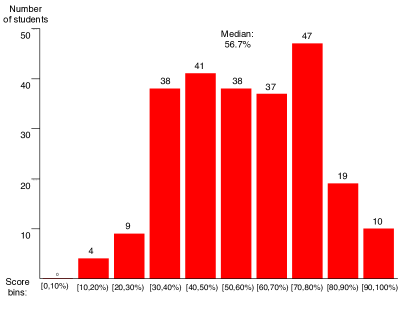
- Compare model performance to university student distributions and historical GPT-3.5 results.
Experimental results
Research questions
- RQ1Can GPT-4 reach expert-like performance on conceptual physics tasks as measured by the FCI?
- RQ2How does GPT-4 compare to GPT-3.5 in accuracy and explanation quality on FCI items?
- RQ3What are the stability characteristics of GPT-4 and GPT-3.5 when prompts are regenerated or slightly perturbed?
- RQ4What limitations does GPT-4 exhibit in reproducing novice-like reasoning or noncanonical problem framings?
- RQ5What are the educational implications of AI performance for physics teaching and assessment?
Key findings
- GPT-3.5: 15/30 correct (50%) on first attempt; near the 60% bare-minimum benchmark.
- GPT-4: 28/30 correct on first attempt, missing items 19 and 26.
- GPT-4’s learning gain relative to a hypothetical student is g = 86.7%.
- GPT-4’s responses are largely stable under prompt regeneration and input perturbations, unlike GPT-3.5.
- Ten GPT-4 free responses were entirely correct; 26 were expert-level correct with some minor errors; one notable error similar to GPT-3.5’s item 19.
- GPT-4 demonstrates expert-like conceptual reasoning but cannot fully reproduce novice cognition and struggles with noncanonical language framing in some prompts.
- GPT-4’s limitations include resistance to adopting novice reasoning and poor performance on noncanonical prompts unless prompts use canonical physics tone.
Read this paper
Open the full text in the Nubint reader and ask about any passage as you read.
Read this paper on NubintThis review was generated by AI from the original paper. Please check the paper before citing it.