
[Paper Review] Advancing DDoS Attack Detection: A Synergistic Approach Using Deep Residual Neural Networks and Synthetic Oversampling
The paper combines SMOTE-based synthetic oversampling with an attention-augmented Deep Residual Network (ResNet) to detect DDoS attacks, achieving near-perfect accuracy on CICIDS data.
Distributed Denial of Service (DDoS) attacks pose a significant threat to the stability and reliability of online systems. Effective and early detection of such attacks is pivotal for safeguarding the integrity of networks. In this work, we introduce an enhanced approach for DDoS attack detection by leveraging the capabilities of Deep Residual Neural Networks (ResNets) coupled with synthetic oversampling techniques. Because of the inherent class imbalance in many cyber-security datasets, conventional methods often struggle with false negatives, misclassifying subtle DDoS patterns as benign. By applying the Synthetic Minority Over-sampling Technique (SMOTE) to the CICIDS dataset, we balance the representation of benign and malicious data points, enabling the model to better discern intricate patterns indicative of an attack. Our deep residual network, tailored for this specific task, further refines the detection process. Experimental results on a real-world dataset demonstrate that our approach achieves an accuracy of 99.98%, significantly outperforming traditional methods. This work underscores the potential of combining advanced data augmentation techniques with deep learning models to bolster cyber-security defenses.
Motivation & Objective
- Address the class-imbalance issue in DDoS detection datasets.
- Leverage SMOTE to balance benign and malicious traffic for robust learning.
- Develop an attention-augmented ResNet tailored for network traffic features.
- Evaluate the proposed method on the CICIDS dataset with rigorous metrics.
- Demonstrate a dual-phase training regime to improve generalization.
Proposed method
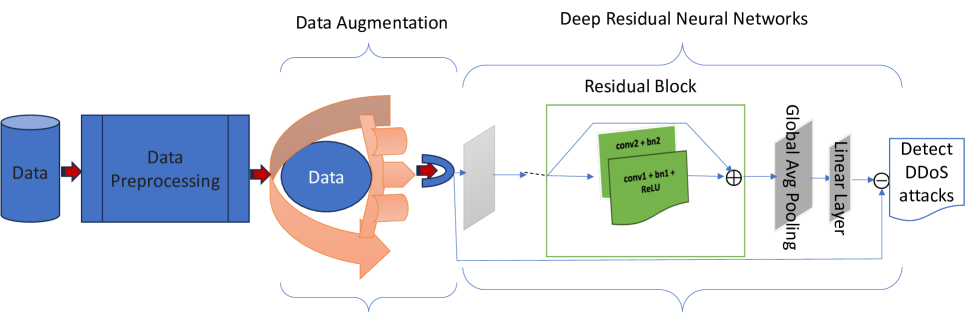
- Apply SMOTE to balance the CICIDS dataset before model training.
- Use a Deep Residual Network with attention augmentation to capture feature interdependencies.
- Incorporate a dual-phase training: Phase 1 pre-training on original data, Phase 2 fine-tuning on SMOTE-balanced data with a regularization term.
- Utilize Dice Loss as the training objective to enhance overlap between predictions and targets.
- Adopt Adagrad as the optimizer for training the network.
- Evaluate using standard metrics: accuracy, precision, recall, F1-score, and ROC-AUC.
Experimental results
Research questions
- RQ1Can SMOTE-balanced training improve DDoS detection accuracy in deep learning models?
- RQ2Does an attention-augmented ResNet improve detection of subtle DDoS patterns in imbalanced traffic data?
- RQ3What is the impact of a dual-phase training regime on model robustness and generalization?
- RQ4How does the proposed approach perform on real-world CICIDS data compared to traditional methods?
Key findings
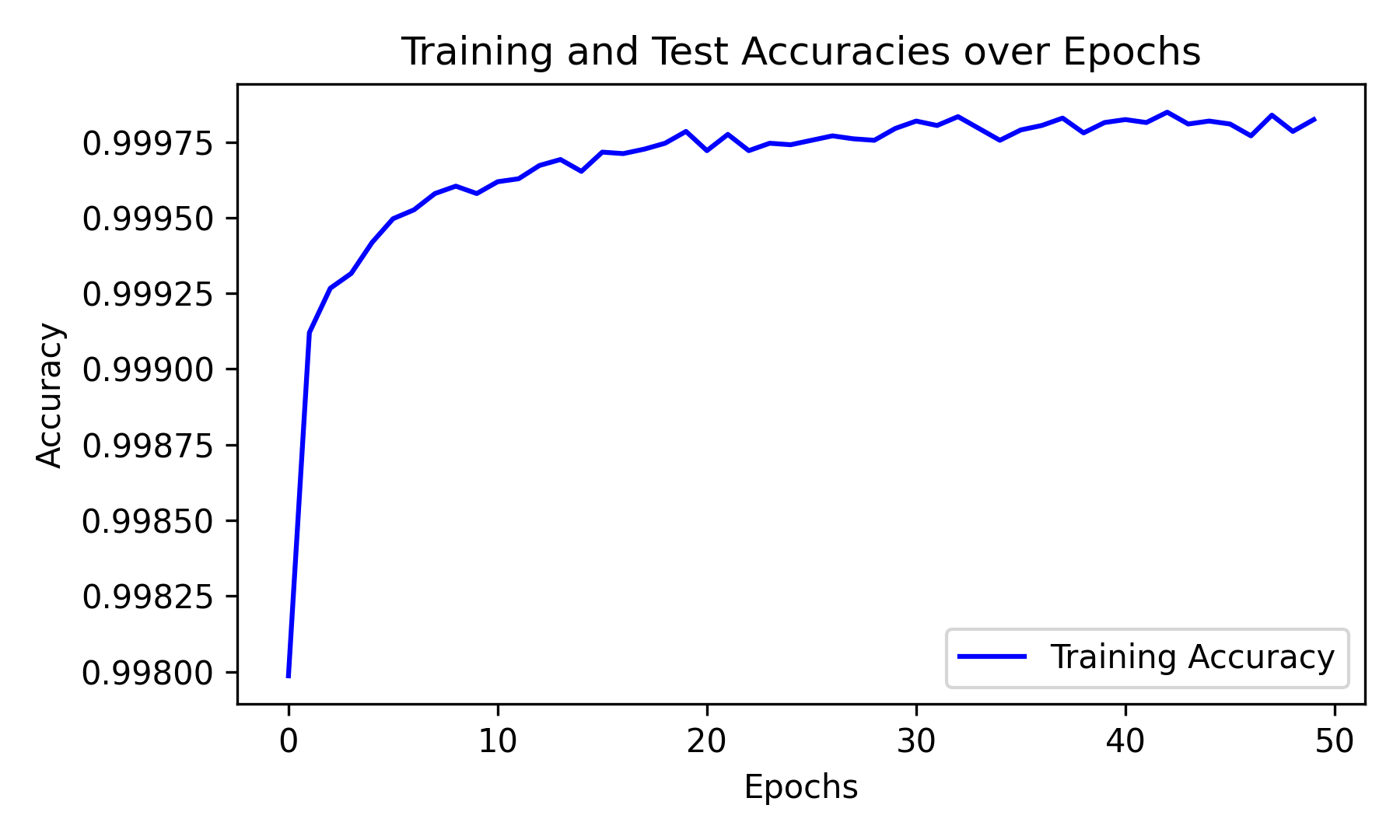
- Accuracy of 99.98% on the balanced CICIDS dataset.
- Precision of 99.98% indicating very low false positives.
- Recall of 99.96% indicating high true positive rate.
- F1-Score of 99.97% reflecting a balanced performance.
- ROC-AUC of 1.00 demonstrating perfect discrimination on the test data.
Read this paper
Open the full text in the Nubint reader and ask about any passage as you read.
Read this paper on NubintThis review was generated by AI from the original paper. Please check the paper before citing it.