
[Paper Review] Advancing LLM Reasoning Generalists with Preference Trees
Eurus is a suite of open-source LLMs finetuned with UltraInteract, achieving state-of-the-art reasoning performance among open models and competitive results with GPT-3.5 Turbo on challenging benchmarks, by leveraging a tree-structured preference data approach and novel reward modeling.
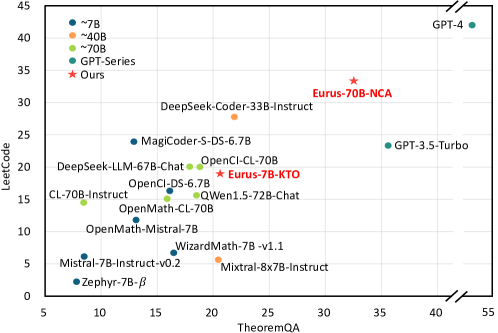
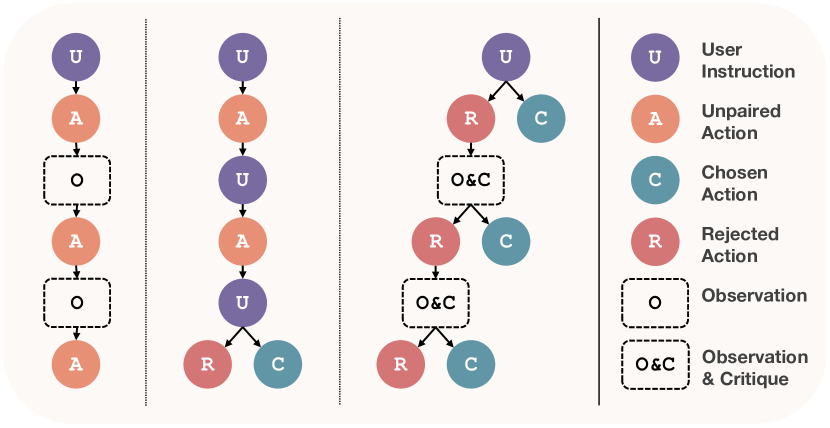
We introduce Eurus, a suite of large language models (LLMs) optimized for reasoning. Finetuned from Mistral-7B and CodeLlama-70B, Eurus models achieve state-of-the-art results among open-source models on a diverse set of benchmarks covering mathematics, code generation, and logical reasoning problems. Notably, Eurus-70B beats GPT-3.5 Turbo in reasoning through a comprehensive benchmarking across 12 tests covering five tasks, and achieves a 33.3% pass@1 accuracy on LeetCode and 32.6% on TheoremQA, two challenging benchmarks, substantially outperforming existing open-source models by margins more than 13.3%. The strong performance of Eurus can be primarily attributed to UltraInteract, our newly-curated large-scale, high-quality alignment dataset specifically designed for complex reasoning tasks. UltraInteract can be used in both supervised fine-tuning and preference learning. For each instruction, it includes a preference tree consisting of (1) reasoning chains with diverse planning strategies in a unified format, (2) multi-turn interaction trajectories with the environment and the critique, and (3) pairwise data to facilitate preference learning. UltraInteract allows us to conduct an in-depth exploration of preference learning for reasoning tasks. Our investigation reveals that some well-established preference learning algorithms may be less suitable for reasoning tasks compared to their effectiveness in general conversations. Inspired by this, we derive a novel reward modeling objective which, together with UltraInteract, leads to a strong reward model.
Motivation & Objective
- Address the gap between open-source and proprietary models in complex reasoning by improving alignment data quality and preference learning for reasoning.
- Develop Eurus models by finetuning Mistral-7B and CodeLlama-70B using UltraInteract alignment data.
- Investigate the effectiveness of preference learning algorithms (DPO, KTO, NCA) for reasoning tasks and derive a reward modeling objective.
- Provide a high-quality, tree-structured alignment dataset (UltraInteract) for supervised fine-tuning and preference learning.
Proposed method
- Create UltraInteract: 86K instructions and 220K action pairs organized as preference trees for multi-turn reasoning.
- Decompose problems into sub-tasks; generate step-by-step actions in text or code; interact with an environment (Python interpreter) and a critique model.
- Train Eurus-7B-SFT and Eurus-70B-SFT with leaf-only correct actions plus data mixtures (UltraChat, ShareGPT2, OpenOrca).
- Explore three preference-learning algorithms (DPO, KTO, NCA) using multi-turn trajectory pairs; augment Bradley-Terry objective with a data-reward regularization term.
- Develop Eurus-RM-7B reward model with a modified objective that increases rewards of chosen actions and decreases those of rejected ones; evaluate on RM benchmarks.
Experimental results
Research questions
- RQ1Can UltraInteract’s tree-structured, multi-turn alignment data improve reasoning capabilities in open-source LLMs more than traditional single-turn data?
- RQ2Which preference-learning algorithms are most effective for reasoning tasks, and how does reward emphasis (absolute vs relative rewards) impact performance?
- RQ3Does mixing UltraInteract with other alignment data preserve instruction-following while enhancing reasoning and tool-use abilities?
- RQ4How effective is a dedicated reward model (Eurus-RM-7B) at improving reasoning-based evaluation metrics and reranking tasks?
Key findings
- Eurus-7B and Eurus-70B achieve best overall performance among open-source models of similar sizes across diverse reasoning benchmarks.
- Eurus-70B-SFT reaches performance comparable to GPT-3.5 Turbo on several benchmarks; adding KTO/NCA improves math and multi-turn evaluations.
- DPO can hurt reasoning performance on many benchmarks, whereas KTO and NCA consistently improve results; higher absolute rewards for chosen solutions correlate with better performance.
- Eurus-RM-7B provides strong reward-model-based reranking, often outperforming larger baselines and correlating well with human judgments on reasoning tasks.
- The UltraInteract data design (diverse reasoning patterns, tool use, multi-turn critique) is critical to gains in reasoning capability when mixed with standard SFT datasets.
Read this paper
Open the full text in the Nubint reader and ask about any passage as you read.
Read this paper on NubintThis review was generated by AI from the original paper. Please check the paper before citing it.