
[Paper Review] Adversarial Example Does Good: Preventing Painting Imitation from Diffusion Models via Adversarial Examples
The paper defines adversarial examples for diffusion models and introduces AdvDM to perturb input paintings so DM-based AI-for-Art cannot extract features or imitate styles, evaluated via Monte Carlo-based optimization and multiple copyright-protection scenarios.
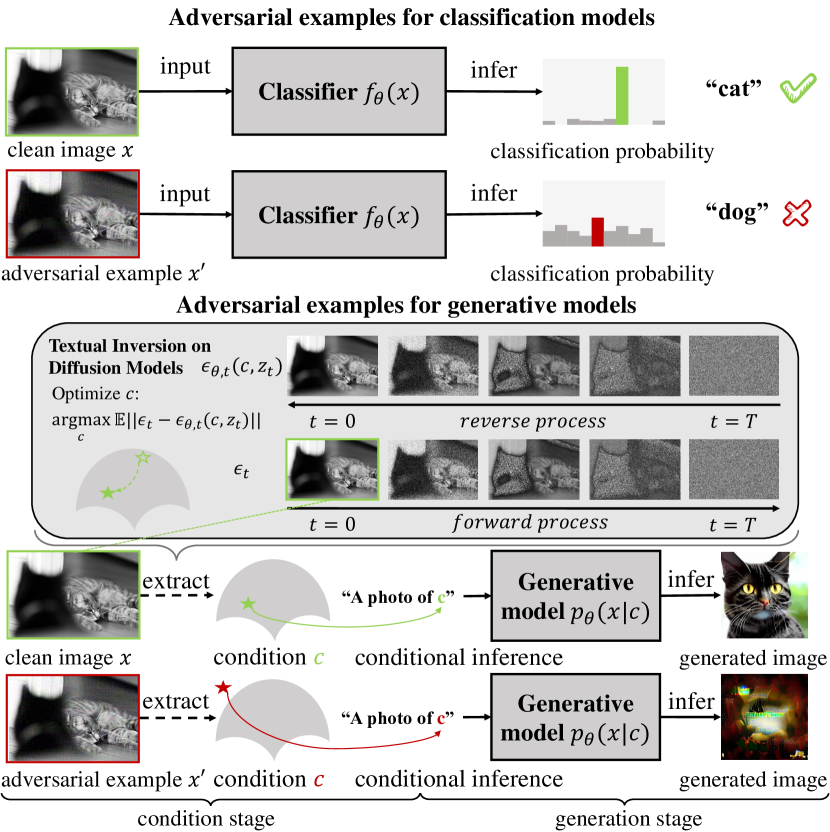
Recently, Diffusion Models (DMs) boost a wave in AI for Art yet raise new copyright concerns, where infringers benefit from using unauthorized paintings to train DMs to generate novel paintings in a similar style. To address these emerging copyright violations, in this paper, we are the first to explore and propose to utilize adversarial examples for DMs to protect human-created artworks. Specifically, we first build a theoretical framework to define and evaluate the adversarial examples for DMs. Then, based on this framework, we design a novel algorithm, named AdvDM, which exploits a Monte-Carlo estimation of adversarial examples for DMs by optimizing upon different latent variables sampled from the reverse process of DMs. Extensive experiments show that the generated adversarial examples can effectively hinder DMs from extracting their features. Therefore, our method can be a powerful tool for human artists to protect their copyright against infringers equipped with DM-based AI-for-Art applications. The code of our method is available on GitHub: https://github.com/mist-project/mist.git.
Motivation & Objective
- Motivate copyright protection for human-created paintings against diffusion-model-based AI art.
- Define a formal framework for adversarial examples in diffusion models (DMs).
- Design AdvDM to generate adversarial inputs via Monte Carlo estimation that hinder DM feature extraction.
- Evaluate AdvDM across text-to-image, style transfer, and image-to-image scenarios on Latent Diffusion Models (LDMs).
- Assess robustness and defense strategies, including preprocessing defenses, against AdvDM.
Proposed method
- Define adversarial example for diffusion models as x' = x + delta with ||delta|| <= epsilon that minimizes p_theta(x+delta) via Monte Carlo over latent diffusion steps.
- Optimize delta by maximizing the DM training loss averaged over samples of latent variables x'1:T drawn from a posterior-like distribution, using gradient ascent.
- Use AdvDM: iterative signed gradient steps with Monte Carlo sampling of latent variables (N samples) to estimate the objective.
- Evaluate with conditional generation metrics (FID, Precision, Recall) on text-to-image, style transfer, and image-to-image tasks.
- Examine trade-offs: sampling steps, perturbation budget, and inference time; compare against preprocessing defenses (JPEG, TVM, SR) and purification (DiffPure).
- Core equations: p_theta(x) = ∫ p_theta(x0:T) dx1:T; adversarial objective max_delta E_{x1:T'~u(x1:T')} L_DM(theta) = -log p_theta(x0:T) (Eq. 7); AdvDM update: x0^(i+1) = x0^(i) + alpha * sgn(∇_{x0^(i)} L_DM(...)) (Eq. 9).
Experimental results
Research questions
- RQ1Can adversarial perturbations prevent diffusion models from extracting conditioning features (e.g., textual inversion prompts) used to imitate paintings?
- RQ2How effective is AdvDM at reducing the quality of DM-generated outputs conditioned on perturbed inputs across multiple generation scenarios?
- RQ3What are the practical trade-offs (sampling steps, perturbation budget, inference time) when generating adversarial examples for DMs?
- RQ4Are preprocessing defenses able to adequately mitigate AdvDM without destroying image semantics?
- RQ5Does AdvDM extend to commercial DM systems (e.g., Stable Diffusion) and to various conditioning paradigms (text, style, image).
Key findings
- Adversarial examples significantly raise FID and reduce Precision in text-to-image generation conditioned on adversarial inputs, indicating successful protection of artwork features.
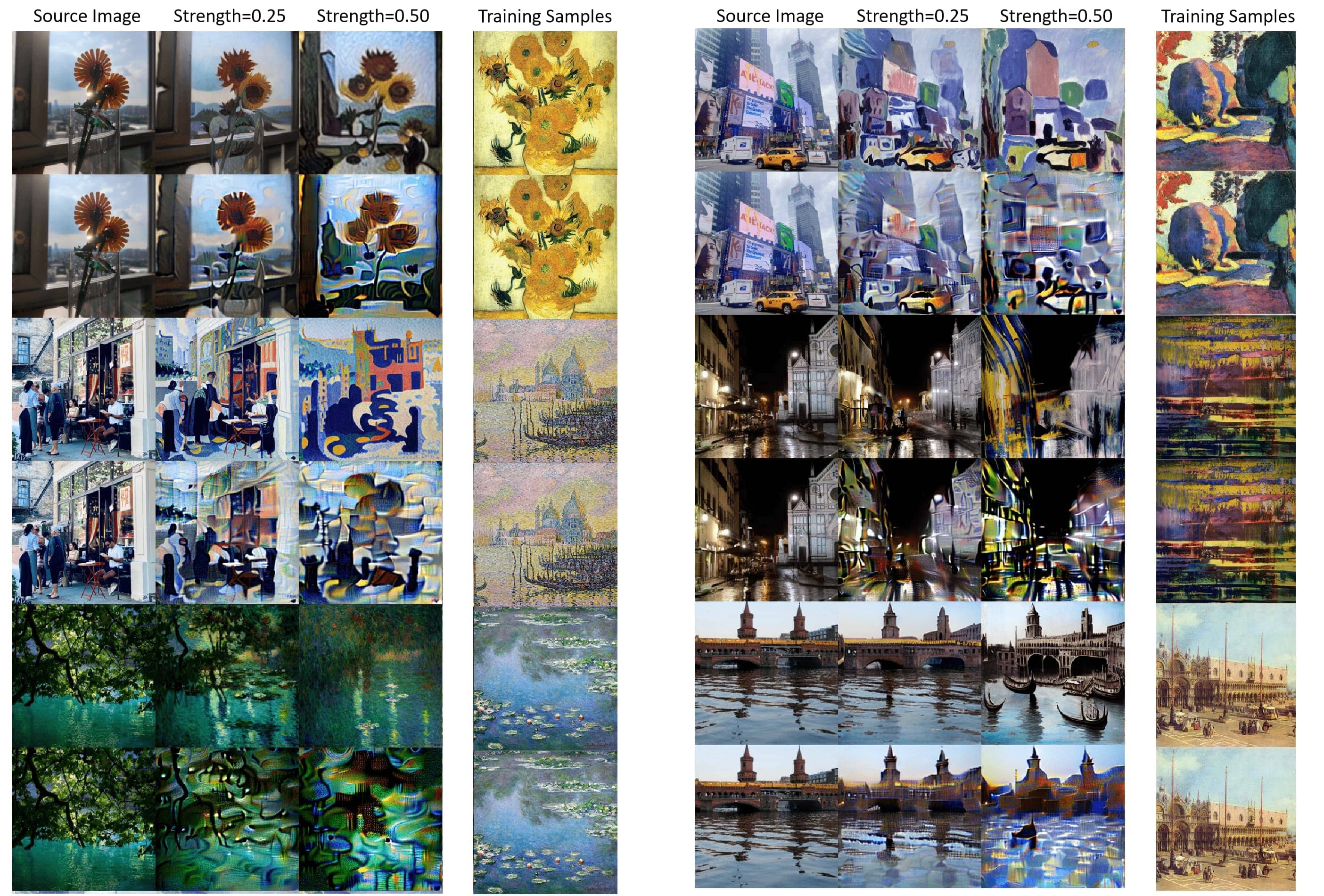
- AdvDM substantially degrades the ability of DMs to imitate styles/contents, as shown by degraded sample quality in style transfer and image-to-image scenarios.
- Increasing Monte Carlo samples improves attack effectiveness (higher FID, lower Precision) but raises inference time; a balance with 40 sampling steps was used in main experiments.
- Perturbation budgets as small as 4/255 already meaningfully impact generation quality; larger budgets yield stronger effects but longer runtimes.
- Preprocessing defenses like JPEG and TVM only partially mitigate AdvDM; SR defense helps more for FID but not consistently for Precision, indicating persistent semantic disruption by AdvDM.
- The approach is effective against textual inversion-based conditioning and generalizes to multiple DM-based art-generation workflows, including evaluation on WikiArt and LSUN datasets.
Read this paper
Open the full text in the Nubint reader and ask about any passage as you read.
Read this paper on NubintThis review was generated by AI from the original paper. Please check the paper before citing it.