
[Paper Review] Adversarial Learning: A Critical Review and Active Learning Study
This paper presents a mixed sample selection strategy in active learning to defend against adversarial attacks that inject misleading samples near the decision boundary. It demonstrates experimentally that combining uncertainty sampling and maximum expected utility (MEU) sampling improves robustness against such attacks, with p=0.75 yielding the most stable and accurate convergence in MNIST digit classification under attack.
This papers consists of two parts. The first is a critical review of prior art on adversarial learning, identifying some significant limitations of previous works. The second part is an experimental study considering adversarial active learning and an investigation of the efficacy of a mixed sample selection strategy for combating an adversary who attempts to disrupt the classifier learning.
Motivation & Objective
- To investigate the vulnerability of active learning to adversarial attacks that inject samples near the decision boundary to degrade classifier performance.
- To evaluate the effectiveness of mixed sample selection strategies in defending against such adversarial manipulations.
- To analyze the trade-offs between robustness and convergence accuracy in active learning under adversarial conditions.
- To explore whether defense mechanisms can be achieved without requiring prior knowledge of attack patterns or labeled adversarial examples.
Proposed method
- Proposes a mixed strategy combining uncertainty sampling (p=0) and maximum expected utility (MEU, p=1) in active learning, parameterized by p to balance exploration and exploitation.
- Uses a linear SVM classifier trained on MNIST data to distinguish between digits '5' and '6' as a testbed for adversarial attacks.
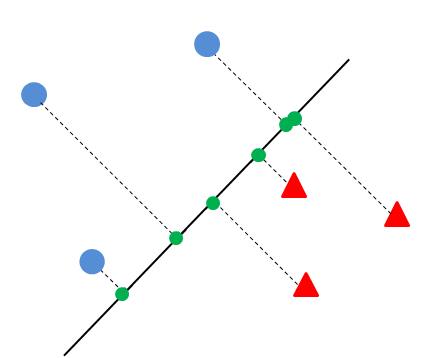
- Generates adversarial samples by projecting existing training and unlabeled samples onto the current decision boundary, creating ambiguous, boundary-crossing examples.
- Employs an oracle (SVM trained on full dataset) to label adversarial samples objectively, ensuring consistency with maximum margin separation.
- Evaluates performance across 10 random trials using average test error as the metric, comparing strategies under both attack and no-attack conditions.
- Analyzes convergence behavior and class-balance effects of different strategies, particularly focusing on MEU's class-biased sampling tendency.
Experimental results
Research questions
- RQ1How vulnerable is uncertainty sampling in active learning to adversarial data injection near the decision boundary?
- RQ2Can a mixed strategy of uncertainty and MEU sampling improve robustness against adversarial attacks without prior knowledge of attack patterns?
- RQ3What is the impact of varying the mixing parameter p on the accuracy and convergence stability of active learning under attack?
- RQ4Does MEU sampling lead to suboptimal decision boundaries due to class imbalance, and can this be mitigated by hybrid strategies?
- RQ5How does the performance of random sampling compare to adaptive strategies under adversarial conditions?
Key findings
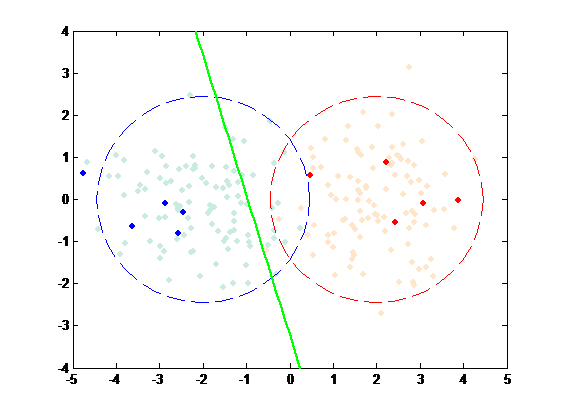
- Uncertainty sampling (p=0) is highly vulnerable to adversarial attacks, as it consistently selects injected adversarial samples, leading to the worst performance under attack.
- MEU sampling (p=1) achieves the fastest initial error reduction but converges to a suboptimal decision boundary due to class-biased sampling, especially under attack.
- Mixed strategies with p ∈ [0.25, 0.75] show monotonically improving performance under attack, with p=0.75 achieving the most stable and accurate convergence.
- The random sampling strategy is robust to attack but fails to converge to high accuracy in the absence of attack, indicating poor learning efficiency.
- In the absence of attack, all mixed strategies perform similarly, confirming that the defense mechanism only provides benefit under adversarial conditions.
- The attack significantly delays learning progress in high-dimensional settings like MNIST, compared to low-dimensional synthetic examples, highlighting real-world threat severity.
Read this paper
Open the full text in the Nubint reader and ask about any passage as you read.
Read this paper on NubintThis review was generated by AI from the original paper. Please check the paper before citing it.