
[Paper Review] Adversarial Motion Priors Make Good Substitutes for Complex Reward Functions
This paper proposes using adversarial motion priors—learned from minimal motion capture data—as substitutes for complex, hand-designed reward functions in reinforcement learning for legged robots. By training policies with these data-driven style rewards, the method produces natural, energy-efficient locomotion with realistic gait transitions that transfer effectively to real-world quadrupedal robots, outperforming both unstructured rewards and manually engineered alternatives in efficiency and realism.
Training a high-dimensional simulated agent with an under-specified reward function often leads the agent to learn physically infeasible strategies that are ineffective when deployed in the real world. To mitigate these unnatural behaviors, reinforcement learning practitioners often utilize complex reward functions that encourage physically plausible behaviors. However, a tedious labor-intensive tuning process is often required to create hand-designed rewards which might not easily generalize across platforms and tasks. We propose substituting complex reward functions with "style rewards" learned from a dataset of motion capture demonstrations. A learned style reward can be combined with an arbitrary task reward to train policies that perform tasks using naturalistic strategies. These natural strategies can also facilitate transfer to the real world. We build upon Adversarial Motion Priors -- an approach from the computer graphics domain that encodes a style reward from a dataset of reference motions -- to demonstrate that an adversarial approach to training policies can produce behaviors that transfer to a real quadrupedal robot without requiring complex reward functions. We also demonstrate that an effective style reward can be learned from a few seconds of motion capture data gathered from a German Shepherd and leads to energy-efficient locomotion strategies with natural gait transitions.
Motivation & Objective
- To address the challenge of training realistic, transferable locomotion policies in simulation without relying on complex, hand-tuned reward functions.
- To investigate whether motion priors learned from small amounts of motion capture data can serve as effective substitutes for intricate reward shaping in reinforcement learning.
- To evaluate the energy efficiency and realism of policies trained with adversarial motion priors compared to those trained with hand-designed rewards or no style regularization.
- To demonstrate that policies trained with motion priors can generalize to real-world deployment, exhibiting natural gait transitions and stable velocity tracking.
Proposed method
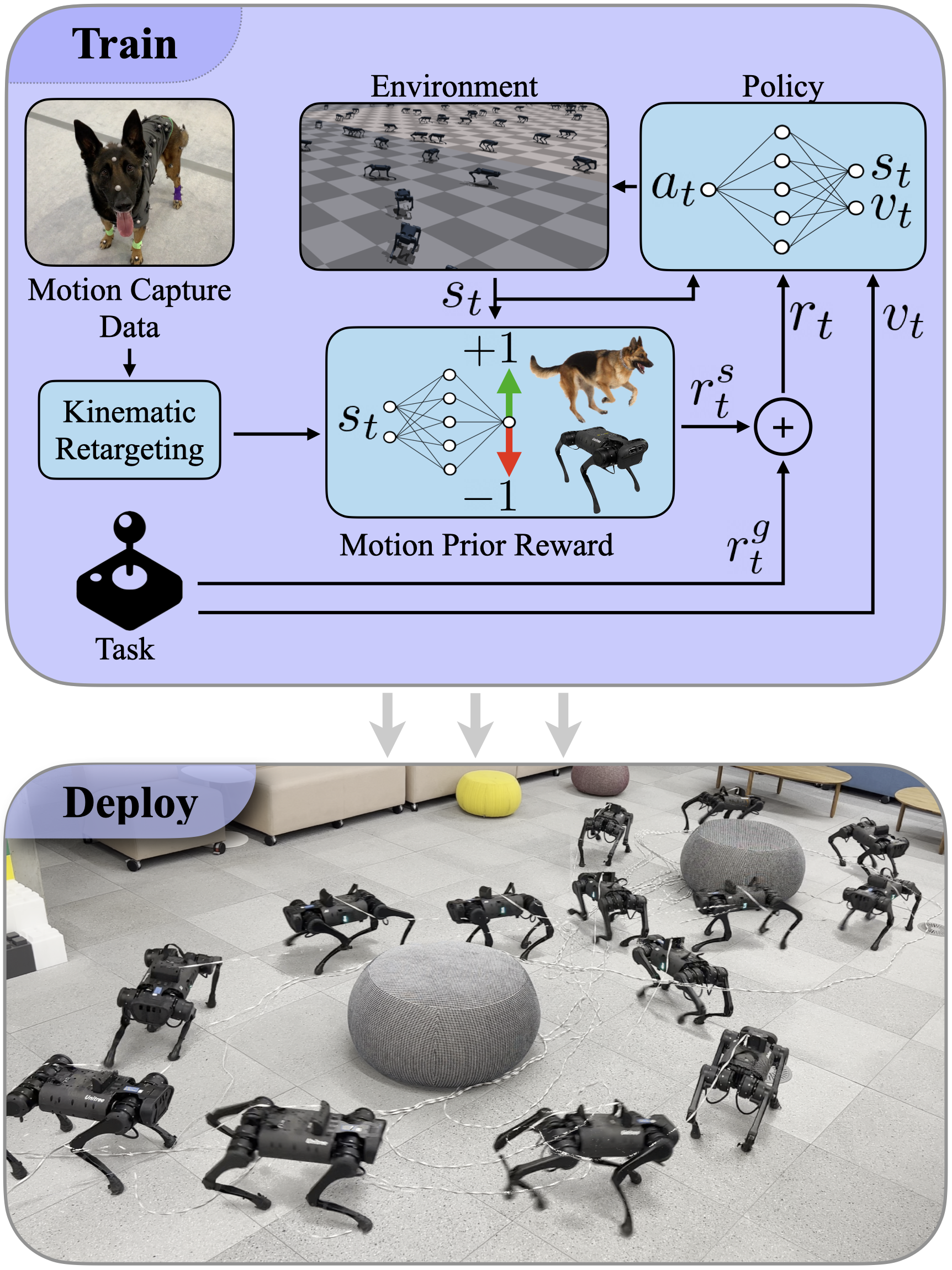
- Leverage Adversarial Motion Priors (AMP), a GAN-style framework, to learn a style reward from a small dataset of 4.5 seconds of German Shepherd motion capture data.
- Train a policy using a combination of the learned AMP style reward and a simple task-specific reward (e.g., velocity tracking) to encourage both task performance and natural motion.
- Use a discriminator network to minimize the Pearson divergence between the distribution of generated trajectories and the reference motion dataset, effectively encoding the 'style' of the demonstrated motions.
- Train the policy via reinforcement learning with the combined reward: task reward + adversarial style reward, enabling the policy to learn physically plausible, energy-efficient behaviors.
- Apply the trained policy directly to a real quadrupedal robot (A1) to evaluate real-world transferability and performance.
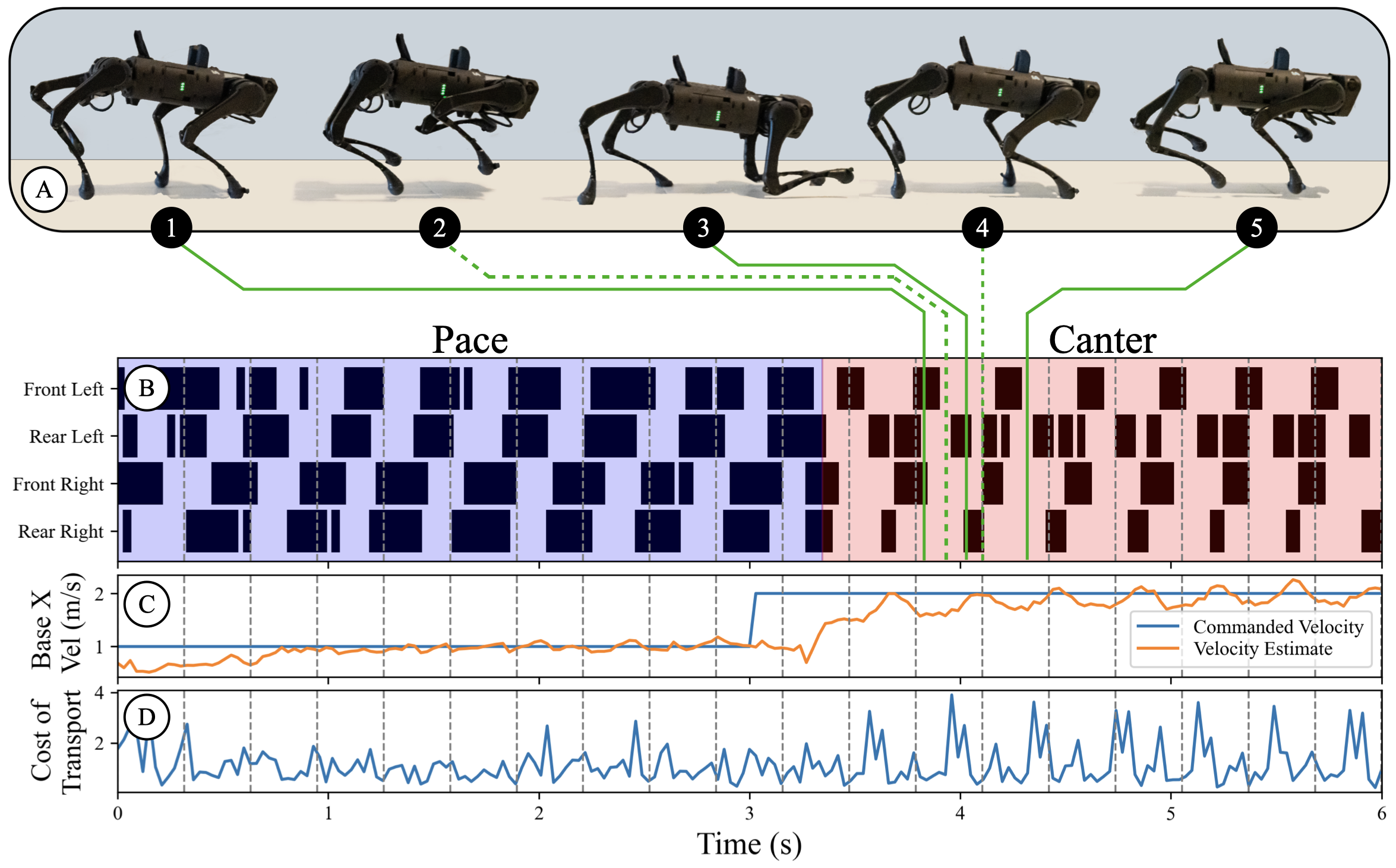
- Analyze gait transitions, energy consumption (Cost of Transport), and velocity tracking accuracy to assess realism and efficiency.
Experimental results
Research questions
- RQ1Can adversarial motion priors learned from minimal motion capture data effectively replace complex, hand-designed reward functions in training locomotion policies?
- RQ2Do policies trained with motion priors exhibit more natural gait transitions and realistic locomotion patterns compared to those trained with standard or complex reward shaping?
- RQ3Can policies trained with motion priors achieve better energy efficiency (lower Cost of Transport) than those trained with hand-designed or unstructured rewards?
- RQ4To what extent can policies generalize to real-world deployment, maintaining stability and tracking performance on a real quadruped robot?
Key findings
- Policies trained with adversarial motion priors achieved a lower Cost of Transport (COT) than those trained with hand-designed rewards, indicating improved energy efficiency.
- The policy learned to transition naturally between gaits—such as from pacing to cantering—based on commanded velocity, closely mimicking biological quadrupedal locomotion.
- Despite the reference dataset containing only 4.5 seconds of motion, the policy successfully tracked velocity commands across a wide range of speeds, including those not present in the dataset.
- The real-world deployment of the policy on the A1 robot demonstrated stable, naturalistic locomotion with accurate velocity tracking and minimal oscillations in energy consumption.
- The motion prior enabled the policy to deviate meaningfully from the reference motions when necessary to complete the task, showing robustness and adaptability.
- The combination of AMP with a simple task reward outperformed complex hand-designed reward formulations in both energy efficiency and realism of motion.
Read this paper
Open the full text in the Nubint reader and ask about any passage as you read.
Read this paper on NubintThis review was generated by AI from the original paper. Please check the paper before citing it.