
[Paper Review] AfriQA: Cross-lingual Open-Retrieval Question Answering for African Languages
AfriQA is the first cross-lingual open-retrieval QA dataset for African languages, with 12,239 questions across 10 languages, enabling evaluation of XOR retrieval and QA in low-resource languages.
African languages have far less in-language content available digitally, making it challenging for question answering systems to satisfy the information needs of users. Cross-lingual open-retrieval question answering (XOR QA) systems -- those that retrieve answer content from other languages while serving people in their native language -- offer a means of filling this gap. To this end, we create AfriQA, the first cross-lingual QA dataset with a focus on African languages. AfriQA includes 12,000+ XOR QA examples across 10 African languages. While previous datasets have focused primarily on languages where cross-lingual QA augments coverage from the target language, AfriQA focuses on languages where cross-lingual answer content is the only high-coverage source of answer content. Because of this, we argue that African languages are one of the most important and realistic use cases for XOR QA. Our experiments demonstrate the poor performance of automatic translation and multilingual retrieval methods. Overall, AfriQA proves challenging for state-of-the-art QA models. We hope that the dataset enables the development of more equitable QA technology.
Motivation & Objective
- Address the lack of African-language QA data by creating a ground-up XOR QA dataset tailored to African languages.
- Provide a scalable benchmark across 10 African languages to study cross-lingual retrieval and answer generation.
- Evaluate various translation, retrieval, and QA baselines to identify current limitations in XOR QA for African languages.
- Offer analyses of linguistic properties and annotation challenges to guide future dataset creation and model development.
Proposed method
- Construct AfriQA with 12,239 questions and 8,892 QA pairs across 10 African languages.
- Use a cross-lingual open-retrieval setup where questions are in the African language and passages are retrieved in a pivot language (English or French).
- Collect data via a four-stage annotation pipeline: question elicitation, translation to a pivot language, answer labeling in the pivot language, and translation back to the source language.
- Evaluate three XOR QA tasks: XOR-Retrieve, XOR-PivotLanguageSpan, and XOR-Full, using translation, retrieval, and reader models.
- Compare baselines including Google Translate, NLLB, M2M-100, BM25, mDPR, and sparse-dense hybrids, with AfroXLMR and mBERT-based readers.
Experimental results
Research questions
- RQ1What is the performance of cross-lingual open-retrieval QA on African languages using current translation and retrieval baselines?
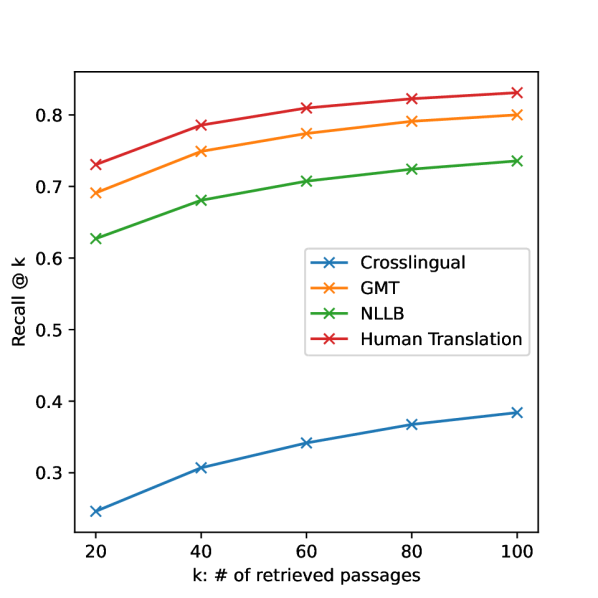
- RQ2How do translation quality and retrieval strategies affect cross-lingual QA accuracy in low-resource languages?
- RQ3Can a hybrid sparse-dense retrieval approach improve over translation-then-retrieve baselines in XOR QA for African languages?
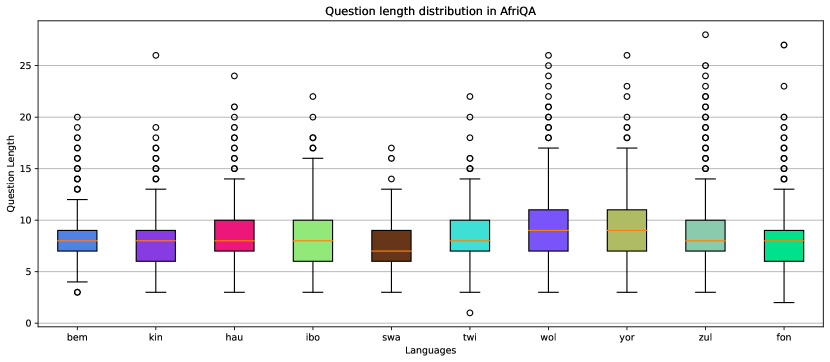
- RQ4What linguistic properties of the 10 African languages impact QA system design and evaluation?
Key findings
- The final AfriQA dataset contains 12,239 questions across 10 languages with 8,892 QA pairs.
- Only 27% of questions are unanswerable, indicating relatively high answer coverage given Wikipedia constraints.
- Cross-lingual retrieval methods underperform translation-based baselines, highlighting deficits in current cross-lingual retrieval for these languages.
- A hybrid sparse-dense retrieval approach improves over either BM25 or mDPR alone in several languages.
- Evaluations show AfriQA is challenging for state-of-the-art QA models, motivating development of more equitable multilingual QA systems.
Read this paper
Open the full text in the Nubint reader and ask about any passage as you read.
Read this paper on NubintThis review was generated by AI from the original paper. Please check the paper before citing it.