
[Paper Review] AfriSenti: A Twitter Sentiment Analysis Benchmark for African Languages
AfriSenti provides the largest multilingual Twitter sentiment dataset for 14 African languages and evaluates baseline multilingual and Africa-centric PLMs, enabling cross-language and zero-shot transfer studies.
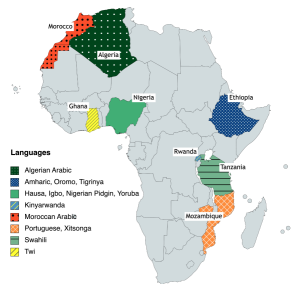
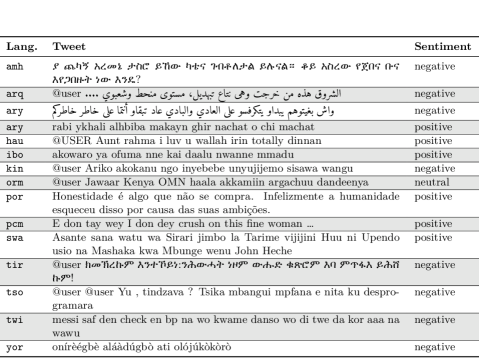
Africa is home to over 2,000 languages from more than six language families and has the highest linguistic diversity among all continents. These include 75 languages with at least one million speakers each. Yet, there is little NLP research conducted on African languages. Crucial to enabling such research is the availability of high-quality annotated datasets. In this paper, we introduce AfriSenti, a sentiment analysis benchmark that contains a total of >110,000 tweets in 14 African languages (Amharic, Algerian Arabic, Hausa, Igbo, Kinyarwanda, Moroccan Arabic, Mozambican Portuguese, Nigerian Pidgin, Oromo, Swahili, Tigrinya, Twi, Xitsonga, and Yorùbá) from four language families. The tweets were annotated by native speakers and used in the AfriSenti-SemEval shared task (The AfriSenti Shared Task had over 200 participants. See website at https://afrisenti-semeval.github.io). We describe the data collection methodology, annotation process, and the challenges we dealt with when curating each dataset. We further report baseline experiments conducted on the different datasets and discuss their usefulness.
Motivation & Objective
- Highlight the need for sentiment-analysis resources in under-represented African languages and create a large, annotated Twitter dataset across 14 languages.
- Describe data collection, annotation, and quality control challenges for multilingual African-language sentiment data.
- Provide baseline experiments using multilingual and Africa-centric PLMs to establish performance benchmarks.
- Release datasets, sentiment lexicons, and resources to enable further research in African-language NLP.
Proposed method
- Collect Twitter data using location-based and vocabulary-based heuristics due to limited Twitter language tagging for African languages.
- Annotate tweets with three-way sentiment labels (positive, negative, neutral) using majority voting; provide individual labels for Ethiopian languages.
- Evaluate monolingual baselines with massively multilingual PLMs (XLM-R, mDeBERTaV3) and Africa-centric models (AfriBERTa, AfroXLMR, XLM-T).
- Conduct multilingual training on combined datasets and assess zero-shot transfer to Oromo and Tigrinya from source languages.
- Release datasets and lexicons; discuss data collection, annotation challenges, and ethical considerations.
Experimental results
Research questions
- RQ1What sentiment analysis resources exist for African languages and how can a large, annotated Twitter dataset be created across 14 languages?
- RQ2How do monolingual, multilingual, and cross-lingual transfer models perform on AfriSenti languages?
- RQ3What are the challenges in collecting, annotating, and aligning sentiment data for diverse African languages, including digraphia and code-switching?
- RQ4How does cross-lingual transfer fare between related languages (e.g., Hausa, Amharic) for zero-shot targets like Oromo and Tigrinya?
Key findings
- AfriSenti includes 110k+ tweets across 14 African languages spanning Afro-Asiatic, Niger-Congo, English Creole, and Indo-European families.
- AfroXLMR-large achieves the best overall performance among evaluated models with an average F1 around 71.2 on the combined test sets.
- Multilingual Afro-centric models generally outperform baseline XLM-R variants in the study, highlighting the benefit of language/domain-specific pre-training and model scale.
- Zero-shot transfer to Oromo and Tigrinya is strongest when using Hausa or Amharic as source languages for Oromo and Yoruba or Hausa for Tigrinya, reflecting linguistic relatedness and data size effects.
- Monolingual baselines vary by language; AfroXLMR-base and AfroXLMR-large show strong results for several AfriSenti languages, with significant gains for some Arabic- and Portuguese-dialect languages.
Read this paper
Open the full text in the Nubint reader and ask about any passage as you read.
Read this paper on NubintThis review was generated by AI from the original paper. Please check the paper before citing it.