
[Paper Review] Agent Instructs Large Language Models to be General Zero-Shot Reasoners
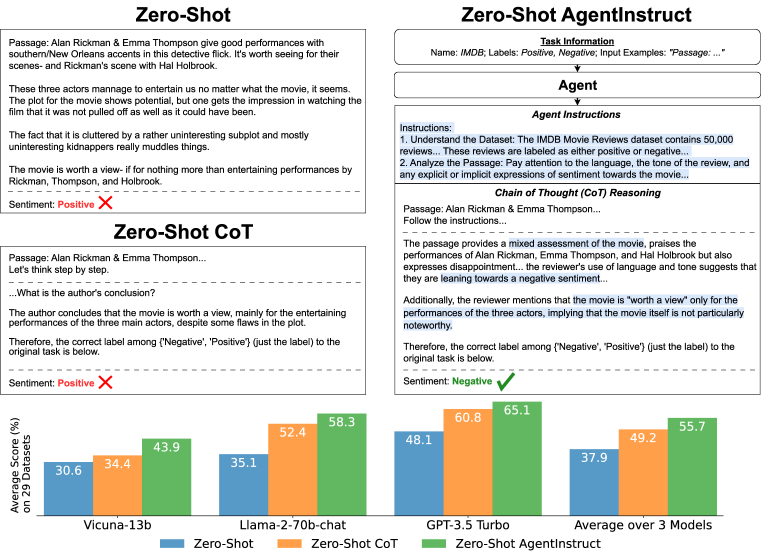
This paper proposes AgentInstruct, a method that uses an autonomous language agent to generate task-specific instructions, enhancing the zero-shot reasoning capabilities of large language models (LLMs) across diverse NLP tasks. By aligning LLM reasoning with web-verified, task-specific guidance, AgentInstruct achieves state-of-the-art zero-shot performance on 20 out of 29 datasets, boosting Llama-2-70b-chat by 23.2% and improving reasoning by 10.5% over chain-of-thought prompting.
We introduce a method to improve the zero-shot reasoning abilities of large language models on general language understanding tasks. Specifically, we build an autonomous agent to instruct the reasoning process of large language models. We show this approach further unleashes the zero-shot reasoning abilities of large language models to more tasks. We study the performance of our method on a wide set of datasets spanning generation, classification, and reasoning. We show that our method generalizes to most tasks and obtains state-of-the-art zero-shot performance on 20 of the 29 datasets that we evaluate. For instance, our method boosts the performance of state-of-the-art large language models by a large margin, including Vicuna-13b (13.3%), Llama-2-70b-chat (23.2%), and GPT-3.5 Turbo (17.0%). Compared to zero-shot chain of thought, our improvement in reasoning is striking, with an average increase of 10.5%. With our method, Llama-2-70b-chat outperforms zero-shot GPT-3.5 Turbo by 10.2%.
Motivation & Objective
- Improve the zero-shot reasoning abilities of large language models on general, diverse language understanding tasks.
- Address the limitation of existing zero-shot methods like chain-of-thought, which generalize poorly across broad task distributions.
- Develop a scalable, general-purpose method to unlock reasoning in LLMs without fine-tuning or task-specific demonstrations.
- Enable LLMs to perform better on unseen tasks by providing high-quality, task-specific reasoning instructions via an autonomous agent.
Proposed method
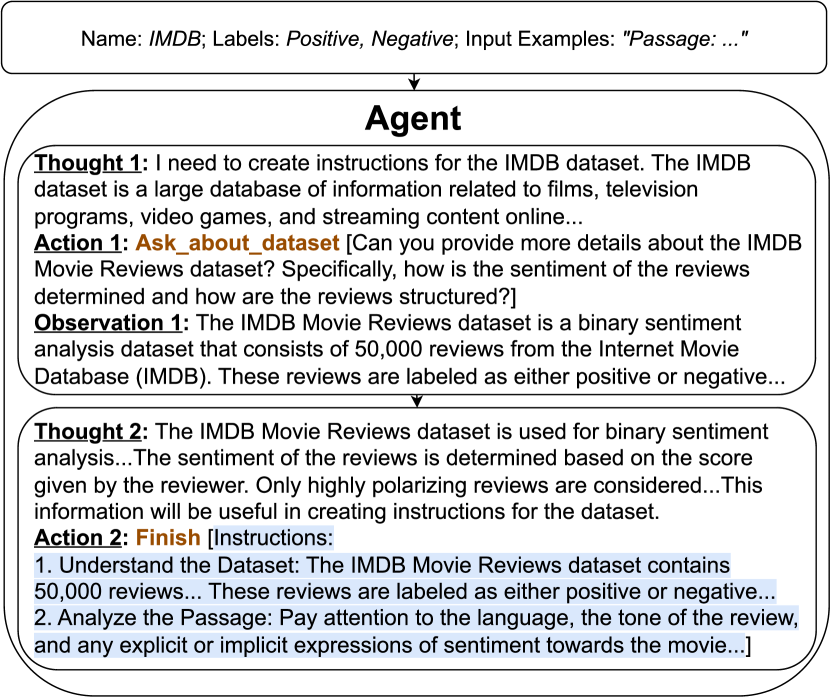
- Deploy an autonomous language agent that uses web retrieval to access task-relevant knowledge based on minimal input (e.g., dataset name and example inputs).
- Use the agent to generate step-by-step, task-specific instructions that guide the LLM’s reasoning process toward the correct solution.
- Integrate the agent-generated instructions with the LLM’s chain-of-thought reasoning to align reasoning steps with task-specific requirements.
- Use a single LLM as the reasoning engine and another LLM as the agent planner, both prompted to generate structured, executable instructions.
- Verify instruction quality via web-sourced facts and consistency checks to ensure reliability and task alignment.
- Apply the method end-to-end in a zero-shot setting—no fine-tuning, no few-shot examples—on generation, classification, and reasoning tasks.
Experimental results
Research questions
- RQ1Can an autonomous agent generate task-specific instructions that significantly improve zero-shot reasoning in LLMs across diverse NLP tasks?
- RQ2How does AgentInstruct compare to standard zero-shot and chain-of-thought prompting in terms of zero-shot performance on general language understanding tasks?
- RQ3To what extent does AgentInstruct generalize beyond narrow task domains and improve reasoning capabilities?
- RQ4Can AgentInstruct achieve state-of-the-art zero-shot performance on a broad benchmark of 29 datasets spanning generation, classification, and reasoning?
Key findings
- AgentInstruct achieves state-of-the-art zero-shot performance on 20 out of 29 evaluated datasets, demonstrating strong generalization across task types.
- The method improves the average zero-shot performance of Llama-2-70b-chat by 23.2%, Vicuna-13b by 13.3%, and GPT-3.5 Turbo by 17.0%.
- AgentInstruct increases reasoning performance by an average of 10.5% compared to zero-shot chain-of-thought, outperforming it on 10 out of 12 reasoning tasks.
- Llama-2-70b-chat with AgentInstruct surpasses standard zero-shot GPT-3.5 Turbo by 10.2% on average, despite GPT-3.5 Turbo being a more powerful model.
- The agent-generated instructions are highly effective, as they are grounded in web-retrieved knowledge and verified for consistency and task relevance.
- The method is robust and scalable, requiring no fine-tuning or task-specific demonstrations, and works across diverse NLP tasks including text generation, classification, and reasoning.
Read this paper
Open the full text in the Nubint reader and ask about any passage as you read.
Read this paper on NubintThis review was generated by AI from the original paper. Please check the paper before citing it.