
[Paper Review] AgentCoord: Visually Exploring Coordination Strategy for LLM-based Multi-Agent Collaboration
AgentCoord presents a visual framework and prototype system to design and explore coordination strategies for LLM-based multi-agent collaboration through a structured three-stage generation process and interactive visualization.
The potential of automatic task-solving through Large Language Model (LLM)-based multi-agent collaboration has recently garnered widespread attention from both the research community and industry. While utilizing natural language to coordinate multiple agents presents a promising avenue for democratizing agent technology for general users, designing coordination strategies remains challenging with existing coordination frameworks. This difficulty stems from the inherent ambiguity of natural language for specifying the collaboration process and the significant cognitive effort required to extract crucial information (e.g. agent relationship, task dependency, result correspondence) from a vast amount of text-form content during exploration. In this work, we present a visual exploration framework to facilitate the design of coordination strategies in multi-agent collaboration. We first establish a structured representation for LLM-based multi-agent coordination strategy to regularize the ambiguity of natural language. Based on this structure, we devise a three-stage generation method that leverages LLMs to convert a user's general goal into an executable initial coordination strategy. Users can further intervene at any stage of the generation process, utilizing LLMs and a set of interactions to explore alternative strategies. Whenever a satisfactory strategy is identified, users can commence the collaboration and examine the visually enhanced execution result. We develop AgentCoord, a prototype interactive system, and conduct a formal user study to demonstrate the feasibility and effectiveness of our approach.
Motivation & Objective
- Regularize the ambiguity of natural-language coordination strategies with a structured representation.
- Provide an initial executable coordination strategy derived from user goals using LLMs.
- Offer visual tools to organize, compare, and explore alternative strategies across plan outline, agent assignment, and task processes.
- Enable visual, enhanced execution results to assist verification and evaluation.
Proposed method
- Define a structured representation for LLM-based multi-agent coordination (Plan Outline, Task, Key Object, Agent, Action, Instruction).
- Develop a three-stage generation pipeline (Plan Outline Generation, Agent Assignment, Task Process Generation) that converts a user goal into an executable strategy via LLM prompts.
- Integrate interactive visual views (Plan Outline View, Agent Board View, Task Process View) and exploration views to iteratively refine strategies.
- Implement a visual exploration framework with planners, role prompts, and a repository of prompts to support iterative design decisions.
- Provide a prototype system AgentCoord and a formal user study to assess feasibility and effectiveness.
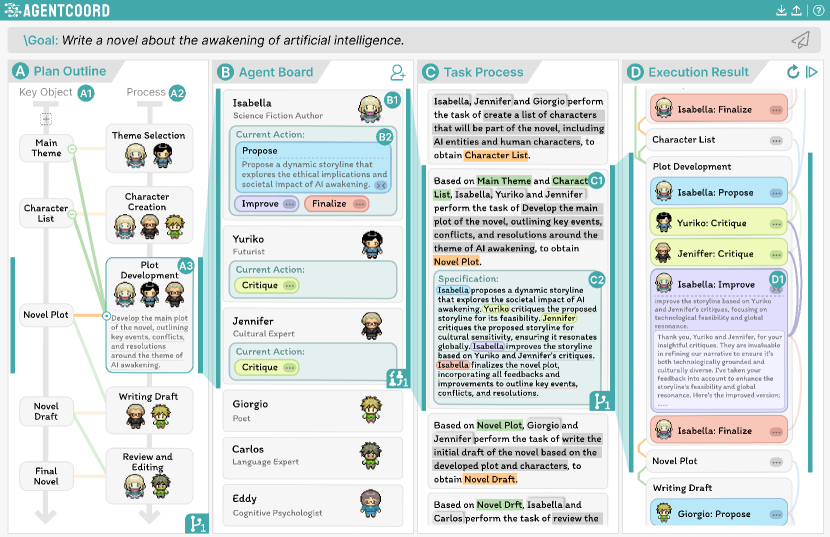
Experimental results
Research questions
- RQ1How can a structured representation regularize natural-language coordination strategies for LLM-based multi-agent collaboration?
- RQ2Can a three-stage generation method reliably convert user goals into executable coordination plans?
- RQ3Do interactive visual tools improve the exploration and comparison of alternative coordination strategies for non-expert users?
- RQ4Does AgentCoord facilitate effective design and understanding of coordination strategies as evidenced by user studies?
Key findings
- A visual exploration framework effectively aids general users in designing coordination strategies for LLM-based multi-agent collaboration.
- AgentCoord provides an open-source system and interaction set to facilitate exploration and refinement of plans, assignments, and task processes.
- The three-stage generation process (Plan Outline, Agent Assignment, Task Process) yields executable coordination strategies aligned with user goals.
- A formal user study with 12 participants demonstrates feasibility and potential democratization of agent coordination.
- The project repository and visual design choices support coherent linkage between strategy design and execution results.
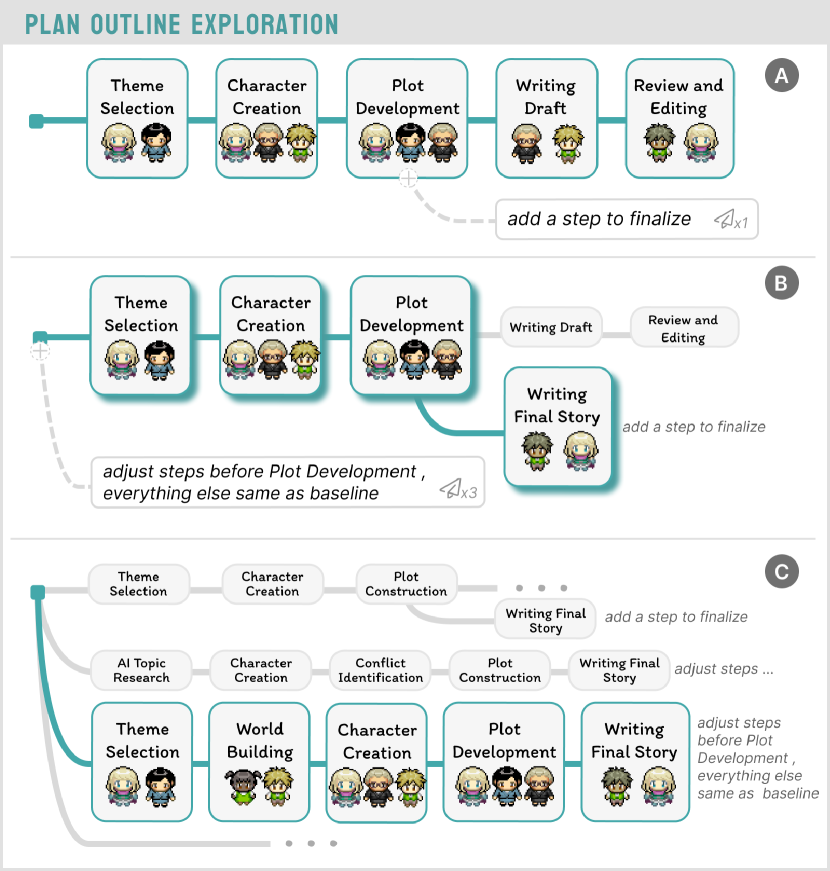
Read this paper
Open the full text in the Nubint reader and ask about any passage as you read.
Read this paper on NubintThis review was generated by AI from the original paper. Please check the paper before citing it.