
[Paper Review] Agile Requirement Change Management Model for Global Software Development
This paper proposes the Agile Requirement Change Management for Global Software Development (ARCM-GSD) model, a comprehensive framework integrating traceability, categorization, prioritization, and effort estimation into agile RCM for distributed teams. Validated by experts, it enhances change management effectiveness in global agile projects by improving transparency, stakeholder communication, and tool integration.
We propose a noble, comprehensive and robust agile requirements change management (ARCM) model that addresses the limitations of existing models and is tailored for agile software development in the global software development paradigm. To achieve this goal, we conducted an exhaustive literature review and an empirical study with RCM industry experts. Our study evaluated the effectiveness of the proposed RCM model in a real-world setting and identifies any limitations or areas for improvement. The results of our study provide valuable insights into how the proposed RCM model can be applied in agile global software development environments to improve software development practices and optimize project success rates.
Motivation & Objective
- Address the lack of comprehensive, agile-specific RCM models tailored for global software development (GSD) environments.
- Overcome limitations in existing RCM models, such as missing change verification, stakeholder notification, and traceability.
- Integrate agile principles—iterative development, stakeholder feedback, and adaptability—into a structured RCM process for distributed teams.
- Enhance industrial usability by defining roles, activities, and artifacts for each phase of the RCM lifecycle.
- Improve project outcomes through systematic change management, including effort estimation and backlog tracking.
Proposed method
- Conducted an exhaustive literature review to identify gaps in existing RCM models, particularly in GSD and agile contexts.
- Performed an empirical study with RCM industry experts to validate and refine the proposed model.
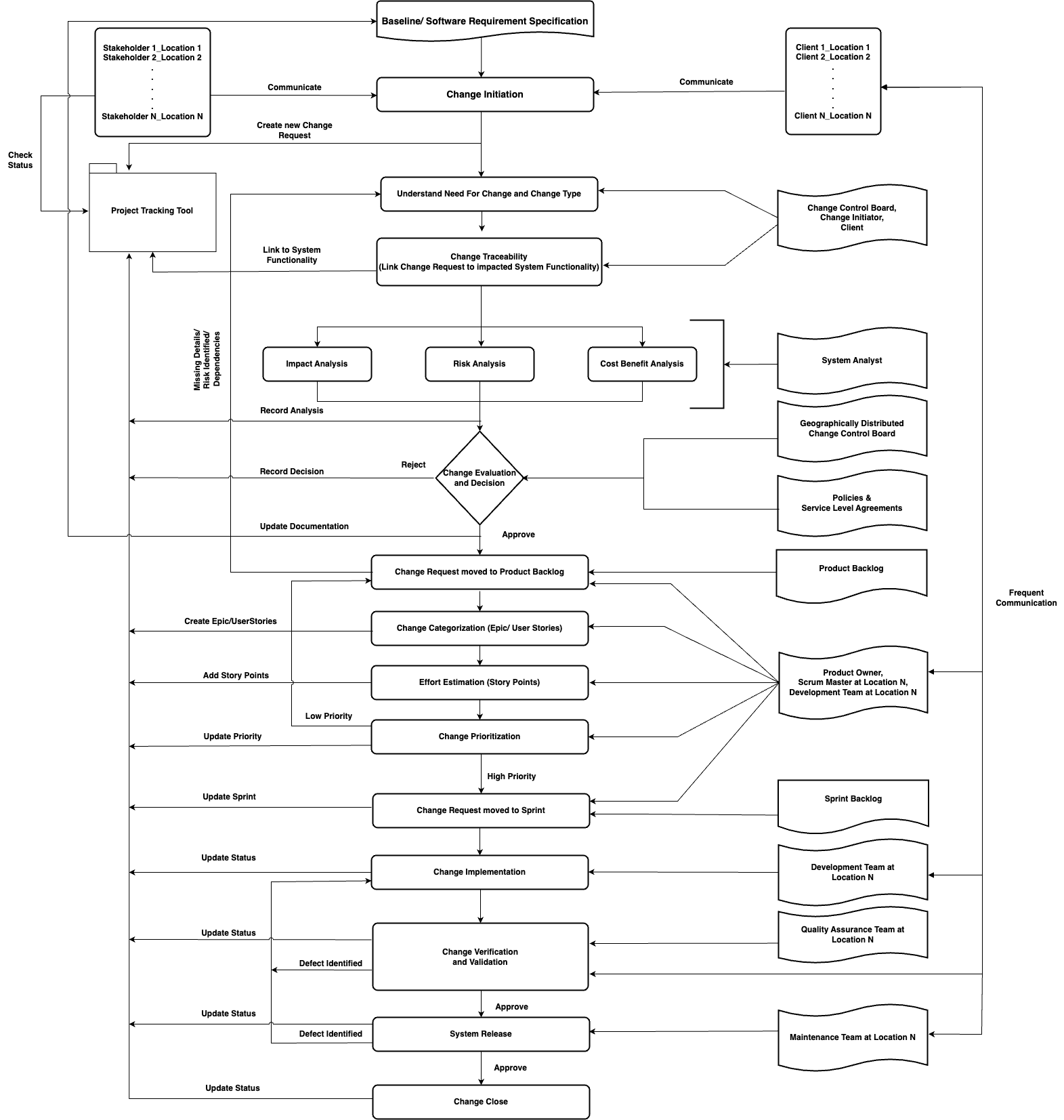
- Designed the ARCM-GSD model with nine distinct phases: Change Initiation, Change Categorization, Change Prioritization, Effort Estimation, Change Evaluation, Change Implementation, Change Verification and Validation, Requirements Backlog Management, and Change Traceability.
- Integrated project tracking tools to monitor change status and ensure real-time visibility across distributed teams.
- Emphasized stakeholder communication and artifact management at each phase to improve transparency and accountability.
- Incorporated traceability as a core phase to systematically track requirement changes across the project lifecycle, a feature missing in prior models.
Experimental results
Research questions
- RQ1How can an agile RCM model be effectively adapted to the unique challenges of global software development, such as time zone differences, cultural diversity, and communication barriers?
- RQ2What critical RCM phases are missing in existing models that hinder effective change management in agile GSD environments?
- RQ3To what extent does the proposed ARCM-GSD model improve comprehensibility, implementability, and coverage of essential RCM activities compared to existing models?
- RQ4How does the integration of traceability, categorization, prioritization, and effort estimation enhance the overall effectiveness of RCM in agile global projects?
- RQ5What are the limitations of the ARCM-GSD model in real-world deployment, and how can they be addressed in future work?
Key findings
- The ARCM-GSD model comprehensively addresses 100% of essential RCM activities, including traceability, categorization, prioritization, and effort estimation—phases omitted in prior models.
- Expert assessment confirmed the model’s comprehensibility, ease of implementation, and strong alignment with agile methodologies and GSD contexts.
- The model outperforms existing RCM frameworks by explicitly incorporating stakeholder communication, artifact management, and integration with project tracking tools.
- The inclusion of change traceability enables systematic tracking of requirements across the development lifecycle, addressing a key challenge identified in prior research.
- The model demonstrates superior coverage of RCM phases compared to nine existing models, as validated through a detailed comparative analysis in Table 5.
- Despite strong expert validation, the model lacks empirical validation in real-world settings, highlighting a need for future field testing and scalability assessment.
Read this paper
Open the full text in the Nubint reader and ask about any passage as you read.
Read this paper on NubintThis review was generated by AI from the original paper. Please check the paper before citing it.