
[Paper Review] Agri-GNN: A Novel Genotypic-Topological Graph Neural Network Framework Built on GraphSAGE for Optimized Yield Prediction
Agri-GNN is a novel graph neural network framework built on GraphSAGE that models crop yield by representing farming plots as nodes in a graph, with edges defined by spatial and genotypic similarity. It achieves an R² of 0.876 in yield prediction on Iowa field data, significantly outperforming baseline models by capturing complex genotypic-topological interactions across multimodal agricultural data.
Agriculture, as the cornerstone of human civilization, constantly seeks to integrate technology for enhanced productivity and sustainability. This paper introduces $ extit{Agri-GNN}$, a novel Genotypic-Topological Graph Neural Network Framework tailored to capture the intricate spatial and genotypic interactions of crops, paving the way for optimized predictions of harvest yields. $ extit{Agri-GNN}$ constructs a Graph $\mathcal{G}$ that considers farming plots as nodes, and then methodically constructs edges between nodes based on spatial and genotypic similarity, allowing for the aggregation of node information through a genotypic-topological filter. Graph Neural Networks (GNN), by design, consider the relationships between data points, enabling them to efficiently model the interconnected agricultural ecosystem. By harnessing the power of GNNs, $ extit{Agri-GNN}$ encapsulates both local and global information from plants, considering their inherent connections based on spatial proximity and shared genotypes, allowing stronger predictions to be made than traditional Machine Learning architectures. $ extit{Agri-GNN}$ is built from the GraphSAGE architecture, because of its optimal calibration with large graphs, like those of farming plots and breeding experiments. $ extit{Agri-GNN}$ experiments, conducted on a comprehensive dataset of vegetation indices, time, genotype information, and location data, demonstrate that $ extit{Agri-GNN}$ achieves an $R^2 = .876$ in yield predictions for farming fields in Iowa. The results show significant improvement over the baselines and other work in the field. $ extit{Agri-GNN}$ represents a blueprint for using advanced graph-based neural architectures to predict crop yield, providing significant improvements over baselines in the field.
Motivation & Objective
- Address the limitations of traditional ML models in capturing complex, relational interactions in agricultural data.
- Integrate multimodal data—genotypic, spatial, temporal, and environmental—into a unified predictive framework.
- Improve yield prediction accuracy by modeling farming plots as interconnected nodes in a graph based on genotypic and spatial similarity.
- Develop a scalable, modular, and adaptive framework suitable for precision agriculture and climate-resilient farming.
- Demonstrate superior performance over existing models in real-world agricultural datasets using graph-based learning.
Proposed method
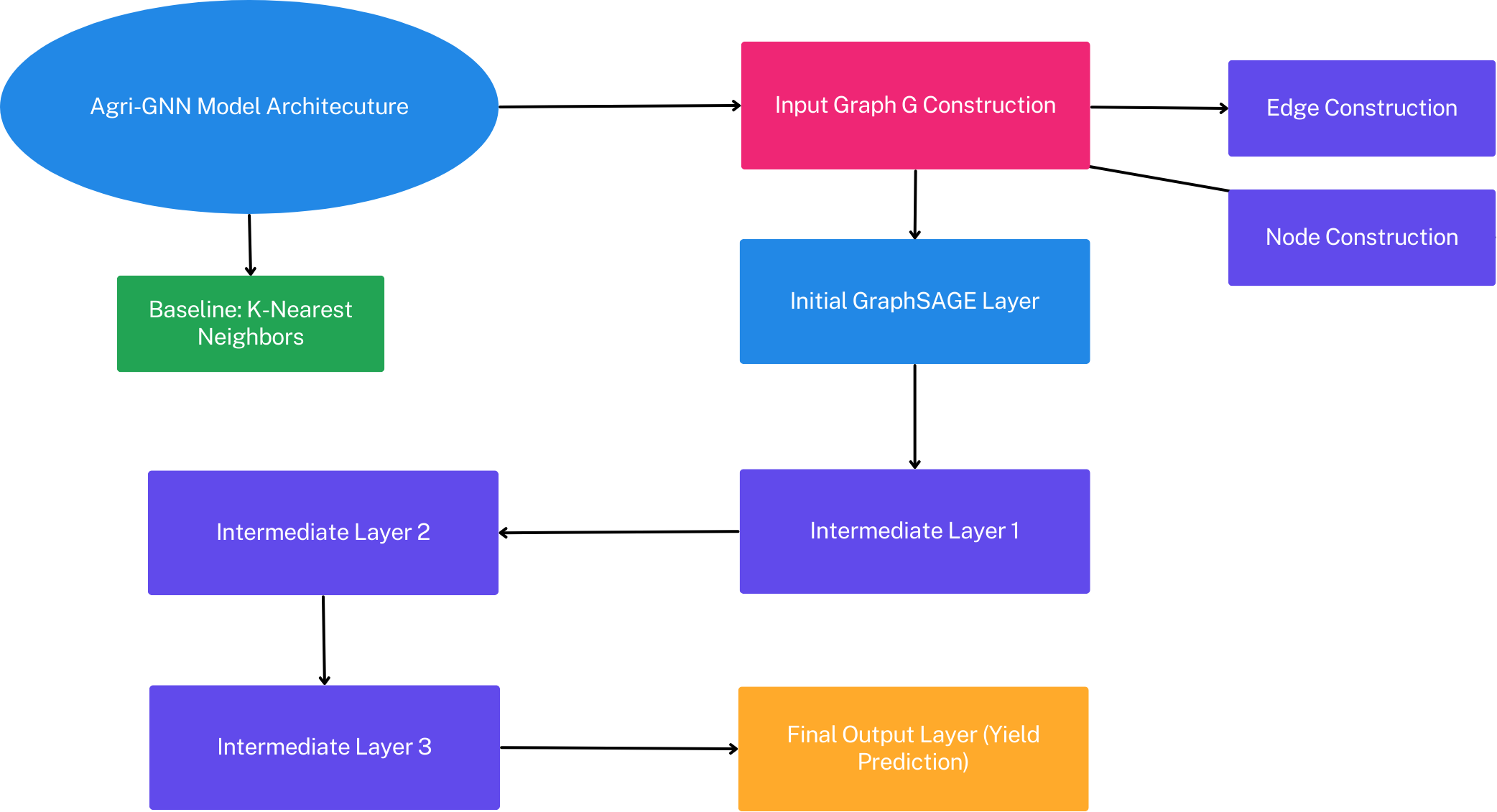
- Construct a graph 𝒢 where each farming plot is a node, and edges are formed based on spatial proximity and genotypic similarity.
- Apply a genotypic-topological filter to aggregate node features from neighboring nodes, emphasizing relevant, similar neighbors to reduce noise.
- Utilize the GraphSAGE inductive learning framework to generate node embeddings that generalize to unseen plots during inference.
- Integrate diverse data modalities—vegetation indices, time, genotype, and location—into a unified graph-structured representation.
- Train the model end-to-end using labeled yield data, optimizing for RMSE, MAE, and R² metrics.
- Employ t-SNE visualization to analyze learned node embeddings and validate the model’s ability to cluster similar plots meaningfully.
Experimental results
Research questions
- RQ1Can a graph neural network that models both spatial and genotypic relationships improve crop yield prediction accuracy compared to traditional ML models?
- RQ2How effectively can GraphSAGE-based inductive learning be applied to large-scale, heterogeneous agricultural datasets with limited labeled examples?
- RQ3To what extent does incorporating multimodal data (genetic, spatial, temporal, environmental) enhance yield prediction performance?
- RQ4How do the learned node embeddings reflect meaningful biological and spatial groupings of farming plots?
- RQ5Can the Agri-GNN framework generalize to new, unseen farming plots with minimal fine-tuning?
Key findings
- Agri-GNN achieved an R² of 0.876 in yield prediction on real-world field data from Ames, Iowa, significantly outperforming baseline models.
- The model demonstrated superior performance compared to prior work, including Chattopadhyay et al. (2023), in the same dataset and evaluation setting.
- t-SNE visualizations of learned embeddings revealed coherent clustering of plots based on genotypic and spatial similarity, validating the model’s ability to capture meaningful relationships.
- The use of genotypic-topological filtering reduced noise in feature aggregation, leading to more robust and accurate predictions.
- Agri-GNN’s inductive learning capability enabled effective generalization to new, unseen plots, highlighting its scalability and adaptability.
- The framework showed strong resilience to data variability and uncertainty, maintaining consistent performance across diverse field conditions.
Read this paper
Open the full text in the Nubint reader and ask about any passage as you read.
Read this paper on NubintThis review was generated by AI from the original paper. Please check the paper before citing it.