
[Paper Review] AI-Aristotle: A Physics-Informed framework for Systems Biology Gray-Box Identification
AI-Aristotle is a physics-informed framework that integrates eXtreme Theory of Functional Connections (X-TFC), Physics-Informed Neural Networks (PINNs), and symbolic regression (SR) to enable accurate parameter estimation and gray-box identification in systems biology. It successfully discovers missing differential equation terms in pharmacokinetics and ultradian endocrine models with high accuracy, even from limited data, and produces interpretable symbolic expressions via robust SR tools like PySR.
Discovering mathematical equations that govern physical and biological systems from observed data is a fundamental challenge in scientific research. We present a new physics-informed framework for parameter estimation and missing physics identification (gray-box) in the field of Systems Biology. The proposed framework -- named AI-Aristotle -- combines eXtreme Theory of Functional Connections (X-TFC) domain-decomposition and Physics-Informed Neural Networks (PINNs) with symbolic regression (SR) techniques for parameter discovery and gray-box identification. We test the accuracy, speed, flexibility and robustness of AI-Aristotle based on two benchmark problems in Systems Biology: a pharmacokinetics drug absorption model, and an ultradian endocrine model for glucose-insulin interactions. We compare the two machine learning methods (X-TFC and PINNs), and moreover, we employ two different symbolic regression techniques to cross-verify our results. While the current work focuses on the performance of AI-Aristotle based on synthetic data, it can equally handle noisy experimental data and can even be used for black-box identification in just a few minutes on a laptop. More broadly, our work provides insights into the accuracy, cost, scalability, and robustness of integrating neural networks with symbolic regressors, offering a comprehensive guide for researchers tackling gray-box identification challenges in complex dynamical systems in biomedicine and beyond.
Motivation & Objective
- To address the challenge of identifying unknown or missing terms in differential equations governing biological systems using data-driven and physics-informed methods.
- To develop a unified framework that integrates neural networks with symbolic regression for improved interpretability and model fidelity in systems biology.
- To evaluate and compare the performance of X-TFC and PINNs in parameter estimation and gray-box identification under varying data conditions.
- To assess the robustness and efficiency of symbolic regression tools (PySR and gplearn) in distilling interpretable mathematical expressions from learned neural surrogates.
- To provide a scalable, accurate, and computationally efficient solution for gray-box identification applicable to biomedical and dynamical systems.
Proposed method
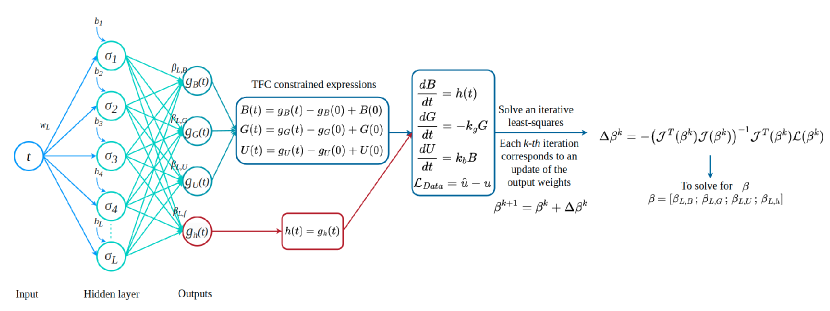
- The framework employs X-TFC and PINNs as neural network solvers to estimate unknown parameters and missing terms in differential equations, leveraging domain decomposition for improved accuracy.
- It uses physics-informed constraints to embed known differential equation structures into the neural network training process, ensuring physical consistency.
- Symbolic regression via PySR and gplearn is applied to distill interpretable, closed-form mathematical expressions from trained neural network surrogates.
- The method combines least-squares optimization (X-TFC) and back-propagation (PINNs) for solving the differential equations, with performance evaluated across data sparsity levels.
- Two benchmark systems—pharmacokinetics and ultradian glucose-insulin dynamics—are used to validate the framework’s accuracy, robustness, and scalability.
- Cross-verification is performed using two SR tools to ensure consistency and reliability of the discovered symbolic expressions.
Experimental results
Research questions
- RQ1How does the performance of X-TFC compare to PINNs in parameter estimation and gray-box identification when data is sparse or abundant?
- RQ2Can symbolic regression tools like PySR and gplearn reliably recover interpretable mathematical expressions from neural network surrogates in systems biology models?
- RQ3What is the impact of dataset size on the accuracy and computational efficiency of X-TFC and PINNs in gray-box identification?
- RQ4How robust are the discovered symbolic expressions across different SR implementations and model complexities?
- RQ5To what extent can the AI-Aristotle framework handle noisy or experimental data in real-world biomedical applications?
Key findings
- X-TFC outperforms PINNs in accuracy and computational efficiency when sufficient data is available, due to its use of least-squares optimization instead of back-propagation.
- PINNs achieve higher accuracy than X-TFC on small datasets, demonstrating superior performance in data-scarce scenarios.
- PySR consistently outperforms gplearn in both speed and robustness, requiring less hyperparameter tuning and completing symbolic regression in ~10 minutes on CPU versus up to one hour for gplearn.
- The symbolic regression process successfully recovered nearly identical expressions for both the pharmacokinetics and ultradian endocrine models using both PySR and gplearn, confirming result consistency.
- The framework achieved high accuracy in identifying missing terms in differential equations, with symbolic expressions closely matching ground-truth functional forms.
- The AI-Aristotle framework can handle noisy experimental data and perform black-box identification in just a few minutes on a standard laptop, demonstrating practical scalability.
Better researchstarts right now
From reading papers to final review, dramatically reduce your research time.
No credit card · Free plan available
This review was created by AI and reviewed by human editors.