
[Paper Review] AI for Low-Code for AI
This paper introduces LowCoder, a novel low-code platform that combines visual programming (LowCoder VP) and an AI-powered natural language interface (LowCoder NL) to help developers build machine learning pipelines with minimal coding. The system significantly improves operator discoverability and pipeline composition, with 75% of tasks benefiting from AI-driven discovery versus only 32.5% using keyword search, and enables 85% task success and 72.5% iterative refinement in user studies.
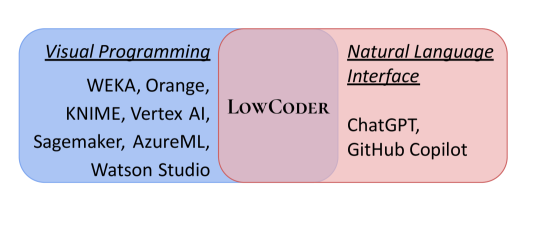
Low-code programming allows citizen developers to create programs with minimal coding effort, typically via visual (e.g. drag-and-drop) interfaces. In parallel, recent AI-powered tools such as Copilot and ChatGPT generate programs from natural language instructions. We argue that these modalities are complementary: tools like ChatGPT greatly reduce the need to memorize large APIs but still require their users to read (and modify) programs, whereas visual tools abstract away most or all programming but struggle to provide easy access to large APIs. At their intersection, we propose LowCoder, the first low-code tool for developing AI pipelines that supports both a visual programming interface (LowCoder_VP) and an AI-powered natural language interface (LowCoder_NL). We leverage this tool to provide some of the first insights into whether and how these two modalities help programmers by conducting a user study. We task 20 developers with varying levels of AI expertise with implementing four ML pipelines using LowCoder, replacing the LowCoder_NL component with a simple keyword search in half the tasks. Overall, we find that LowCoder is especially useful for (i) Discoverability: using LowCoder_NL, participants discovered new operators in 75% of the tasks, compared to just 32.5% and 27.5% using web search or scrolling through options respectively in the keyword-search condition, and (ii) Iterative Composition: 82.5% of tasks were successfully completed and many initial pipelines were further successfully improved. Qualitative analysis shows that AI helps users discover how to implement constructs when they know what to do, but still fails to support novices when they lack clarity on what they want to accomplish. Overall, our work highlights the benefits of combining the power of AI with low-code programming.
Motivation & Objective
- To address the dual challenges of syntactic complexity in AI libraries and limited discoverability in visual low-code tools for machine learning pipelines.
- To investigate how combining visual programming with AI-powered natural language interfaces improves developer productivity and pipeline composition.
- To evaluate the effectiveness of AI in aiding discoverability and implementation when users know what they want but lack coding expertise.
- To identify limitations of current AI assistants in supporting novice users who lack clarity on their goals.
- To explore design improvements such as contextual templates and data-aware suggestions for future low-code ML tools.
Proposed method
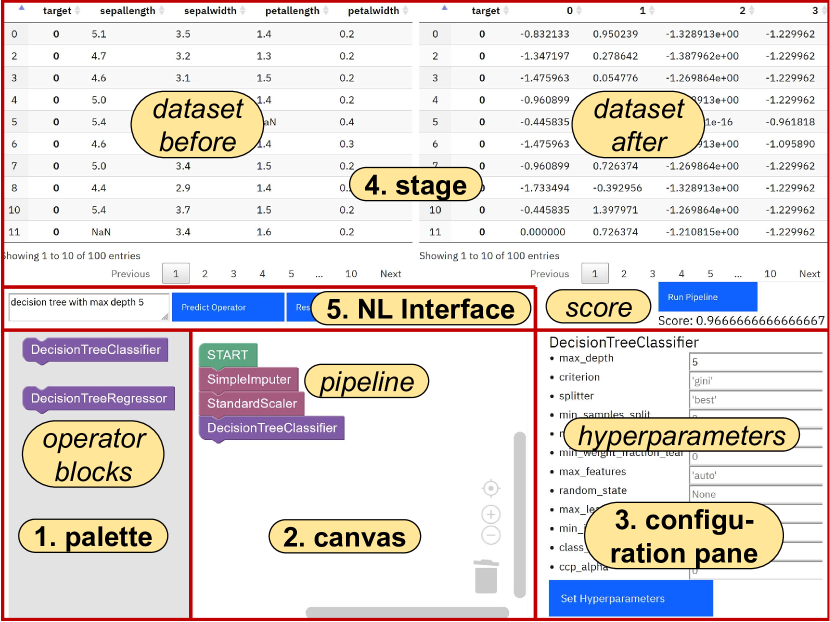
- LowCoder integrates a visual programming interface (LowCoder VP) based on Blockly, enabling users to compose pipelines via drag-and-drop blocks representing AI operators.
- It includes a natural language interface (LowCoder NL) that uses a fine-tuned CodeT5 model to predict relevant ML operators and hyperparameters from natural language prompts.
- A novel task formulation was developed to handle partial hyperparameter mentions in user queries, improving model performance on real-world low-code use cases.
- The system was evaluated through a within-subjects user study with 20 participants of varying AI expertise, comparing LowCoder NL against keyword search and web search for operator discovery.
- The study assessed task success, iteration, and qualitative insights into user challenges, particularly around conceptual design barriers in ML development.
- Data from the study, including anonymized qualitative and quantitative results, are publicly available via Zenodo.
Experimental results
Research questions
- RQ1How does combining visual programming with an AI-powered natural language interface improve discoverability of AI operators in low-code ML development?
- RQ2To what extent does LowCoder NL support both novice and experienced developers in composing and refining machine learning pipelines?
- RQ3In what ways does PBNL assist users when they know what they want but struggle with implementation, and where does it fail?
- RQ4How do design barriers—especially uncertainty and lack of conceptual clarity—affect novice users in machine learning pipeline development?
- RQ5What role can contextual suggestions, templates, or data-aware recommendations play in guiding users toward effective pipeline design?
Key findings
- LowCoder NL significantly improved operator discoverability: 75% of tasks discovered new operators using AI, compared to 32.5% with keyword search and 27.5% with scrolling through options.
- 85% of tasks were successfully completed when using LowCoder NL, demonstrating strong support for pipeline composition across user expertise levels.
- 72.5% of tasks involved iterative refinement, showing that users effectively improved their initial pipelines with the help of the AI interface.
- Despite AI assistance, novices struggled when they lacked clarity on their goals, indicating that PBNL alone cannot overcome conceptual design barriers in ML development.
- The fine-tuned CodeT5 model for LowCoder NL generalized well to real user queries, even when trained on a different dataset, indicating robustness in practical use.
- Qualitative feedback suggests that contextual suggestions—such as templates, data visualization, and feature-aware recommendations—could further enhance usability for citizen developers.
Read this paper
Open the full text in the Nubint reader and ask about any passage as you read.
Read this paper on NubintThis review was generated by AI from the original paper. Please check the paper before citing it.