
[Paper Review] AI for Science: An Emerging Agenda
This report summarises Dagstuhl Seminar 22382 on Machine Learning for Science, and outlines a roadmap to integrate data-driven and mechanistic modelling, plus community-building for AI-enabled scientific discovery.
This report documents the programme and the outcomes of Dagstuhl Seminar 22382 "Machine Learning for Science: Bridging Data-Driven and Mechanistic Modelling". Today's scientific challenges are characterised by complexity. Interconnected natural, technological, and human systems are influenced by forces acting across time- and spatial-scales, resulting in complex interactions and emergent behaviours. Understanding these phenomena -- and leveraging scientific advances to deliver innovative solutions to improve society's health, wealth, and well-being -- requires new ways of analysing complex systems. The transformative potential of AI stems from its widespread applicability across disciplines, and will only be achieved through integration across research domains. AI for science is a rendezvous point. It brings together expertise from $\mathrm{AI}$ and application domains; combines modelling knowledge with engineering know-how; and relies on collaboration across disciplines and between humans and machines. Alongside technical advances, the next wave of progress in the field will come from building a community of machine learning researchers, domain experts, citizen scientists, and engineers working together to design and deploy effective AI tools. This report summarises the discussions from the seminar and provides a roadmap to suggest how different communities can collaborate to deliver a new wave of progress in AI and its application for scientific discovery.
Motivation & Objective
- Motivate the need to address scientific complexity through new AI-enabled methods.
- Propose a roadmap for AI for science that crosses disciplines and domains.
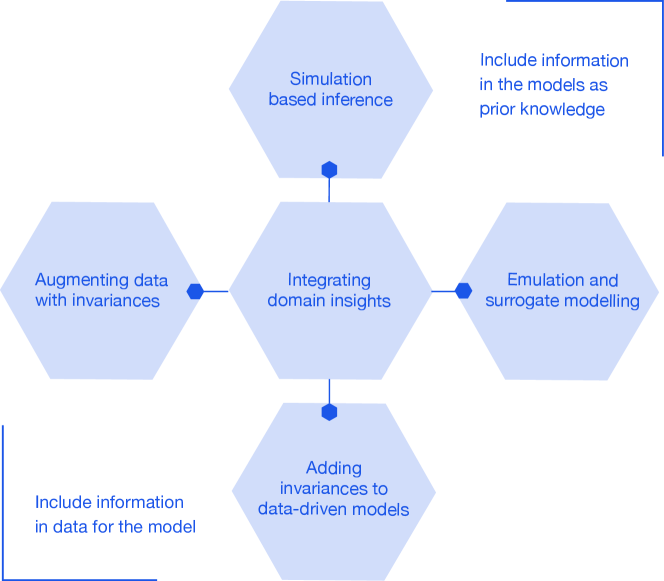
- Highlight core themes such as simulation, causality, and encoding domain knowledge.
- Advocate for community-building, interoperable toolkits, and best practices in software and data engineering.
Proposed method
- Synthesize discussions from the Dagstuhl seminar to articulate a research agenda.
- Identify core thematic areas to advance AI for science: simulation, causality, and domain knowledge encoding.
- Propose actionable steps and an enabling environment for deploying AI tools in scientific practice.
- Advocate for user-friendly toolkits and standardized software/data engineering practices.
- Recommend interdisciplinary collaborations among ML researchers, domain experts, and engineers.

Experimental results
Research questions
- RQ1How can AI methods be designed to support sophisticated simulations and data-informed interrogations of complex systems?
- RQ2How can data-driven models be effectively integrated with mechanistic knowledge to uncover causal relationships in science?
- RQ3What strategies and infrastructures are needed to ensure safe, robust, and domain-aligned deployment of AI in scientific workflows?
- RQ4What organizational and community-building actions are required to accelerate AI for science across disciplines?
- RQ5What role do toolkits, benchmarks, and governance play in enabling widespread adoption of AI for scientific discovery?
Key findings
- AI offers transformative potential across natural, physical, social, medical, and engineering sciences by enabling insights from diverse data sources and scales.
- Progress depends on developing hybrid models that combine physical laws with data-driven learning and on bridging data-driven and mechanistic modelling.
- Integration of AI into scientific practice requires domain knowledge encoding, human–AI interfaces, and mechanisms for knowledge sharing.
- Building a community of ML researchers, domain experts, citizen scientists, and engineers is crucial for designing and deploying effective AI tools.
- Actionable steps include creating user-friendly toolkits, adopting best practices in software/data engineering, and investing in interdisciplinary talent.
- The roadmap emphasizes cross-domain collaboration, evaluation of model reliability, and careful consideration of uncertainties and societal impacts.
Better researchstarts right now
From reading papers to final review, dramatically reduce your research time.
No credit card · Free plan available
This review was created by AI and reviewed by human editors.