
[Paper Review] AI in Thyroid Cancer Diagnosis: Techniques, Trends, and Future Directions
This paper reviews AI techniques—particularly deep learning and machine learning—for thyroid cancer diagnosis, proposing a novel classification of AI methods by algorithm type, purpose, and computing platform. It identifies key challenges like data quality and model interpretability, while highlighting emerging trends such as Explainable AI and edge computing to improve diagnostic accuracy and privacy in clinical settings.
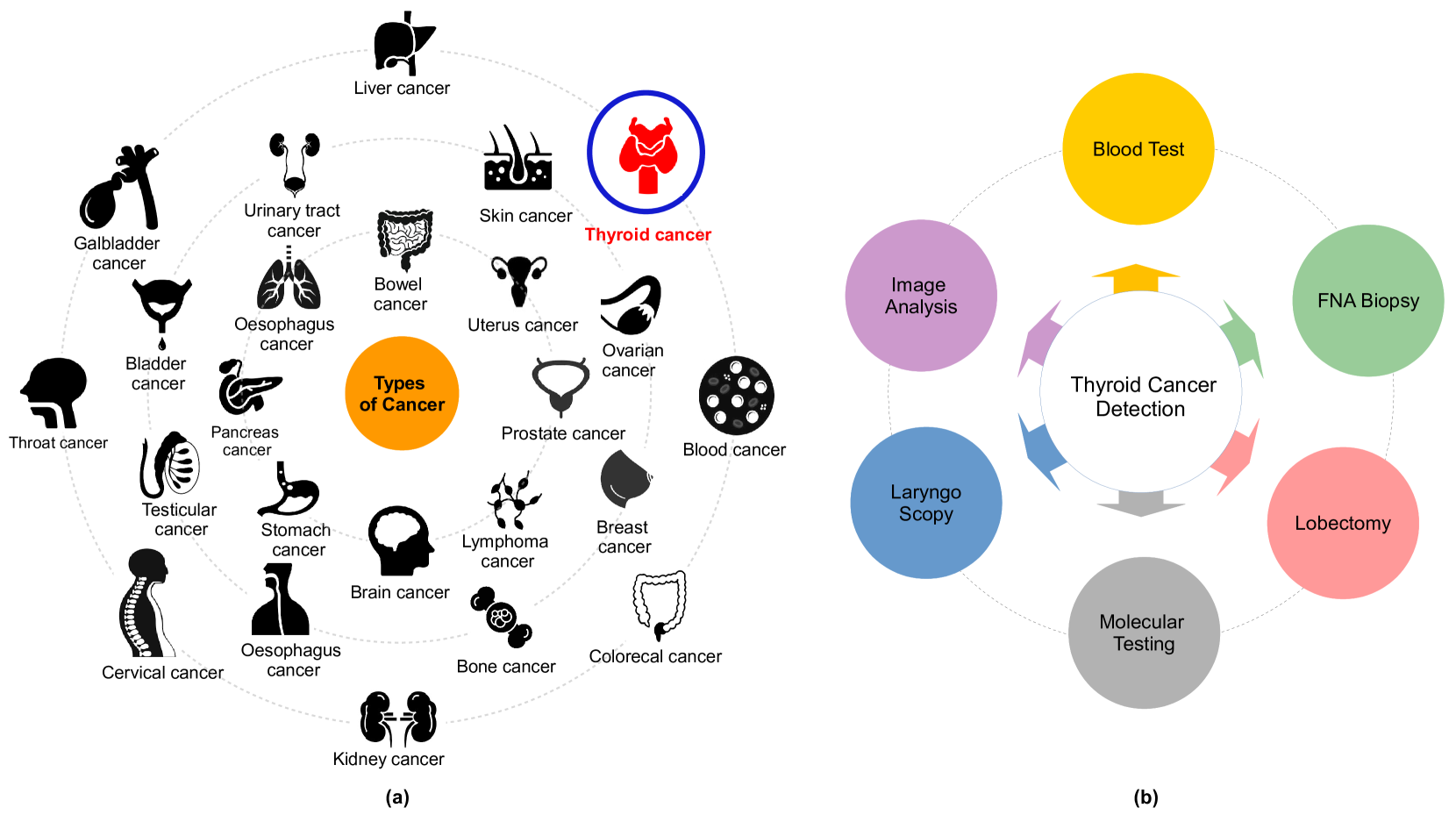
There has been a growing interest in creating intelligent diagnostic systems to assist medical professionals in analyzing and processing big data for the treatment of incurable diseases. One of the key challenges in this field is detecting thyroid cancer, where advancements have been made using machine learning (ML) and big data analytics to evaluate thyroid cancer prognosis and determine a patient's risk of malignancy. This review paper summarizes a large collection of articles related to artificial intelligence (AI)-based techniques used in the diagnosis of thyroid cancer. Accordingly, a new classification was introduced to classify these techniques based on the AI algorithms used, the purpose of the framework, and the computing platforms used. Additionally, this study compares existing thyroid cancer datasets based on their features. The focus of this study is on how AI-based tools can support the diagnosis and treatment of thyroid cancer, through supervised, unsupervised, or hybrid techniques. It also highlights the progress made and the unresolved challenges in this field. Finally, the future trends and areas of focus in this field are discussed.
Motivation & Objective
- To systematically review and classify AI-based techniques for thyroid cancer diagnosis based on algorithms, application purpose, and computing platforms.
- To evaluate existing thyroid cancer datasets in terms of features, size, and clinical relevance to identify gaps in data availability.
- To analyze the performance and limitations of supervised, unsupervised, and hybrid AI models in detecting thyroid nodules and classifying malignancy.
- To identify unresolved challenges such as lack of clean, standardized datasets and model interpretability in clinical deployment.
- To explore future research directions, including Explainable AI, federated learning, and edge computing, to enhance diagnostic accuracy and patient privacy.
Proposed method
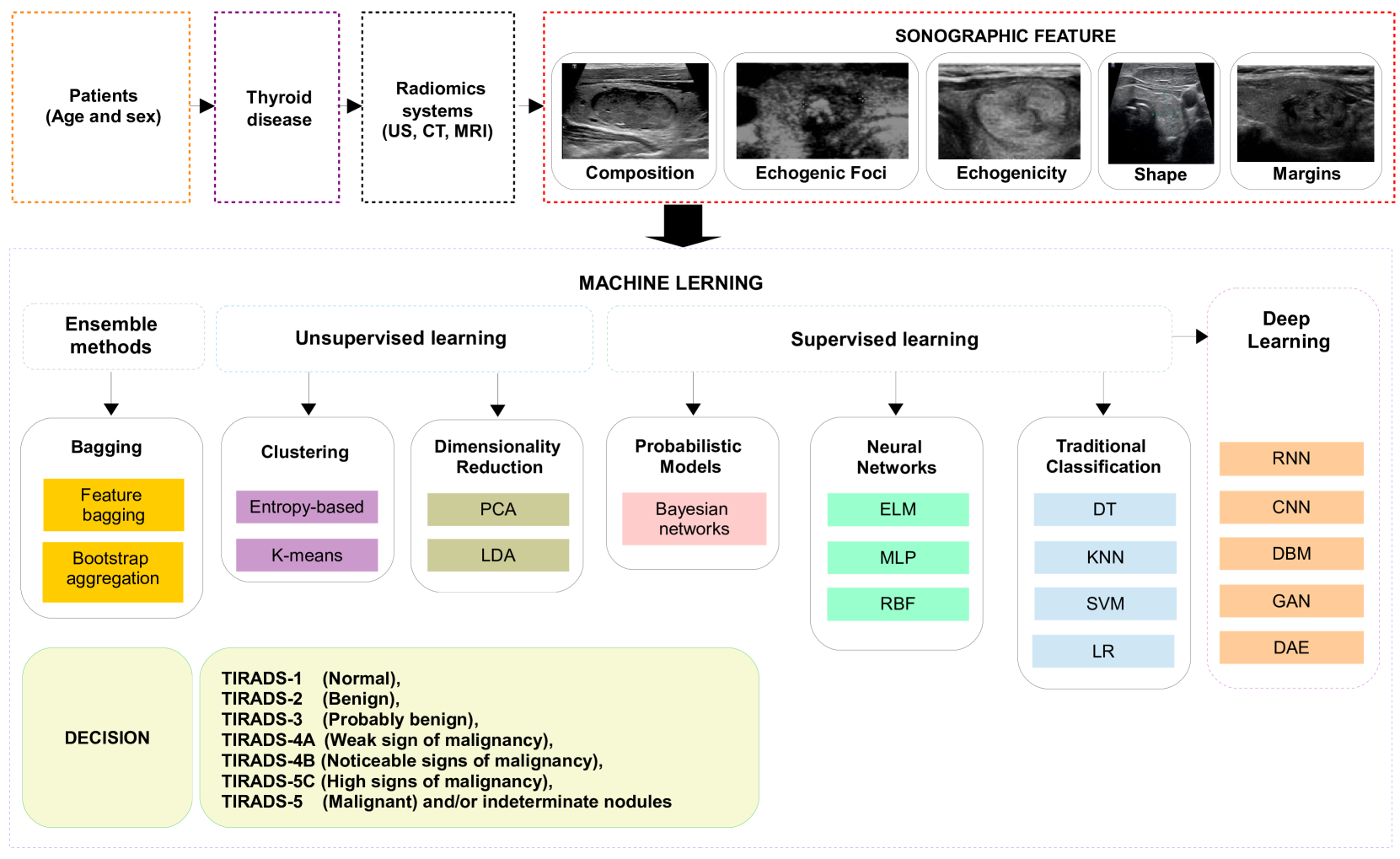
- Proposes a new multi-dimensional classification framework for AI techniques in thyroid cancer diagnosis, organized by AI algorithm type (e.g., CNN, SVM, XGBoost), purpose (e.g., classification, segmentation), and computing platform (e.g., cloud, edge, fog).
- Reviews and compares 15+ publicly available thyroid cancer datasets (e.g., TCD, TCGA, SEER, WBCD) based on features, sample size, imaging modality, and clinical annotations.
- Analyzes performance of supervised learning models (e.g., CNN, Random Forest, SVM) and unsupervised methods (e.g., clustering, autoencoders) for nodule classification and risk prediction.
- Evaluates emerging AI paradigms such as transfer learning, federated learning, and explainable AI (XAI) to improve model generalization and clinical trustworthiness.
- Integrates hybrid approaches combining traditional ML with deep learning (e.g., CNN + XGBoost) to enhance diagnostic accuracy and robustness.
- Discusses the role of advanced techniques like panoptic segmentation, generative adversarial networks (GANs) for data augmentation, and reinforcement learning for adaptive decision support.
Experimental results
Research questions
- RQ1How do different AI algorithms (e.g., CNN, SVM, XGBoost) compare in performance for classifying thyroid nodules as benign or malignant?
- RQ2What are the key limitations of current thyroid cancer datasets in terms of data quality, size, and feature diversity?
- RQ3How can Explainable AI (XAI) and federated learning improve model transparency and privacy in clinical deployment?
- RQ4What role do hybrid AI models (e.g., CNN + ensemble methods) play in enhancing diagnostic accuracy and robustness?
- RQ5How can emerging technologies like edge computing and panoptic segmentation advance real-time, accurate, and privacy-preserving thyroid cancer diagnosis?
Key findings
- Deep learning models, especially Convolutional Neural Networks (CNNs), demonstrate superior accuracy in classifying thyroid nodules compared to traditional machine learning methods.
- The lack of standardized, high-quality, and large-scale datasets remains a major bottleneck in training robust and generalizable AI models for thyroid cancer diagnosis.
- Explainable AI (XAI) and federated learning are emerging as critical enablers for improving model interpretability and preserving patient data privacy in clinical applications.
- Hybrid models combining CNNs with ensemble techniques (e.g., XGBoost, Random Forest) show improved performance by leveraging both feature extraction and decision-level fusion.
- Panoptic segmentation and 3D-based deep learning approaches are promising for accurate volumetric nodule detection and characterization, though limited by the scarcity of 3D annotated datasets.
- Generative AI models such as GANs can enhance data augmentation, particularly for rare thyroid cancer subtypes, improving model generalization and reducing overfitting.
Read this paper
Open the full text in the Nubint reader and ask about any passage as you read.
Read this paper on NubintThis review was generated by AI from the original paper. Please check the paper before citing it.