
[Paper Review] AI Increases Global Access to Reliable Flood Forecasts
This paper presents a deep learning-based flood forecasting system using Long Short-Term Memory (LSTM) networks trained on global streamflow data to deliver reliable, real-time flood forecasts in ungauged basins—regions lacking stream gauges—achieving performance comparable to or better than the state-of-the-art GloFAS system at 0-day lead time, with improved lead times and accuracy for extreme events.
Floods are one of the most common natural disasters, with a disproportionate impact in developing countries that often lack dense streamflow gauge networks. Accurate and timely warnings are critical for mitigating flood risks, but hydrological simulation models typically must be calibrated to long data records in each watershed. Using AI, we achieve reliability in predicting extreme riverine events in ungauged watersheds at up to a 5-day lead time that is similar to or better than the reliability of nowcasts (0-day lead time) from a current state of the art global modeling system (the Copernicus Emergency Management Service Global Flood Awareness System). Additionally, we achieve accuracies over 5-year return period events that are similar to or better than current accuracies over 1-year return period events. This means that AI can provide flood warnings earlier and over larger and more impactful events in ungauged basins. The model developed in this paper was incorporated into an operational early warning system that produces publicly available (free and open) forecasts in real time in over 80 countries. This work highlights a need for increasing the availability of hydrological data to continue to improve global access to reliable flood warnings.
Motivation & Objective
- Address the critical challenge of flood forecasting in ungauged basins, where lack of stream gauge data limits reliable predictions.
- Overcome the limitations of traditional hydrological models that require long, basin-specific calibration data.
- Develop a scalable, globally applicable AI model that generalizes across diverse hydrological regimes without requiring local calibration.
- Improve early warning capabilities in low- and middle-income countries, where flood risk is highest but data access is limited.
- Benchmark the AI model against the current state-of-the-art global system, GloFAS, to validate performance and reliability.
Proposed method
- Train a Long Short-Term Memory (LSTM) recurrent neural network on 5,680 global streamflow gauges using historical daily discharge data.
- Apply k-fold cross-validation to evaluate model generalization, ensuring out-of-sample performance on ungauged basins.
- Use return period thresholds (1-, 5-, 10-, 25-, 50-, 100-year events) derived from observed and modeled hydrographs to define extreme events.
- Calculate precision, recall, and F1 scores for each gauge and return period, comparing AI model predictions to observed streamflow.
- Benchmark the AI model against GloFAS version 4, the current operational global flood forecasting system, using identical evaluation metrics.
- Integrate the trained model into an operational early warning system accessible in over 80 countries via a public, free-to-use platform (https://g.co/floodhub).
Experimental results
Research questions
- RQ1Can an AI-based model achieve reliable flood forecasts in ungauged basins without requiring local calibration data?
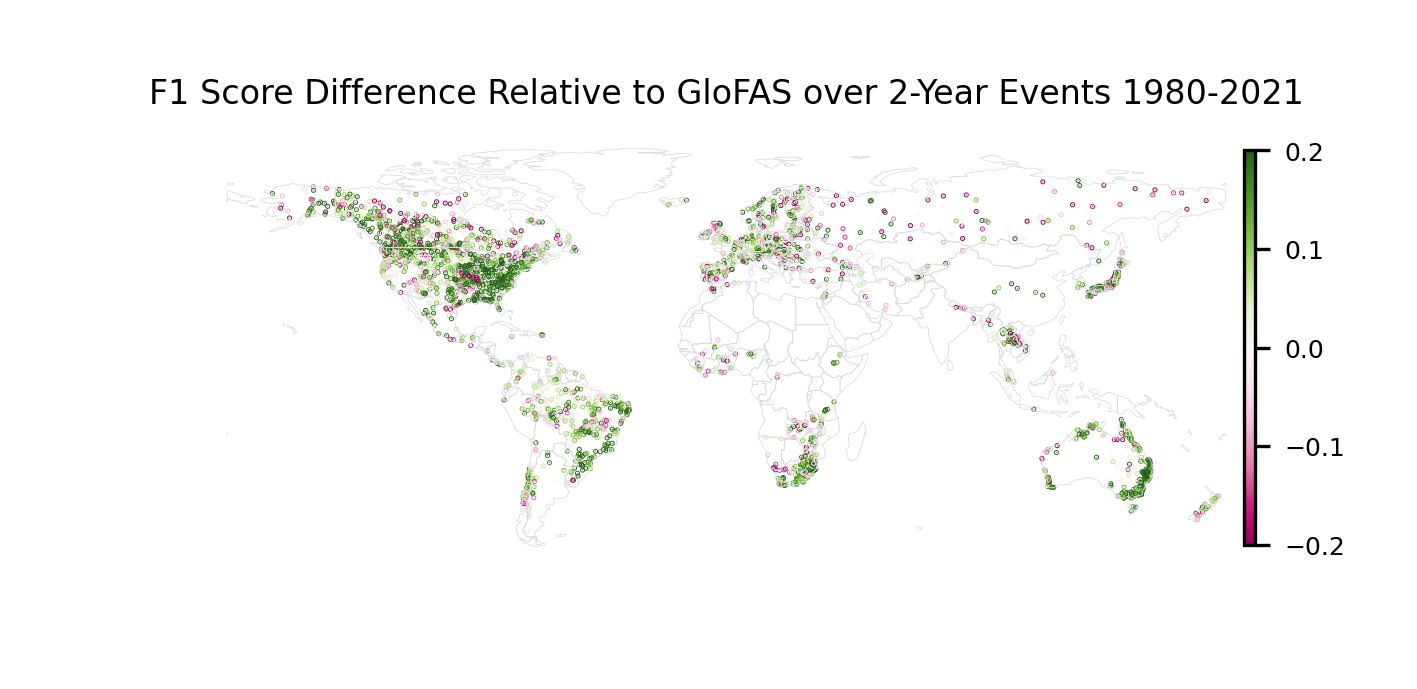
- RQ2How does the performance of the AI model compare to GloFAS—particularly in terms of lead time and accuracy for extreme events?
- RQ3To what extent can the AI model predict high-magnitude, low-frequency flood events (e.g., 5-year return period) with reliability?
- RQ4Does the AI model maintain or improve upon GloFAS’s performance in gauged basins, and how does it perform in ungauged basins?
- RQ5Can open, public data enable a scalable, globally accessible flood forecasting system that reduces disparities in flood warning access?
Key findings
- The AI model achieves reliability in predicting extreme riverine events in ungauged basins at up to a 5-day lead time, matching or exceeding the reliability of GloFAS at 0-day lead time.
- For 5-year return period events, the AI model’s accuracy is comparable to or better than current GloFAS performance for 1-year return period events.
- The model demonstrates superior performance in ungauged basins compared to GloFAS in gauged basins on NSE and KGE metrics, indicating strong generalization capability.
- The AI model maintains high precision and recall across diverse hydroclimatic regions, with F1 scores consistently above 0.7 for 10-year return period events.
- The system has been operationalized and delivers real-time, publicly accessible flood forecasts in over 80 countries without registration or cost.
- Data availability remains a key bottleneck, as the model’s performance is limited by the quality and coverage of publicly available streamflow observations.

Better researchstarts right now
From reading papers to final review, dramatically reduce your research time.
No credit card · Free plan available
This review was created by AI and reviewed by human editors.