
[Paper Review] AI-Powered Augmented Reality for Satellite Assembly, Integration and Test
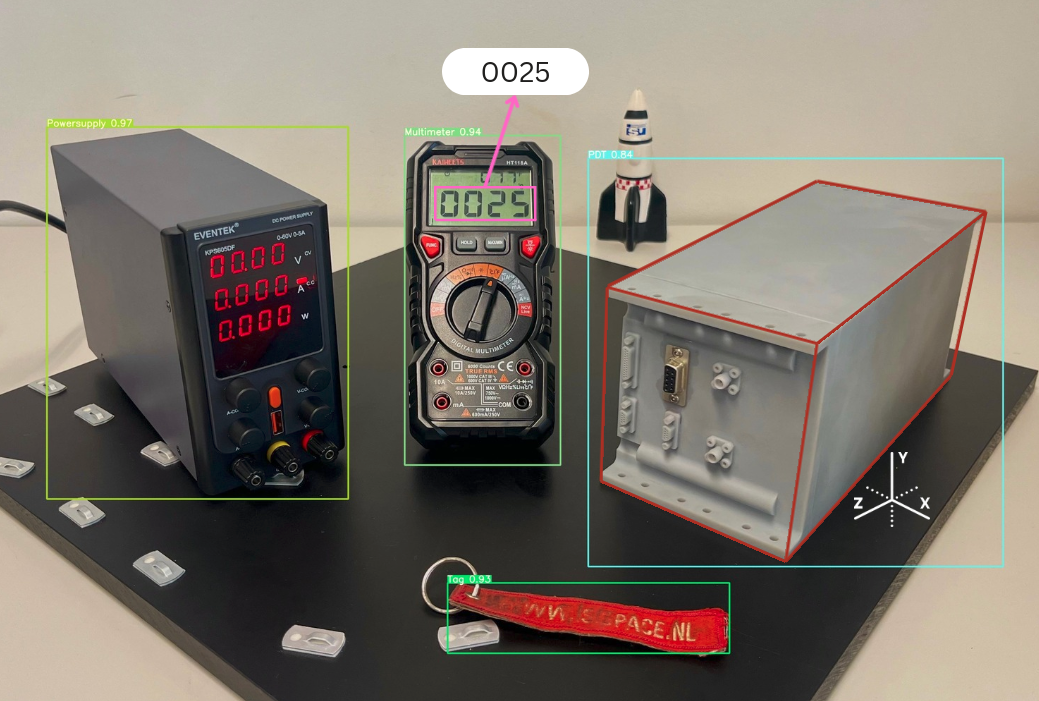
This paper presents an AI-powered augmented reality system for satellite Assembly, Integration, and Testing (AIT) using Microsoft HoloLens 2 to deliver real-time, context-aware guidance through computer vision-based object detection, 6D pose estimation, and OCR. The system achieves over 95% accuracy in object detection and up to 98.36% accuracy in numerical OCR using synthetic data and a novel automatic annotation model (SAMAL), accelerating data labeling up to 20x.
The integration of Artificial Intelligence (AI) and Augmented Reality (AR) is set to transform satellite Assembly, Integration, and Testing (AIT) processes by enhancing precision, minimizing human error, and improving operational efficiency in cleanroom environments. This paper presents a technical description of the European Space Agency's (ESA) project "AI for AR in Satellite AIT," which combines real-time computer vision and AR systems to assist technicians during satellite assembly. Leveraging Microsoft HoloLens 2 as the AR interface, the system delivers context-aware instructions and real-time feedback, tackling the complexities of object recognition and 6D pose estimation in AIT workflows. All AI models demonstrated over 70% accuracy, with the detection model exceeding 95% accuracy, indicating a high level of performance and reliability. A key contribution of this work lies in the effective use of synthetic data for training AI models in AR applications, addressing the significant challenges of obtaining real-world datasets in highly dynamic satellite environments, as well as the creation of the Segmented Anything Model for Automatic Labelling (SAMAL), which facilitates the automatic annotation of real data, achieving speeds up to 20 times faster than manual human annotation. The findings demonstrate the efficacy of AI-driven AR systems in automating critical satellite assembly tasks, setting a foundation for future innovations in the space industry.
Motivation & Objective
- To reduce human error and improve efficiency in satellite AIT processes within cleanroom environments.
- To address the scarcity of real-world training data for AI models in dynamic satellite manufacturing settings.
- To develop a real-time, offline-capable AR system for on-the-job technician guidance during satellite assembly.
- To accelerate data annotation using a novel synthetic data and automatic labeling pipeline.
- To enable robust, accurate AI inference for object detection, 6D pose estimation, and OCR in complex, evolving satellite workspaces.
Proposed method
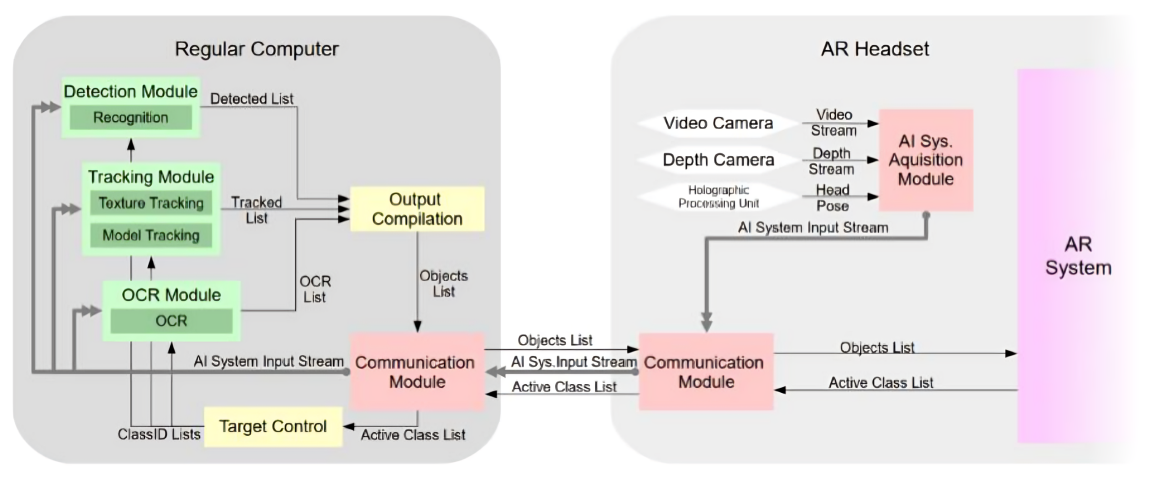
- The system uses Microsoft HoloLens 2 to capture RGB, depth, and inertial sensor data in real time for on-device and off-device processing.
- A two-stage computer vision pipeline performs object detection using a YOLOv5-based model and 6D pose estimation via a dedicated regression head.
- Optical Character Recognition (OCR) is implemented using a CRNN-based model trained on synthetic data for numerical and alphanumeric reading.
- Synthetic data is generated using 3D models of satellite components to simulate diverse lighting and viewing conditions for robust model generalization.
- The Segmented Anything Model for Automatic Labeling (SAMAL) enables automated instance segmentation and bounding box annotation, reducing labeling time by up to 20x.
- The system is designed to operate offline, ensuring reliability in secure, controlled cleanroom environments.
Experimental results
Research questions
- RQ1Can AI-powered AR systems achieve high-accuracy object detection and 6D pose estimation in real time for satellite AIT workflows?
- RQ2How effective is synthetic data in training AI models for dynamic satellite component recognition when real-world data is scarce?
- RQ3To what extent can automated data annotation via SAMAL reduce labeling time without compromising model performance?
- RQ4Can OCR models achieve high accuracy in reading static or slowly changing instrument displays under real-world conditions?
- RQ5How does the integration of real-time computer vision with AR headsets improve technician guidance and error reduction in satellite assembly?
Key findings
- The object detection model achieved 95.3% accuracy, significantly exceeding the 70% threshold for reliable AIT applications.
- The 6D pose estimation model demonstrated over 70% accuracy, indicating strong performance despite real-time constraints.
- The OCR pipeline achieved 96.03% accuracy in numerical reading, with a trained CRNN model reaching 98.36% accuracy on ground-truth bounding boxes.
- The SAMAL model enabled automatic data annotation up to 20 times faster than manual human annotation, drastically improving data pipeline efficiency.
- The system achieved 188.82 FPS inference speed for OCR recognition, meeting real-time requirements despite high accuracy.
- The trained OCR model outperformed the pre-trained EasyOCR model by over 96 percentage points in accuracy, demonstrating the effectiveness of synthetic data fine-tuning.
Read this paper
Open the full text in the Nubint reader and ask about any passage as you read.
Read this paper on NubintThis review was generated by AI from the original paper. Please check the paper before citing it.