
[Paper Review] AI Security Threats against Pervasive Robotic Systems: A Course for Next Generation Cybersecurity Workforce
This paper proposes a seven-module academic course designed to train the next generation of cybersecurity professionals in securing pervasive robotic systems against AI-driven cyber threats. The course integrates hands-on labs and theoretical modules covering attack surfaces, adversarial inputs, model poisoning, inference attacks, actuator manipulation, and ethical implications, with key findings showing a critical skills gap among CS students in detecting and defending AI vulnerabilities in robotics systems.
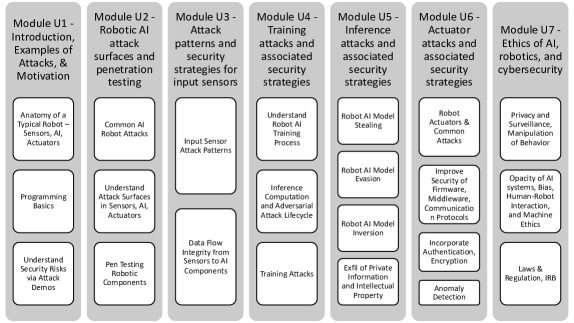
Robotics, automation, and related Artificial Intelligence (AI) systems have become pervasive bringing in concerns related to security, safety, accuracy, and trust. With growing dependency on physical robots that work in close proximity to humans, the security of these systems is becoming increasingly important to prevent cyber-attacks that could lead to privacy invasion, critical operations sabotage, and bodily harm. The current shortfall of professionals who can defend such systems demands development and integration of such a curriculum. This course description includes details about seven self-contained and adaptive modules on "AI security threats against pervasive robotic systems". Topics include: 1) Introduction, examples of attacks, and motivation; 2) - Robotic AI attack surfaces and penetration testing; 3) - Attack patterns and security strategies for input sensors; 4) - Training attacks and associated security strategies; 5) - Inference attacks and associated security strategies; 6) - Actuator attacks and associated security strategies; and 7) - Ethics of AI, robotics, and cybersecurity.
Motivation & Objective
- Address the growing need for cybersecurity expertise in pervasive robotic systems, which are increasingly vulnerable to AI-driven cyberattacks.
- Bridge the critical skills gap identified in student surveys, where 96% of senior CS students lack knowledge of AI security strategies for robotic systems.
- Equip senior undergraduate and graduate students with technical skills to detect, prevent, and mitigate AI security threats across robotic AI subsystems.
- Integrate ethics and human-robot interaction (HRI) into cybersecurity education to promote trustworthy, transparent, and accountable robotic systems.
- Develop a modular, self-contained curriculum that can be adopted across universities to scale cybersecurity education in robotics.
Proposed method
- Design seven self-contained, adaptive modules covering AI security threats across robotic system components, from sensors to actuators.
- Use real-world attack examples—such as adversarial stickers on road signs and facial recognition spoofing—throughout the curriculum to illustrate threat vectors.
- Implement hands-on labs (e.g., Lab U6.1 and U6.2) where students simulate actuator-based attacks and implement defense mechanisms like control signal sanitization and rule-based action verification.
- Incorporate AI-based anomaly detection models using time-series analysis of normal robotic operation data to identify deviations.
- Integrate ethical frameworks and HRI studies, including IRB-compliant experiments, to evaluate privacy and security perceptions in human-robot interactions.
- Leverage established tools and frameworks such as ROS (Robot Operating System) and digital twins to demonstrate secure middleware hardening and predictive threat detection.
Experimental results
Research questions
- RQ1What are the primary AI security threats targeting pervasive robotic systems, and how do they exploit vulnerabilities in sensors, AI models, and actuators?
- RQ2How can students be effectively trained to identify and defend against adversarial attacks on robotic AI systems, including data poisoning and inference-time manipulation?
- RQ3To what extent do current computer science students lack foundational knowledge in securing AI-powered robotic systems, as revealed by pre-course surveys?
- RQ4How can ethical considerations, including fairness, transparency, and privacy, be systematically integrated into robotic cybersecurity education?
- RQ5What role do human-robot interaction (HRI) studies play in shaping secure and trustworthy robotic systems from a user-centric perspective?
Key findings
- 86% of first-year computer science students were surprised by the possibility of remote hacking in autonomous vehicles, indicating low baseline awareness of AI security threats in robotics.
- 90% of fourth-year CS students reported they do not possess the skills to detect exploitable AI vulnerabilities in models they develop, highlighting a major educational gap.
- 96% of senior CS students were unaware of any security strategies to protect AI subsystems in robots or autonomous vehicles, underscoring the urgency for targeted education.
- Hands-on labs, such as injecting malicious code to cause robot path deviation and implementing actuator action verification, effectively demonstrate real-world attack and defense mechanics.
- The integration of HRI studies and IRB-compliant experiments enables students to evaluate privacy and security perceptions, linking technical defenses to human-centered trust.
- The course structure successfully addresses a niche in cybersecurity education by focusing on AI-robotics threats, a domain largely absent in standard robotics and cybersecurity curricula.
Read this paper
Open the full text in the Nubint reader and ask about any passage as you read.
Read this paper on NubintThis review was generated by AI from the original paper. Please check the paper before citing it.