
[Paper Review] Air-Ground Collaborative Mobile Edge Computing: Architecture, Challenges, and Opportunities
This paper proposes an Air-Ground Collaborative Mobile Edge Computing (AGC-MEC) architecture that integrates aerial (UAVs, airships, balloons) and terrestrial (BSs, RSUs, vehicles, powerful users) MEC servers to enhance computational efficiency and service quality in 6G networks. By jointly optimizing service placement and UAV trajectory, the proposed method reduces UE energy consumption by up to 87.89% compared to local execution, demonstrating significant gains in latency and energy efficiency through cross-layer collaboration.
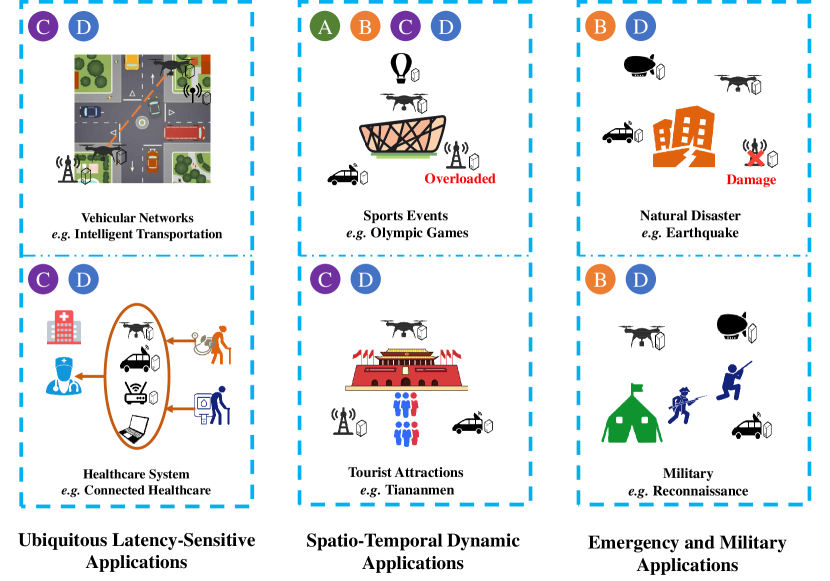
By pushing computation, cache, and network control to the edge, mobile edge computing (MEC) is expected to play a leading role in fifth generation (5G) and future sixth generation (6G). Nevertheless, facing ubiquitous fast-growing computational demands, it is impossible for a single MEC paradigm to effectively support high-quality intelligent services at end user equipments (UEs). To address this issue, we propose an air-ground collaborative MEC (AGC-MEC) architecture in this article. The proposed AGC-MEC integrates all potentially available MEC servers within air and ground in the envisioned 6G, by a variety of collaborative ways to provide computation services at their best for UEs. Firstly, we introduce the AGC-MEC architecture and elaborate three typical use cases. Then, we discuss four main challenges in the AGC-MEC as well as their potential solutions. Next, we conduct a case study of collaborative service placement for AGC-MEC to validate the effectiveness of the proposed collaborative service placement strategy. Finally, we highlight several potential research directions of the AGC-MEC.
Motivation & Objective
- Address the limitations of standalone terrestrial or aerial MEC systems in meeting dynamic, high-computation demands of future 6G networks.
- Overcome the constraints of fixed ground MEC (lack of mobility) and aerial MEC (limited battery, low reliability) through integrated air-ground collaboration.
- Develop a unified framework for collaborative service placement and resource management across heterogeneous MEC paradigms (UAVs, airships, BSs, vehicles, mobile users).
- Improve energy efficiency and reduce latency for latency-sensitive, computation-intensive applications in 6G environments.
- Identify and address key challenges such as network control, security, and intelligent collaboration in AGC-MEC systems.
Proposed method
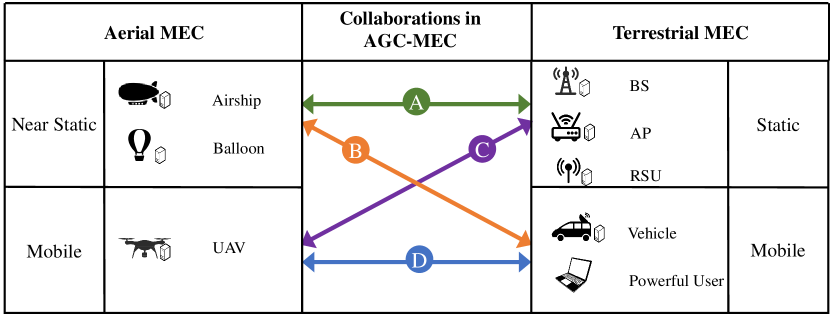
- Proposes a two-layer AGC-MEC architecture: aerial MEC (UAVs, airships/balloons) and terrestrial MEC (BSs, APs, RSUs, vehicles, powerful mobile users).
- Introduces a collaborative service placement algorithm that jointly optimizes UAV trajectory and service deployment across UAV and BS to minimize UE energy consumption.
- Uses a mixed-integer non-linear programming (MINLP) formulation to model the joint optimization problem, incorporating constraints on computation, storage, and communication resources.
- Employs a heuristic algorithm based on alternating optimization and successive convex approximation to solve the non-convex MINLP problem efficiently.
- Incorporates a dynamic service placement strategy that adapts to changing UE workloads and network conditions.
- Validates the approach via simulation with realistic parameters, comparing performance against baseline strategies (Random, Greedy, Local).
Experimental results
Research questions
- RQ1How can air and ground MEC servers be effectively integrated to provide scalable, low-latency, and energy-efficient computing services in 6G networks?
- RQ2What is the optimal joint placement of MEC services and UAV trajectory to minimize end-user energy consumption in dynamic, heterogeneous networks?
- RQ3How do varying storage capacities and workloads affect the performance of collaborative MEC service placement strategies?
- RQ4What are the key challenges in managing a heterogeneous, large-scale AGC-MEC network, and what architectural solutions can address them?
- RQ5What emerging technologies (e.g., SDN, Blockchain, AI) can enable secure, intelligent, and scalable control in AGC-MEC systems?
Key findings
- The proposed collaborative service placement algorithm converges rapidly, reducing total UE energy consumption from 150.5956 J to 31.8719 J in just three iterations.
- The UAV trajectory optimization enables the UAV to fly closer to UEs, improving communication quality and reducing offloading latency.
- With increased storage capacity, UE energy consumption decreases across all algorithms; the proposed method reduces consumption by 65.96% compared to Random, 49.35% compared to Greedy, and 87.89% compared to Local execution.
- Under increasing UE workloads (measured by CPU cycles), the proposed algorithm reduces energy consumption by 46.62% compared to Random, 48.42% compared to Greedy, and 75.53% compared to Local execution.
- The AGC-MEC architecture outperforms single-paradigm MEC systems by combining the mobility of UAVs with the reliability and capacity of ground MEC servers.
- Simulation results confirm that collaborative resource management across air and ground MEC nodes significantly enhances system performance in terms of energy efficiency and latency reduction.
Read this paper
Open the full text in the Nubint reader and ask about any passage as you read.
Read this paper on NubintThis review was generated by AI from the original paper. Please check the paper before citing it.