
[Paper Review] AirPhyNet: Harnessing Physics-Guided Neural Networks for Air Quality Prediction
AirPhyNet integrates diffusion-advection physics into a neural network to predict PM2.5 with improved accuracy, especially in sparse data scenarios, outperforming state-of-the-art baselines.
Air quality prediction and modelling plays a pivotal role in public health and environment management, for individuals and authorities to make informed decisions. Although traditional data-driven models have shown promise in this domain, their long-term prediction accuracy can be limited, especially in scenarios with sparse or incomplete data and they often rely on black-box deep learning structures that lack solid physical foundation leading to reduced transparency and interpretability in predictions. To address these limitations, this paper presents a novel approach named Physics guided Neural Network for Air Quality Prediction (AirPhyNet). Specifically, we leverage two well-established physics principles of air particle movement (diffusion and advection) by representing them as differential equation networks. Then, we utilize a graph structure to integrate physics knowledge into a neural network architecture and exploit latent representations to capture spatio-temporal relationships within the air quality data. Experiments on two real-world benchmark datasets demonstrate that AirPhyNet outperforms state-of-the-art models for different testing scenarios including different lead time (24h, 48h, 72h), sparse data and sudden change prediction, achieving reduction in prediction errors up to 10%. Moreover, a case study further validates that our model captures underlying physical processes of particle movement and generates accurate predictions with real physical meaning.
Motivation & Objective
- Motivate accurate outdoor PM2.5 forecasting by blending physics with data-driven learning.
- Incorporate fundamental air transport physics (diffusion and advection) into a deep learning framework.
- Enhance prediction accuracy and interpretability, especially under sparse data and abrupt changes.
Proposed method
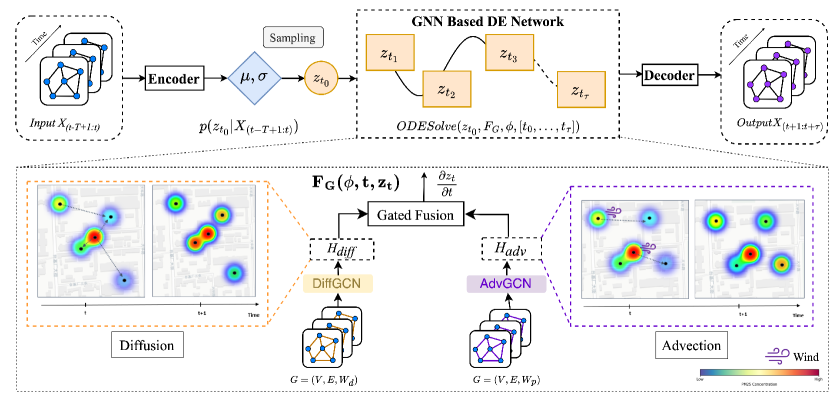
- Encode historical PM2.5 and weather data with an RNN encoder (GRU).
- Model diffusion and advection on a sensor network as differential equation networks with graph Laplacians.
- Fuse diffusion and advection dynamics via a gated mechanism to form a Diffusion-Advection Differential Equation (DE).
- Parameterize the DE network with a GNN-informed neural ODE to evolve latent states over time.
- Decode latent predictions to PM2.5 concentrations at future horizons (up to 72 hours).
- Train end-to-end by minimizing MAE between predicted and ground-truth concentrations.
Experimental results
Research questions
- RQ1Can physics-guided deep learning (diffusion-advection) improve outdoor PM2.5 forecasting over purely data-driven models?
- RQ2Do physics-informed components enhance performance in sparse data and sudden-change scenarios?
- RQ3Does the proposed GNN-based differential equation network effectively capture spatiotemporal transport dynamics on sensor networks?
- RQ4What is the interpretability benefit of linking predictions to underlying diffusion and advection processes?
Key findings
- AirPhyNet consistently outperforms baselines across both Beijing and Shenzhen datasets for 24h, 48h, and 72h forecasts.
- Mean improvements over the second-best method are 3.7% in MAE and 6.1% in RMSE on average in full-data settings.
- In sparse data settings, AirPhyNet yields 8.3% (MAE) and 8.1% (RMSE) improvements on average over competitors.
- The model achieves up to 8% reduction in prediction errors for sudden-change scenarios.
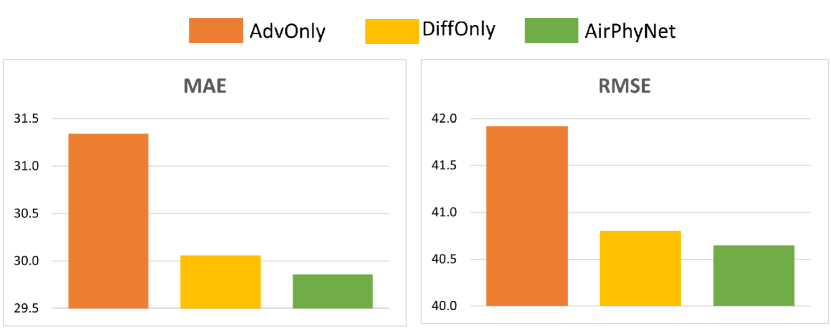
- Ablation studies show advantages of combining diffusion and advection, and of using a GRU encoder over a TCN-based encoder.
- Case study visualizations illustrate physically meaningful diffusion and advection patterns in predictions.
Better researchstarts right now
From reading papers to final review, dramatically reduce your research time.
No credit card · Free plan available
This review was created by AI and reviewed by human editors.