
[Paper Review] ALCM: Autonomous LLM-Augmented Causal Discovery Framework
ALCM is a novel autonomous framework that integrates data-driven causal discovery with large language models (LLMs) to generate more accurate, robust, and interpretable causal graphs. By combining causal structure learning, a causal wrapper, and an LLM-driven refiner, ALCM outperforms existing LLM-based and conventional methods in causal discovery accuracy and identifies previously undetected causal relationships and hidden variables.
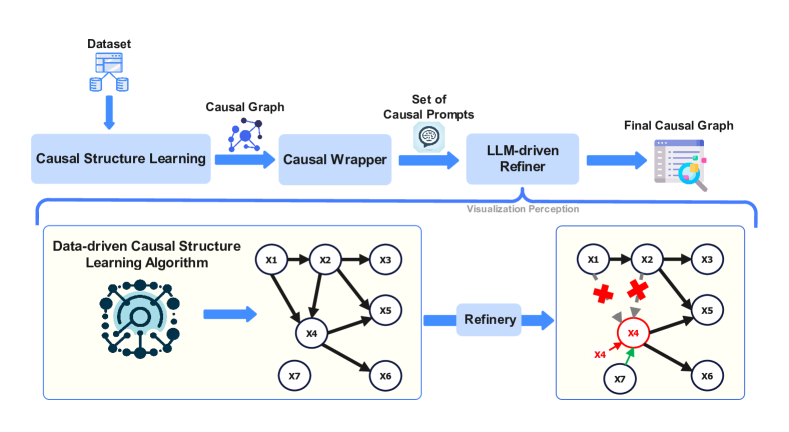
To perform effective causal inference in high-dimensional datasets, initiating the process with causal discovery is imperative, wherein a causal graph is generated based on observational data. However, obtaining a complete and accurate causal graph poses a formidable challenge, recognized as an NP- hard problem. Recently, the advent of Large Language Models (LLMs) has ushered in a new era, indicating their emergent capabilities and widespread applicability in facilitating causal reasoning across diverse domains, such as medicine, finance, and science. The expansive knowledge base of LLMs holds the potential to elevate the field of causal reasoning by offering interpretability, making inferences, generalizability, and uncovering novel causal structures. In this paper, we introduce a new framework, named Autonomous LLM-Augmented Causal Discovery Framework (ALCM), to synergize data-driven causal discovery algorithms and LLMs, automating the generation of a more resilient, accurate, and explicable causal graph. The ALCM consists of three integral components: causal structure learning, causal wrapper, and LLM-driven causal refiner. These components autonomously collaborate within a dynamic environment to address causal discovery questions and deliver plausible causal graphs. We evaluate the ALCM framework by implementing two demonstrations on seven well-known datasets. Experimental results demonstrate that ALCM outperforms existing LLM methods and conventional data-driven causal reasoning mechanisms. This study not only shows the effectiveness of the ALCM but also underscores new research directions in leveraging the causal reasoning capabilities of LLMs.
Motivation & Objective
- Address the challenge of generating accurate and complete causal graphs from high-dimensional observational data, which is NP-hard and prone to errors.
- Overcome limitations of conventional data-driven causal discovery methods, such as reliance on expert knowledge, data bias, and inability to resolve Markov equivalence classes.
- Leverage the emergent reasoning and world knowledge of LLMs to improve causal graph accuracy, interpretability, and generalizability.
- Develop an autonomous, end-to-end framework that synergizes LLMs with causal discovery algorithms to reduce human intervention and enhance reliability.
- Enable the discovery of hidden or previously overlooked causal variables and edges not present in the original dataset through LLM-guided reasoning.
Proposed method
- ALCM employs a three-component architecture: (1) causal structure learning using established algorithms (e.g., PC, GES), (2) a causal wrapper to validate and refine candidate graphs, and (3) an LLM-driven causal refiner for hypothesis generation and validation.
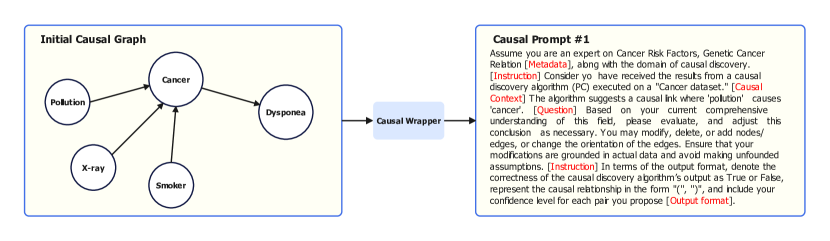
- The LLM-driven refiner uses chain-of-thought prompting and confidence scoring to generate and evaluate potential causal relationships, including new nodes and edges.
- The framework integrates retrieval-augmented generation (RAG) and openCHA to reduce hallucination and improve factual grounding in LLM outputs.
- A hybrid variant, ALCM-Hybrid, combines algorithmic precision with LLM insights to further enhance performance.
- The system operates in a dynamic, autonomous loop, iteratively refining causal graphs using data, algorithms, and LLM reasoning.
- Evaluation includes visual and quantitative comparison against ground truth on seven benchmark datasets, including Sachs and neuropathic pain data.
Experimental results
Research questions
- RQ1Can LLMs effectively augment data-driven causal discovery to improve the accuracy and completeness of learned causal graphs?
- RQ2To what extent can LLMs identify hidden or previously undetected causal variables and edges not present in the original dataset?
- RQ3How does the integration of LLM reasoning with causal discovery algorithms reduce reliance on expert annotation and improve interpretability?
- RQ4Can a hybrid framework combining algorithmic precision and LLM reasoning outperform both pure algorithmic and pure LLM-based approaches?
- RQ5How robust is the ALCM framework in detecting and validating causal structures in real-world, high-dimensional datasets?
Key findings
- ALCM significantly outperforms both conventional data-driven causal discovery methods (e.g., PC) and existing LLM-based approaches in causal discovery accuracy across seven benchmark datasets.
- The ALCM-Hybrid variant achieves the highest performance, demonstrating the effectiveness of combining algorithmic precision with LLM reasoning.
- ALCM successfully identifies new nodes and edges not present in the original causal discovery output, as validated by up-to-date medical literature.
- The LLM-driven refiner component increases the detection of true causal relationships, particularly in complex or ambiguous cases.
- ALCM reduces the impact of data bias and model limitations by leveraging the broad world knowledge and reasoning capabilities of LLMs.
- Visualizations confirm that ALCM uncovers hidden or ignored causal connections, such as those in the Markov blanket, that standard algorithms miss.
Better researchstarts right now
From reading papers to final review, dramatically reduce your research time.
No credit card · Free plan available
This review was created by AI and reviewed by human editors.