
[Paper Review] Aleth-NeRF: Low-light Condition View Synthesis with Concealing Fields
Aleth-NeRF proposes an unsupervised NeRF-based method for view synthesis in low-light conditions by introducing 'Concealing Fields'—a surrogate model for light attenuation between scene and viewer. By training solely on dark multi-view sRGB images and eliminating Concealing Fields during inference, it achieves superior 3D multi-view consistency and image quality over 2D enhancement methods, outperforming baselines in both SSIM, PSNR, and LPIPS metrics on the newly collected LOM dataset.
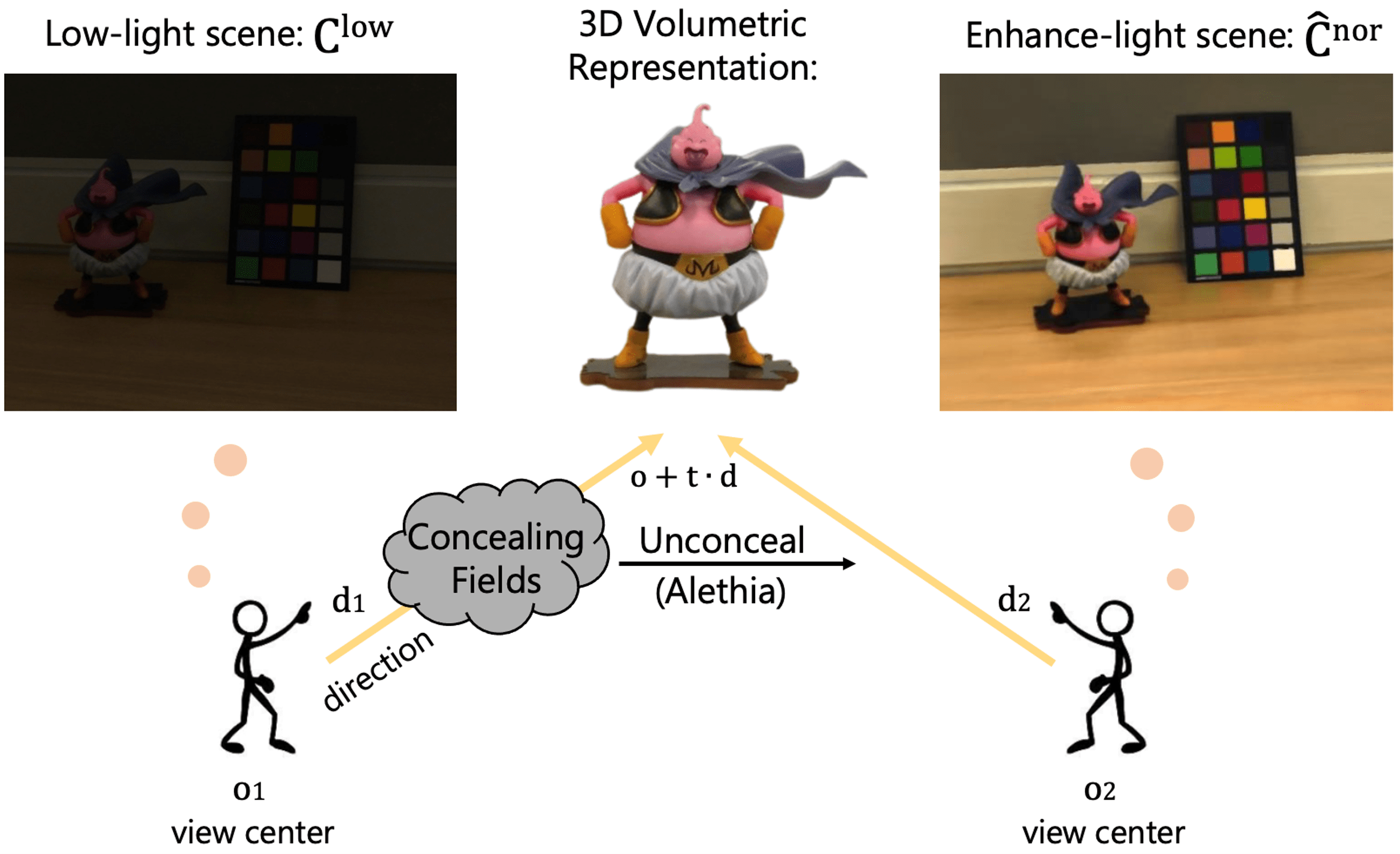
Common capture low-light scenes are challenging for most computer vision techniques, including Neural Radiance Fields (NeRF). Vanilla NeRF is viewer-centred simplifies the rendering process only as light emission from 3D locations in the viewing direction, thus failing to model the low-illumination induced darkness. Inspired by the emission theory of ancient Greeks that visual perception is accomplished by rays casting from eyes, we make slight modifications on vanilla NeRF to train on multiple views of low-light scenes, we can thus render out the well-lit scene in an unsupervised manner. We introduce a surrogate concept, Concealing Fields, that reduces the transport of light during the volume rendering stage. Specifically, our proposed method, Aleth-NeRF, directly learns from the dark image to understand volumetric object representation and concealing field under priors. By simply eliminating Concealing Fields, we can render a single or multi-view well-lit image(s) and gain superior performance over other 2D low-light enhancement methods. Additionally, we collect the first paired LOw-light and normal-light Multi-view (LOM) datasets for future research. This version is invalid, please refer to our new AAAI version: arXiv:2312.09093
Motivation & Objective
- To address the challenge of training NeRF on low-light scenes where vanilla NeRF fails due to insufficient illumination and poor multi-view consistency.
- To overcome limitations of 2D low-light enhancement methods that disrupt 3D geometric consistency when applied before NeRF training.
- To propose a NeRF variant that learns volumetric scene representation and concealment effects jointly from dark images without supervision.
- To collect and release the first paired low-light and normal-light multi-view dataset (LOM) for future research in low-light 3D scene understanding.
Proposed method
- Introduce 'Concealing Fields' as a surrogate for light attenuation in the viewing direction, extending the transmittance function in NeRF to model low-light conditions.
- Modify vanilla NeRF to jointly optimize radiance fields and Concealing Fields using only low-light multi-view sRGB images during training.
- Enable rendering of well-lit scenes by simply removing Concealing Fields during inference, achieving unsupervised enhancement.
- Use a differentiable volume rendering process that incorporates Concealing Fields as a multiplicative attenuation factor in the ray integration step.
- Leverage the philosophical analogy of ancient Greek emission theory—where vision results from rays emitted from the eye—to frame the problem as 'unconcealing' hidden structures.
- Train the model end-to-end using standard NeRF loss on dark images, with no need for ground-truth normal-light supervision.
Experimental results
Research questions
- RQ1Can NeRF be effectively trained on low-light images alone to synthesize well-lit novel views without any normal-light supervision?
- RQ2How does modeling light attenuation via Concealing Fields improve multi-view consistency compared to post-processing NeRF outputs with 2D enhancement methods?
- RQ3To what extent does the proposed method outperform state-of-the-art 2D low-light enhancement techniques when integrated into NeRF-based view synthesis?
- RQ4Does the use of a physically inspired Concealing Field concept lead to more robust and generalizable 3D scene reconstruction under low illumination?
- RQ5Can a single, scene-specific NeRF model trained on dark images achieve better performance than multi-stage pipelines involving 2D enhancement and NeRF fine-tuning?
Key findings
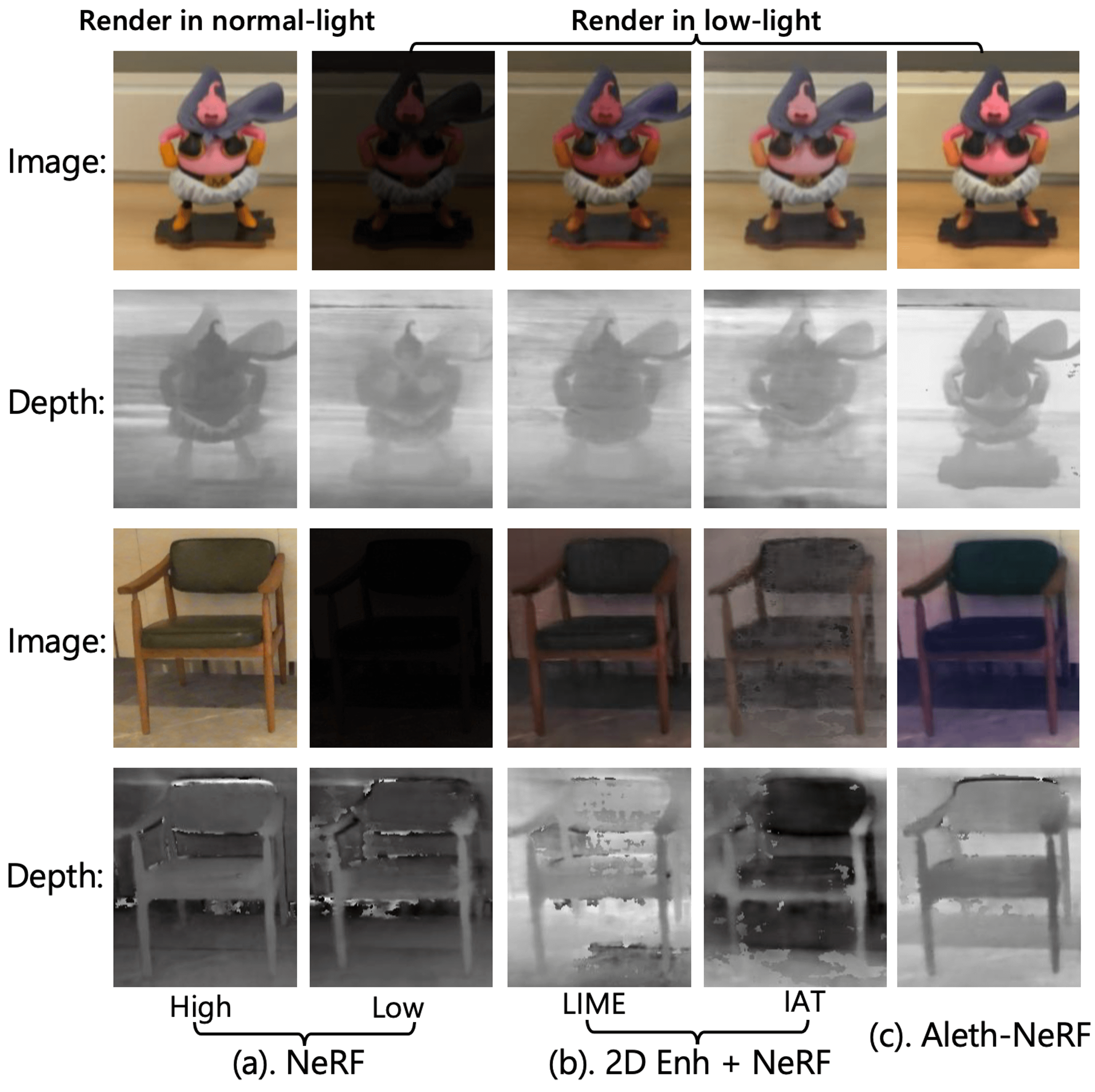
- Aleth-NeRF achieves the best mean performance across all metrics (SSIM, PSNR, LPIPS) on the LOM dataset, outperforming both 'NeRF + 2D enhancement' and '2D enhancement + NeRF' baselines.
- The 'NeRF + 2D enhancement' pipeline performs worse than '2D enhancement + NeRF', indicating that low-quality NeRF outputs degrade 2D enhancement results.
- The '2D enhancement + NeRF' pipeline suffers from artifacts and inconsistency in novel view generation due to inconsistent 2D enhancements across views.
- Aleth-NeRF maintains high multi-view consistency and image quality, as evidenced by visualizations and quantitative metrics on the 'sofa', 'bike', and 'shrub' scenes.
- The method achieves state-of-the-art performance on the LOM dataset, demonstrating that end-to-end unsupervised learning from dark images is effective for 3D view synthesis.
- The LOM dataset, containing 5 real-world scenes with 25–65 paired low-light and normal-light views, enables reliable evaluation of multi-view low-light enhancement.
Read this paper
Open the full text in the Nubint reader and ask about any passage as you read.
Read this paper on NubintThis review was generated by AI from the original paper. Please check the paper before citing it.