
[Paper Review] Align and Distill: Unifying and Improving Domain Adaptive Object Detection
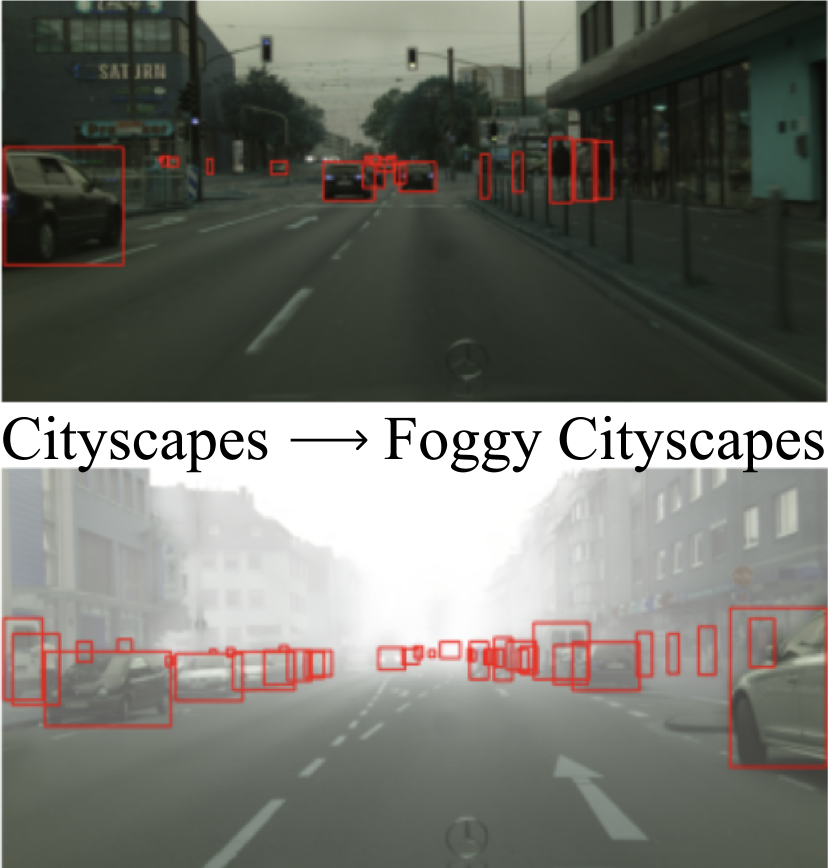
This paper introduces ALDI, a unified benchmarking and training framework for domain adaptive object detection (DAOD), addressing systemic flaws in prior evaluation practices. By standardizing implementations, introducing the CFC-DAOD benchmark, and proposing ALDI++, the method achieves state-of-the-art performance—surpassing previous SOTA by +3.5 AP50 on Cityscapes→Foggy Cityscapes and +5.7 AP50 on Sim10k→Cityscapes—while revealing that prior results were overestimated due to inconsistent baselines and hyperparameter choices.
Object detectors often perform poorly on data that differs from their training set. Domain adaptive object detection (DAOD) methods have recently demonstrated strong results on addressing this challenge. Unfortunately, we identify systemic benchmarking pitfalls that call past results into question and hamper further progress: (a) Overestimation of performance due to underpowered baselines, (b) Inconsistent implementation practices preventing transparent comparisons of methods, and (c) Lack of generality due to outdated backbones and lack of diversity in benchmarks. We address these problems by introducing: (1) A unified benchmarking and implementation framework, Align and Distill (ALDI), enabling comparison of DAOD methods and supporting future development, (2) A fair and modern training and evaluation protocol for DAOD that addresses benchmarking pitfalls, (3) A new DAOD benchmark dataset, CFC-DAOD, enabling evaluation on diverse real-world data, and (4) A new method, ALDI++, that achieves state-of-the-art results by a large margin. ALDI++ outperforms the previous state-of-the-art by +3.5 AP50 on Cityscapes to Foggy Cityscapes, +5.7 AP50 on Sim10k to Cityscapes (where ours is the only method to outperform a fair baseline), and +0.6 AP50 on CFC Kenai to Channel. ALDI and ALDI++ are architecture-agnostic, setting a new state-of-the-art for YOLO and DETR-based DAOD as well without additional hyperparameter tuning. Our framework, dataset, and state-of-the-art method offer a critical reset for DAOD and provide a strong foundation for future research. Code and data are available: https://github.com/justinkay/aldi and https://github.com/visipedia/caltech-fish-counting.
Motivation & Objective
- Address systemic benchmarking flaws in DAOD research, including underpowered baselines, inconsistent implementations, and outdated or narrow benchmarks.
- Establish a fair and transparent evaluation protocol that isolates domain adaptation performance from architectural and hyperparameter improvements.
- Develop a new, diverse, real-world benchmark dataset, CFC-DAOD, to improve generalization and applicability of DAOD methods.
- Propose ALDI++, a new DAOD method that achieves state-of-the-art performance across multiple benchmarks, demonstrating the effectiveness of unified alignment and distillation.
- Provide a public codebase and standardized framework to enable reproducible, transparent, and comparable future research in DAOD.
Proposed method
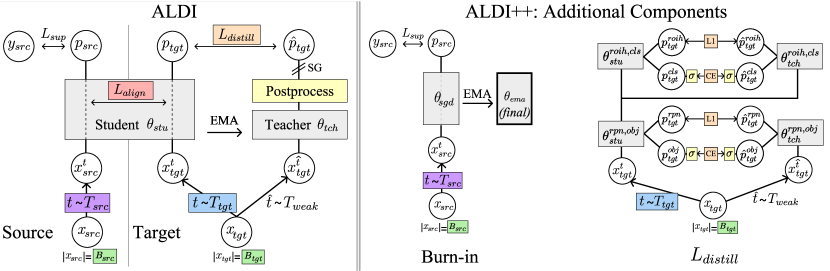
- Introduce ALDI, a unified framework that standardizes training, evaluation, and implementation of DAOD methods across different object detection backbones and libraries.
- Implement a fair training and evaluation protocol that uses consistent architectures, hyperparameters, and data augmentations for all methods, including source-only and oracle baselines.
- Design ALDI++ by combining feature alignment and self-training distillation, where predictions from a teacher model guide the student model via consistency regularization.
- Use a two-stage training process: first pre-train a student model on source data, then apply iterative self-training with a momentum-averaged teacher model to refine predictions on unlabeled target data.
- Apply feature-level alignment via contrastive loss between source and target features to reduce domain shift, while maintaining detection head consistency.
- Integrate strong data augmentations and exponential moving average (EMA) of network weights during training to improve generalization without requiring target labels.
Experimental results
Research questions
- RQ1To what extent do prior DAOD results overestimate performance due to inconsistent or underpowered baselines and hyperparameter choices?
- RQ2How does the performance of DAOD methods change when evaluated under a fair, standardized protocol that isolates domain adaptation from architectural and training improvements?
- RQ3Can a unified framework and benchmark improve the reproducibility, transparency, and generalization of DAOD research?
- RQ4What is the relative contribution of feature alignment versus self-training in DAOD, and how do they interact when combined?
- RQ5Can a new benchmark like CFC-DAOD better reflect real-world domain shift challenges and support more robust method evaluation?
Key findings
- When evaluated under a fair protocol, no existing DAOD method outperforms the oracle model, and many fail to surpass the source-only baseline, contradicting previously reported gains.
- ALDI++ achieves +3.5 AP50 on Cityscapes→Foggy Cityscapes and +5.7 AP50 on Sim10k→Cityscapes, significantly outperforming prior state-of-the-art methods.
- Feature alignment alone improves performance by up to 2.6 AP50, but its benefit diminishes to ≤0.2 AP50 when combined with self-training, indicating self-training is the dominant driver of improvement.
- Stronger backbones like VitDet and improved training practices (e.g., EMA, strong augmentations) significantly boost source-only performance, often surpassing prior DAOD methods.
- The gap between DAOD methods and oracle performance remains large, especially for advanced architectures like VitDet, indicating substantial room for future improvement.
- The use of target-domain validation sets in evaluation violates the unsupervised assumption of DAOD, limiting real-world applicability and suggesting the need for unsupervised validation procedures.
Read this paper
Open the full text in the Nubint reader and ask about any passage as you read.
Read this paper on NubintThis review was generated by AI from the original paper. Please check the paper before citing it.