
[Paper Review] Align-DETR: Enhancing End-to-end Object Detection with Aligned Loss
Align-DETR introduces an IoU-aware BCE loss (IA-BCE) with mixed matching and prime sample weighting to fix misalignment between classification confidence and localization, yielding AP gains on COCO with DETR-based detectors.
DETR has set up a simple end-to-end pipeline for object detection by formulating this task as a set prediction problem, showing promising potential. Despite its notable advancements, this paper identifies two key forms of misalignment within the model: classification-regression misalignment and cross-layer target misalignment. Both issues impede DETR's convergence and degrade its overall performance. To tackle both issues simultaneously, we introduce a novel loss function, termed as Align Loss, designed to resolve the discrepancy between the two tasks. Align Loss guides the optimization of DETR through a joint quality metric, strengthening the connection between classification and regression. Furthermore, it incorporates an exponential down-weighting term to facilitate a smooth transition from positive to negative samples. Align-DETR also employs many-to-one matching for supervision of intermediate layers, akin to the design of H-DETR, which enhances robustness against instability. We conducted extensive experiments, yielding highly competitive results. Notably, our method achieves a 49.3% (+0.6) AP on the H-DETR baseline with the ResNet-50 backbone. It also sets a new state-of-the-art performance, reaching 50.5% AP in the 1x setting and 51.7% AP in the 2x setting, surpassing several strong competitors. Our code is available at https://github.com/FelixCaae/AlignDETR.
Motivation & Objective
- Identify and quantify the misalignment between classification confidence and localization accuracy in DETR-based detectors.
- Propose a simple, effective IA-BCE loss to align classification and localization without altering the post-processing.
- Improve training efficiency with a mixed many-to-one and one-to-one matching strategy.
- Mitigate negative impact of sparse queries through prime sample weighting.
- Demonstrate state-of-the-art results on COCO with strong baselines.
Proposed method
- Define a quality target t = s^α · u^(1−α) to capture IoU and confidence (IA-BCE target).
- Use an asymmetric IA-BCE loss: BCE on foreground with IA-BCE targets and focal-like weighting for negatives.
- Apply a mixed matching strategy: many-to-one matching at shallow decoder layers and one-to-one at the top layer.
- Introduce prime sample weighting: down-weight secondary positives using weights w_i = exp(−r_i/τ) based on sample rank within a group.
- Down-weight the regression loss with the same w_i to maintain consistent training emphasis.
- Adopt a loss form that blends L_m2o for intermediate layers with L_o2o for the final layer (Eq. 8).
Experimental results
Research questions
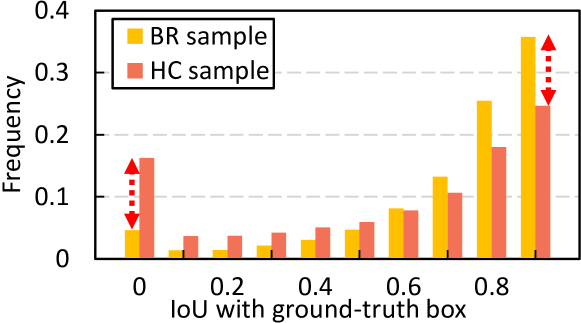
- RQ1Does DETR's one-to-one matching induce misalignment between classification confidence and localization quality?
- RQ2Can an IoU-aware loss improve the correlation between confidence scores and localization accuracy in DETR?
- RQ3Does mixed matching accelerate training without sacrificing end-to-end optimization?
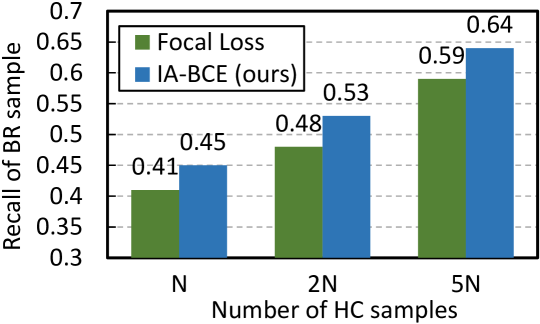
- RQ4Do prime samples and down-weighting of secondary positives improve BR (best-regressed) sample recall and overall AP?
Key findings
- IA-BCE improves alignment between confidence and IoU, boosting AP and AP75 compared to baselines.
- Align-DETR with IA-BCE + mixed matching achieves +3.8 AP on DAB-DETR-R50 baseline (50 epochs).
- In 1x COCO with DINO as baseline, Align-DETR reaches 50.2 AP on val; 1x and 2x schedules show improvements over strong baselines.
- Align-DETR outperforms several DETR variants and CNN-based detectors while using similar or fewer queries and training effort.
- Prime sample weighting and mixed matching both contribute to performance gains; IA-BCE provides the main improvement.
- Ablations show α around 0.25 yields best stability and performance; k and τ have moderate effects.
Read this paper
Open the full text in the Nubint reader and ask about any passage as you read.
Read this paper on NubintThis review was generated by AI from the original paper. Please check the paper before citing it.