
[Paper Review] Aligning Language Models to Explicitly Handle Ambiguity
This paper proposes a novel alignment method that enables large language models (LLMs) to explicitly handle ambiguous queries by leveraging their intrinsic knowledge to self-disambiguate. Using a proxy task and an information gain metric (Infogain) to identify ambiguity from the model's perspective, the approach improves robustness on ambiguous inputs without degrading performance on clear questions, as validated across multiple QA benchmarks.
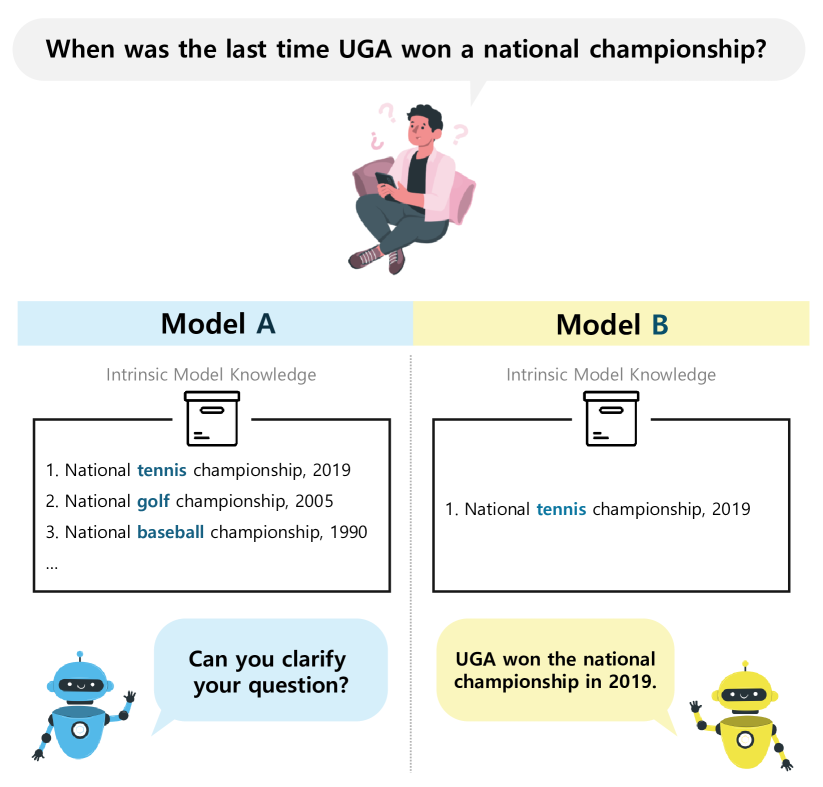
In interactions between users and language model agents, user utterances frequently exhibit ellipsis (omission of words or phrases) or imprecision (lack of exactness) to prioritize efficiency. This can lead to varying interpretations of the same input based on different assumptions or background knowledge. It is thus crucial for agents to adeptly handle the inherent ambiguity in queries to ensure reliability. However, even state-of-the-art large language models (LLMs) still face challenges in such scenarios, primarily due to the following hurdles: (1) LLMs are not explicitly trained to deal with ambiguous utterances; (2) the degree of ambiguity perceived by the LLMs may vary depending on the possessed knowledge. To address these issues, we propose Alignment with Perceived Ambiguity (APA), a novel pipeline that aligns LLMs to manage ambiguous queries by leveraging their own assessment of ambiguity (i.e., perceived ambiguity). Experimental results on question-answering datasets demonstrate that APA empowers LLMs to explicitly detect and manage ambiguous queries while retaining the ability to answer clear questions. Furthermore, our finding proves that APA excels beyond training with gold-standard labels, especially in out-of-distribution scenarios. The data and code are available at https://github.com/heyjoonkim/APA.
Motivation & Objective
- To address the challenge of LLMs failing to recognize or respond appropriately to ambiguous user queries due to lack of explicit training for ambiguity handling.
- To overcome the difficulty of measuring ambiguity from the model's perspective, which varies with its intrinsic knowledge.
- To develop a data selection strategy based on model-perceived ambiguity, enabling targeted alignment for improved robustness.
- To evaluate the effectiveness of this alignment approach on ambiguous inputs while maintaining strong performance on unambiguous ones.
- To contribute a new dataset, AmbigTriviaQA, to support broader evaluation of ambiguity robustness in LLMs.
Proposed method
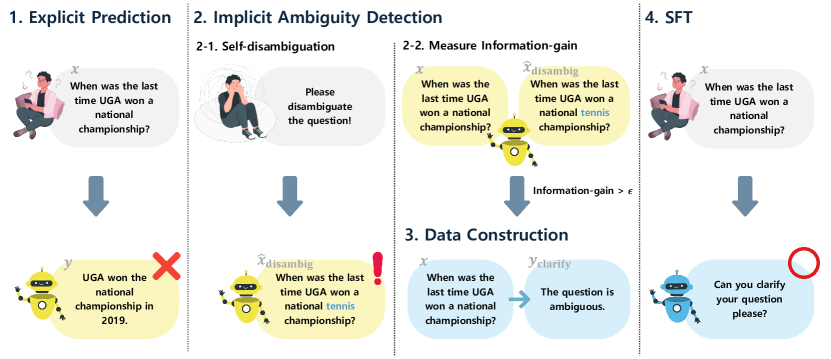
- Introduce a proxy task where the LLM is prompted to self-disambiguate a given query using its intrinsic knowledge.
- Define Infogain as a measure of information gain from disambiguation, serving as an implicit indicator of perceived ambiguity.
- Use Infogain scores to select samples deemed ambiguous from the model's perspective for downstream alignment.
- Fine-tune LLMs on the selected ambiguous samples using supervised fine-tuning (SFT), focusing on generating clarification requests.
- Evaluate alignment performance using metrics like Valid Alignment Rate (VAR), Misaligned Clarification Rate (MCR), and Overall Alignment Performance (OAP).
- Construct a new benchmark dataset, AmbigTriviaQA, to support comprehensive evaluation of ambiguity handling in LLMs.
Experimental results
Research questions
- RQ1Can LLMs be effectively aligned to recognize and explicitly respond to ambiguous queries using only their intrinsic knowledge?
- RQ2How can ambiguity be quantitatively measured from the model’s perspective, independent of human-annotated labels?
- RQ3Does using Infogain as a data selection cue improve the model’s ability to handle ambiguous queries without harming performance on unambiguous ones?
- RQ4How does the model’s perceived ambiguity vary with its knowledge base, and can this be leveraged for better alignment?
- RQ5To what extent does the proposed alignment method generalize to out-of-distribution ambiguous inputs?
Key findings
- The proposed alignment method significantly improves the model’s ability to generate clarification requests for ambiguous queries, with a 12.5% increase in Valid Alignment Rate (VAR) on AmbigQA compared to baseline methods.
- The method achieves a 5-point F1-score improvement over Random sampling and outperforms Implicit baseline, validating the effectiveness of Infogain as a data selection cue.
- The Overall Alignment Performance (OAP) of the proposed method reaches 0.84 on Llama2 7B, outperforming Honesty-tuned (0.71) and Full-set (0.78), indicating a better balance between handling ambiguity and preserving correct responses on unambiguous inputs.
- The model demonstrates robustness on out-of-distribution ambiguous queries, with consistent performance gains across multiple datasets including AmbigQA and TriviaQA.
- Case studies confirm that the model can correctly identify ambiguity when it lacks sufficient knowledge, and avoid false positives when the query is unambiguous, though some misclassifications occur due to knowledge over-association with multiple media titles.
- The new AmbigTriviaQA dataset enables more comprehensive evaluation of ambiguity robustness and supports future research in this domain.
Read this paper
Open the full text in the Nubint reader and ask about any passage as you read.
Read this paper on NubintThis review was generated by AI from the original paper. Please check the paper before citing it.