
[Paper Review] Aligning Large Multimodal Models with Factually Augmented RLHF
The paper adapts reinforcement learning from human feedback (RLHF) to large multimodal models (LMMs) and introduces Factually Augmented RLHF (Fact-RLHF) to reduce hallucinations by incorporating factual cues (captions, ground-truth options) into the reward signal, plus high-quality vision instruction tuning data and a new MMHal-Bench evaluation benchmark.
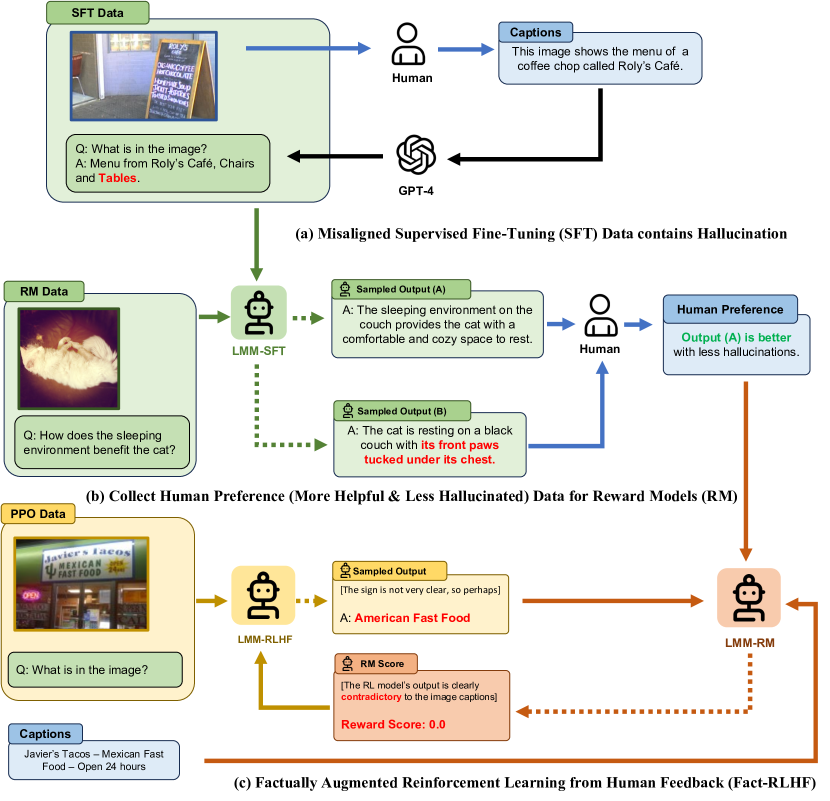
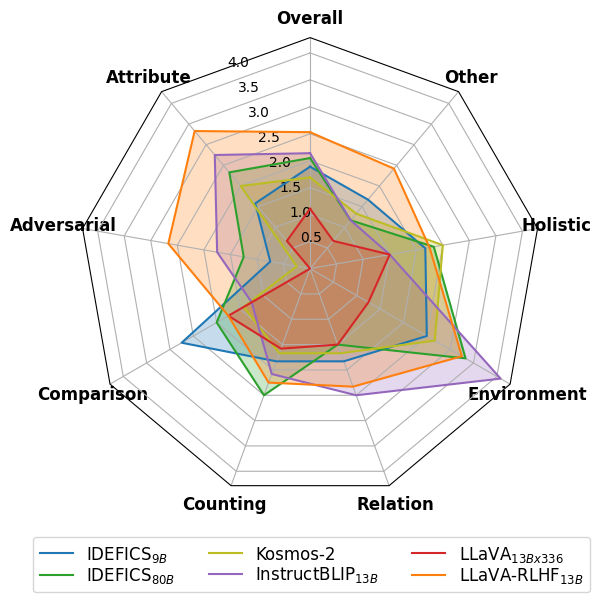
Large Multimodal Models (LMM) are built across modalities and the misalignment between two modalities can result in "hallucination", generating textual outputs that are not grounded by the multimodal information in context. To address the multimodal misalignment issue, we adapt the Reinforcement Learning from Human Feedback (RLHF) from the text domain to the task of vision-language alignment, where human annotators are asked to compare two responses and pinpoint the more hallucinated one, and the vision-language model is trained to maximize the simulated human rewards. We propose a new alignment algorithm called Factually Augmented RLHF that augments the reward model with additional factual information such as image captions and ground-truth multi-choice options, which alleviates the reward hacking phenomenon in RLHF and further improves the performance. We also enhance the GPT-4-generated training data (for vision instruction tuning) with previously available human-written image-text pairs to improve the general capabilities of our model. To evaluate the proposed approach in real-world scenarios, we develop a new evaluation benchmark MMHAL-BENCH with a special focus on penalizing hallucinations. As the first LMM trained with RLHF, our approach achieves remarkable improvement on the LLaVA-Bench dataset with the 94% performance level of the text-only GPT-4 (while previous best methods can only achieve the 87% level), and an improvement by 60% on MMHAL-BENCH over other baselines. We opensource our code, model, data at https://llava-rlhf.github.io.
Motivation & Objective
- Motivate and address multimodal misalignment and hallucinations in LMMs.
- Propose an RLHF-based alignment pipeline adapted to vision-language tasks.
- Introduce Factually Augmented RLHF to calibrate rewards with factual information.
- Enhance vision instruction tuning data with high-quality human-annotated multimodal data.
- Develop MMHal-Bench to specifically penalize hallucinations and evaluate real-world alignment.
Proposed method
- Apply RLHF to LMMs with a three-stage pipeline: multimodal supervised fine-tuning, multimodal preference modeling, and reinforcement learning with a reward model.
- Introduce Fact-RLHF where the reward model uses additional factual information (image captions, A-OKVQA rationales, ground-truth options) during training and inference to curb reward hacking.
- Incorporate symbolic rewards (ground-truth options) and a length penalty to discourage verbose, hallucination-prone outputs.
- Augment training data by converting VQA-v2, A-OKVQA, and Flickr30k into more structured, high-quality vision instruction-tuning datasets.
- Scale models with LoRA-based fine-tuning for efficient RLHF; use PPO with KL penalties to stabilize updates.
Experimental results
Research questions
- RQ1How can RLHF be effectively adapted to align large multimodal models with visual ground truth?
- RQ2Does incorporating factual information into the reward model reduce multimodal hallucinations and reward hacking?
- RQ3What impact does high-quality vision instruction-tuning data have on LMM capabilities and alignment?
- RQ4如何 measure and benchmark hallucinations in LMM outputs with a dedicated MMHal-Bench?
- RQ5What are the relative gains of Fact-RLHF over standard RLHF across capability and alignment benchmarks?
Key findings
- Fact-RLHF improves alignment on human-preference benchmarks and reduces hallucinations compared to standard RLHF.
- High-quality vision instruction-tuning data notably boosts capability benchmarks like MMBench and POPE, especially with larger models.
- RLHF enhances human-alignment benchmarks (MMHal-Bench, LLaVA-Bench) but may show mixed effects on capability benchmarks at smaller scales.
- MMHal-Bench reveals that LMMs tend to hallucinate on not-grounded questions, and Fact-RLHF reduces such errors.
- LLaVA- RLHF achieves 94% on LLaVA-Bench and 60% improvement on MMHal-Bench over baselines, with competitive results on MMBench and POPE.
Read this paper
Open the full text in the Nubint reader and ask about any passage as you read.
Read this paper on NubintThis review was generated by AI from the original paper. Please check the paper before citing it.