
[Paper Review] All about Structure: Adapting Structural Information across Domains for Boosting Semantic Segmentation
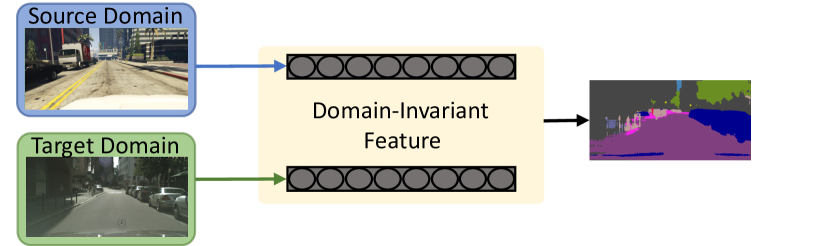
This paper proposes Domain Invariant Structure Extraction (DISE), a framework that disentangles image representations into domain-invariant structure and domain-specific texture components to improve unsupervised domain adaptation for semantic segmentation. By aligning only the structure components across synthetic (GTA5) and real-world (Cityscapes) domains and enabling image translation and label transfer, DISE achieves a 45.4 mIoU on Cityscapes, outperforming state-of-the-art methods by up to 4.3 mIoU.
In this paper we tackle the problem of unsupervised domain adaptation for the task of semantic segmentation, where we attempt to transfer the knowledge learned upon synthetic datasets with ground-truth labels to real-world images without any annotation. With the hypothesis that the structural content of images is the most informative and decisive factor to semantic segmentation and can be readily shared across domains, we propose a Domain Invariant Structure Extraction (DISE) framework to disentangle images into domain-invariant structure and domain-specific texture representations, which can further realize image-translation across domains and enable label transfer to improve segmentation performance. Extensive experiments verify the effectiveness of our proposed DISE model and demonstrate its superiority over several state-of-the-art approaches.
Motivation & Objective
- To address domain shift in semantic segmentation when transferring models trained on synthetic data to real-world images.
- To improve unsupervised domain adaptation by focusing on disentangling high-level structural content from low-level texture differences.
- To enable effective label transfer from source (synthetic) to target (real) domain by preserving structural consistency during image translation.
- To develop a unified framework that supports both domain-invariant structure learning and cross-domain image translation.
Proposed method
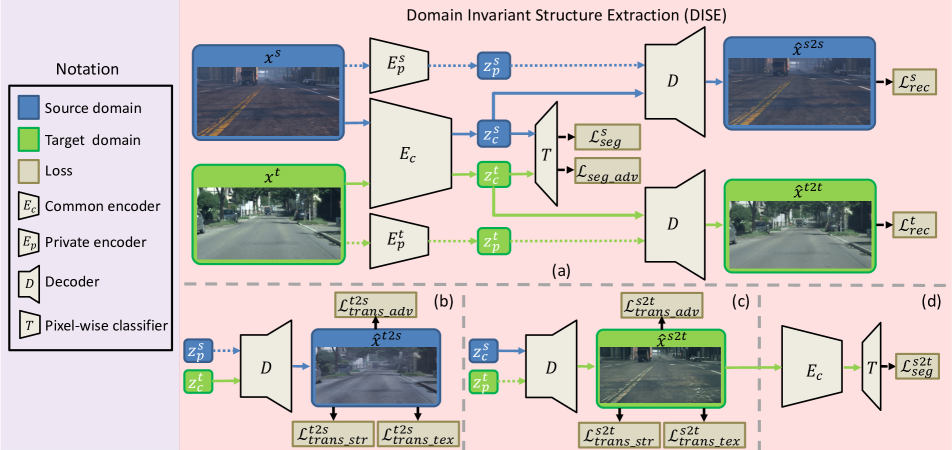
- The DISE framework uses a shared encoder for structure and domain-specific encoders for texture, enabling disentangled representation learning.
- It decomposes input images into a domain-invariant structure code and a domain-specific texture code via separate encoders.
- Image translation is performed by combining the structure code from one domain with the texture code from another, using a shared decoder.
- A segmentation head is trained on source-domain labels, and pseudo-labels from translated source images further supervise the target domain.
- The method employs multiple losses: segmentation loss, adversarial loss on segmentation predictions, reconstruction loss, and cycle-consistency losses for structure and texture translation.
- Domain-invariant structure alignment is achieved through adversarial training on the structure code, while texture is kept domain-specific.
Experimental results
Research questions
- RQ1Can high-level structural content be made invariant across domains to improve semantic segmentation generalization?
- RQ2Does disentangling structure and texture components lead to better domain adaptation than joint feature alignment?
- RQ3Can image-to-image translation based on structure-texture disentanglement enable effective label transfer from synthetic to real images?
- RQ4How does the proposed method compare to state-of-the-art domain adaptation approaches in terms of segmentation accuracy?
Key findings
- The DISE model achieves a 45.4 mIoU on the Cityscapes dataset when adapted from GTA5, significantly outperforming the 'Source Only' baseline of 39.8 mIoU.
- The ablation study confirms that disentanglement alone (without label transfer) improves performance to 44.1 mIoU, demonstrating the value of structure-texture disentanglement.
- Label transfer via translated images contributes an additional 1.3 mIoU gain over the 'DISE w/o Label Transfer' variant, validating its effectiveness.
- Qualitative results show high-fidelity image translation where structure is preserved and texture is transferred across domains, supporting the feasibility of pseudo-label generation.
- The method surpasses the state-of-the-art Seg-map Adaptation approach by 2.8 mIoU, confirming its superiority in domain adaptation.
- The framework enables both domain-invariant structure learning and cross-domain image translation within a single architecture, offering a unified solution to domain shift in semantic segmentation.
Read this paper
Open the full text in the Nubint reader and ask about any passage as you read.
Read this paper on NubintThis review was generated by AI from the original paper. Please check the paper before citing it.