
[Paper Review] All-path convexity: Combinatorial and complexity aspects
This paper investigates all-path convexity in graphs, establishing that convex sets are characterized by cut vertex separation in block decompositions. It proves that in all-path convexity, the convex hull of any set equals its interval, making all graphs interval monotone (geodetic iteration number ≤ 1), and provides linear-time algorithms for key graph convexity problems using block-cut tree structures.
Let $¶$ be any collection of paths of a graph $G=(V,E)$. For $S\subseteq V$, define $I(S)=S\cup\{v\mid v \ \mbox{lies in a path of} \ ¶\ \mbox{with endpoints in} \ S\}$. Let $\C$ be the collection of fixed points of the function $I$, that is, $\C=\{S\subseteq V\mid I(S)=S\}$. It is well known that $(V,\C)$ is a finite convexity space, where the members of $\C$ are precisely the convex sets. If $¶$ is taken as the collection of all the paths of $G$, then $(V,\C)$ is the {\em all-path convexity} with respect to graph $G$. In this work we study how important parameters and problems in graph convexity are solved for the all-path convexity.
Motivation & Objective
- To characterize convex sets in all-path convexity using graph block decomposition and cut vertices.
- To determine the computational complexity of fundamental graph convexity problems under all-path convexity.
- To establish efficient algorithms for computing key parameters such as convexity number, interval number, and hull number.
- To prove that all graphs are interval monotone under all-path convexity, implying geodetic iteration number ≤ 1.
- To provide linear-time solutions for convexity problems using block-cut tree and graph decomposition techniques.
Proposed method
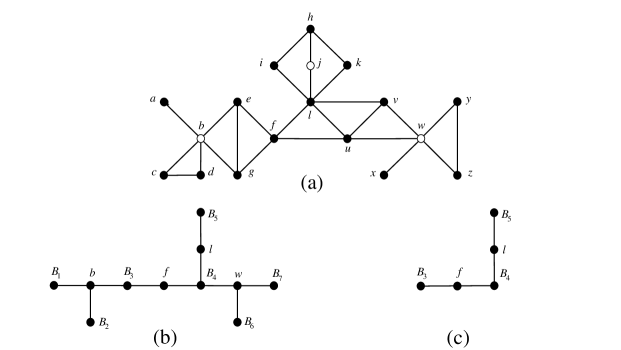
- Uses the block-cut tree of a graph to analyze the structure of connected components in G−S and their neighborhood relations.
- Applies the Fan Lemma to show that in 2-connected graphs, every pair of vertices forms an interval set, implying interval number = 2.
- Defines a set S as an interval set if every vertex lies on a path between two vertices in S, and proves I(S) = H(S) for all S.
- Characterizes convex sets as those where each connected component of G−S has exactly one neighbor in S, ensuring no vertex can be added via a path.
- Leverages block decomposition to compute the convexity number as n − b(G) + 1 when G is not 2-connected, where b(G) is the size of the smallest end block.
- Uses the block-cut tree to show that the minimum interval set must include at least one non-cut vertex from each end block, leading to interval number = eb(G) for non-2-connected graphs.
Experimental results
Research questions
- RQ1What characterizes convex sets in the all-path convexity of a graph?
- RQ2What is the computational complexity of determining the convex hull, interval set, and hull set in all-path convexity?
- RQ3How does the block decomposition of a graph influence the convexity number and interval number?
- RQ4Is the geodetic iteration number bounded in all-path convexity, and if so, what is its maximum value?
- RQ5Can key graph convexity parameters be computed in linear time under all-path convexity?
Key findings
- A set S is convex in all-path convexity if and only if S = V or every connected component of G−S has exactly one neighbor in S.
- The convex hull H(S) equals I(S) for all S ⊆ V, implying that all graphs are interval monotone with geodetic iteration number gin(G) ≤ 1.
- The convexity number c(G) is 1 if |V| = 2 or G is 2-connected; otherwise, c(G) = n − b(G) + 1, where b(G) is the size of the smallest end block.
- The interval number i(G) is 1 for trivial graphs, 2 for |V| = 2 or 2-connected graphs, and eb(G) (number of end blocks) otherwise.
- The hull number h(G) equals the interval number i(G) in all-path convexity, and both can be computed in O(n + m) time.
- All-path convexity problems—Convex Set, Interval Determination, Convex Hull, Convexity Number, Interval Number, Hull Number—can be solved in O(n + m) time, while Geodetic Iteration Number is solvable in O(1) time.
Read this paper
Open the full text in the Nubint reader and ask about any passage as you read.
Read this paper on NubintThis review was generated by AI from the original paper. Please check the paper before citing it.