
[Paper Review] AlphaBlock: Embodied Finetuning for Vision-Language Reasoning in Robot Manipulation
AlphaBlock introduces AlphaBlock dataset and CogLoop, a closed-loop, vision-language robot planning framework that uses LLMs with a vision adapter and Q-former to generate and update high-level sub-task plans for manipulation tasks, achieving higher success than prior methods.
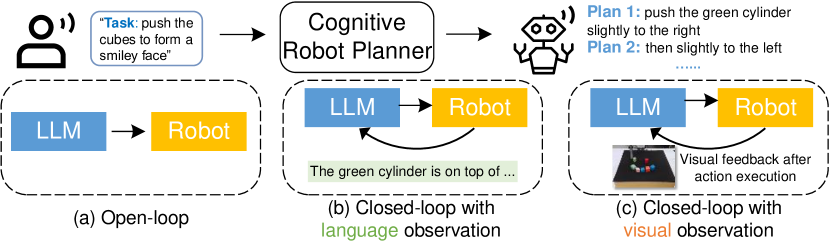
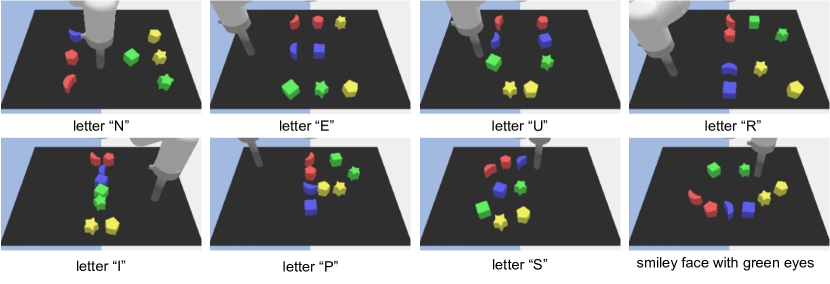
We propose a novel framework for learning high-level cognitive capabilities in robot manipulation tasks, such as making a smiley face using building blocks. These tasks often involve complex multi-step reasoning, presenting significant challenges due to the limited paired data connecting human instructions (e.g., making a smiley face) and robot actions (e.g., end-effector movement). Existing approaches relieve this challenge by adopting an open-loop paradigm decomposing high-level instructions into simple sub-task plans, and executing them step-by-step using low-level control models. However, these approaches are short of instant observations in multi-step reasoning, leading to sub-optimal results. To address this issue, we propose to automatically collect a cognitive robot dataset by Large Language Models (LLMs). The resulting dataset AlphaBlock consists of 35 comprehensive high-level tasks of multi-step text plans and paired observation sequences. To enable efficient data acquisition, we employ elaborated multi-round prompt designs that effectively reduce the burden of extensive human involvement. We further propose a closed-loop multi-modal embodied planning model that autoregressively generates plans by taking image observations as input. To facilitate effective learning, we leverage MiniGPT-4 with a frozen visual encoder and LLM, and finetune additional vision adapter and Q-former to enable fine-grained spatial perception for manipulation tasks. We conduct experiments to verify the superiority over existing open and closed-loop methods, and achieve a significant increase in success rate by 21.4% and 14.5% over ChatGPT and GPT-4 based robot tasks. Real-world demos are shown in https://www.youtube.com/watch?v=ayAzID1_qQk .
Motivation & Objective
- Motivate learning high-level cognitive abilities for robot manipulation through multi-step reasoning guided by language instructions.
- Reduce data collection burden by automatically generating a cognitive robot dataset with LLMs and an execution model.
- Develop a multi-modal planning model that fuses vision features with language to produce sub-task plans.
- Enable end-to-end training with a frozen LLM and vision encoder plus lightweight adapters for robotics tasks.
Proposed method
- Collect AlphaBlock dataset by prompting GPT-4 with multi-round prompts to generate high-level tasks, sub-task plans, and observation-action sequences; use LAVA as the execution model to create real-time planning data.
- Propose CogLoop: a decoder architecture that aligns ViT-based vision features with a frozen language decoder (Vicuna via LLaMA) using Vision Adapter and Vision Tokenizer (Q-former + projector) for fine-grained spatial perception.
- Train CogLoop to generate auto-regressive sub-task plans with cross-entropy loss while keeping the LLM and vision encoder frozen and tuning only adapters and Q-former as needed.
- Use a backtrace-like prompting and self-verification strategy to ensure data quality and reduce human effort during data collection.
- Evaluate CogLoop against open-loop and closed-loop baselines using a simulated LAVA-based controller, and conduct ablations on steps, re-planning frequency, and modality components.
Experimental results
Research questions
- RQ1Can AlphaBlock data improve high-level cognitive planning for robot manipulation beyond existing open- and closed-loop methods?
- RQ2Is a closed-loop vision-language planning approach superior to language-only observation for updating sub-task plans in real time?
- RQ3How do vision adapters and Q-former-based modality alignment impact planning performance and spatial reasoning in robotics?
- RQ4What is the trade-off between planning/updating frequency and computational cost for effective cognition in robots?
Key findings
- CogLoop with vision-based closed-loop planning achieves a 23.5% success rate, outperforming baselines including ChatGPT (16.4%) and GPT-4 with language observations.
- AlphaBlock enables significant improvements over ChatGPT (+21.4%) and GPT-4 (+7.1%) when using vision-informed plan updates.
- Vision adapters and tuning the Vision Q-former materially improve performance; the best results arise from tuning both components.
- Increasing total steps improves success rate up to convergence around 150 steps, and more frequent re-planning (every 10 steps) boosts success at the cost of time; re-planning every 10 steps is a practical balance.
- Real-world deployment on a Franka Emika arm with Kinect sensing demonstrates transfer from simulation to physical environments.
Read this paper
Open the full text in the Nubint reader and ask about any passage as you read.
Read this paper on NubintThis review was generated by AI from the original paper. Please check the paper before citing it.