
[Paper Review] AlphaStar Unplugged: Large-Scale Offline Reinforcement Learning
This paper introduces AlphaStar Unplugged, a large-scale offline reinforcement learning benchmark using over a million human-played StarCraft II games. It demonstrates that one-step offline RL methods, which first learn a behavior policy and value function, then improve the policy using the value function, achieve 90% win rate against a prior AlphaStar behavior cloning agent, outperforming standard offline RL approaches on this complex, high-dimensional environment.
StarCraft II is one of the most challenging simulated reinforcement learning environments; it is partially observable, stochastic, multi-agent, and mastering StarCraft II requires strategic planning over long time horizons with real-time low-level execution. It also has an active professional competitive scene. StarCraft II is uniquely suited for advancing offline RL algorithms, both because of its challenging nature and because Blizzard has released a massive dataset of millions of StarCraft II games played by human players. This paper leverages that and establishes a benchmark, called AlphaStar Unplugged, introducing unprecedented challenges for offline reinforcement learning. We define a dataset (a subset of Blizzard's release), tools standardizing an API for machine learning methods, and an evaluation protocol. We also present baseline agents, including behavior cloning, offline variants of actor-critic and MuZero. We improve the state of the art of agents using only offline data, and we achieve 90% win rate against previously published AlphaStar behavior cloning agent.
Motivation & Objective
- To establish a challenging, large-scale offline reinforcement learning benchmark using real human gameplay data from StarCraft II.
- To evaluate the performance of offline RL algorithms on a complex, partially observable, multi-agent environment with long-horizon planning and sparse rewards.
- To identify limitations of existing offline RL methods—such as return-conditioned behavior cloning and Q-function-based approaches—on high-dimensional, real-world-like data.
- To develop and validate a new two-step offline RL recipe: first learning a behavior policy and value function, then using the value function to improve the policy.
- To enable broader access to StarCraft II RL research by removing the need for online environment interaction, reducing compute demands.
Proposed method
- Leverages a dataset of over a million StarCraft II replays from human players on Blizzard’s Battle.net, curated as a subset of the official release.
- Standardizes an API and evaluation protocol to enable consistent benchmarking of offline RL agents across different methods.
- Proposes a two-step training recipe: first pre-train a behavior policy and behavior value function from offline data, then use the value function to refine the policy during training or inference.
- Employs one-step offline RL approaches, including behavior cloning, offline actor-critic, and MuZero variants, to learn from fixed datasets without environment interaction.
- Uses the behavior value function as a critic signal to guide policy improvement, avoiding the need for iterative off-policy updates or complex value function correction.
- Implements a Q-function that operates only on the function argument of the autoregressive action space to sidestep challenges in modeling full autoregressive action distributions.
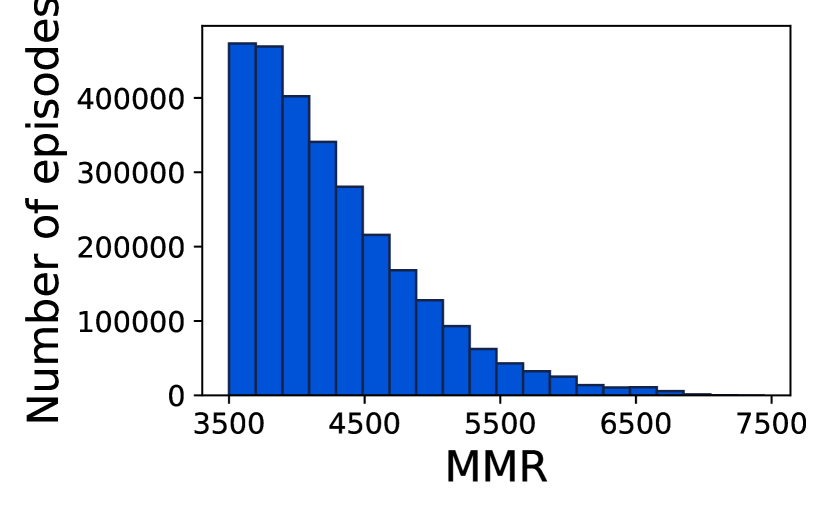
Experimental results
Research questions
- RQ1Can standard offline RL algorithms, such as return-conditioned behavior cloning and Q-function-based methods, generalize effectively to a large-scale, high-dimensional, partially observable environment like StarCraft II?
- RQ2How do offline RL methods perform when trained exclusively on data from weak human players, rather than expert or synthetic trajectories?
- RQ3Can one-step offline RL approaches—where policy improvement is guided by a pre-learned value function—outperform more complex, iterative offline RL algorithms in complex environments?
- RQ4To what extent does the combination of behavior policy and value function learning enable strong performance in offline RL on long-horizon, sparse-reward tasks?
- RQ5What are the key architectural and training design choices that lead to success in large-scale offline RL, especially when standard methods fail?
Key findings
- Standard offline RL methods such as return-conditioned behavior cloning and Q-function-based approaches failed to win a single game against the weakest opponent, indicating poor generalization on this benchmark.
- All tested standard offline RL methods underperformed a simple unconditional behavior cloning baseline, highlighting the limitations of existing approaches on real-world-like, diverse human data.
- One-step offline RL methods that first learn a behavior policy and value function, then use the value function to improve the policy, achieved a 90% win rate against the previously published AlphaStar behavior cloning agent.
- The success of the best-performing agents was consistently tied to the use of a pre-learned behavior value function to guide policy improvement, suggesting its critical role in effective offline learning.
- The benchmark revealed that state-of-the-art algorithms on small-scale offline RL benchmarks do not generalize to large-scale, real-world-like environments, indicating a need for new algorithmic designs.
- Removing online environment interaction by using offline data significantly reduces compute requirements, making large-scale StarCraft II RL accessible to a broader research community.

Read this paper
Open the full text in the Nubint reader and ask about any passage as you read.
Read this paper on NubintThis review was generated by AI from the original paper. Please check the paper before citing it.