
[Paper Review] Alphazero-like Tree-Search can Guide Large Language Model Decoding and Training
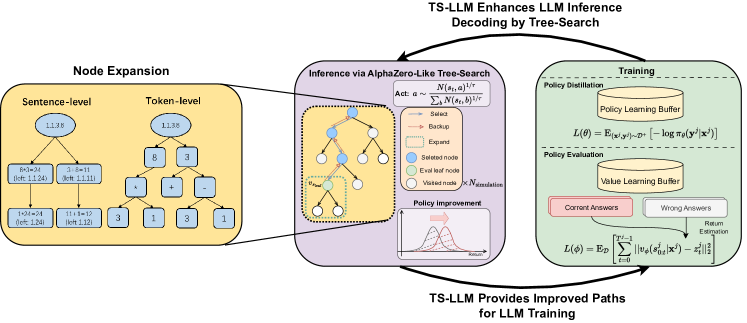
This paper proposes TS-LLM, an AlphaZero-like tree-search framework that uses a learned value function to guide large language model (LLM) decoding and training. By integrating deep tree search with policy distillation and value function learning, TS-LLM achieves state-of-the-art performance on reasoning, planning, alignment, and decision-making tasks, scaling to search depths of 64—significantly beyond prior methods limited to depths of 7–10.
Recent works like Tree-of-Thought (ToT) and Reasoning via Planning (RAP) aim to augment the reasoning capabilities of LLMs by using tree-search algorithms to guide multi-step reasoning. These methods rely on prompting a pre-trained model to serve as a value function and focus on problems with low search depth. As a result, these methods will not work in domains where the pre-trained LLM does not have enough knowledge to serve as an effective value function or in domains that require long-horizon planning. To address these limitations, we present an AlphaZero-like tree-search learning framework for LLMs (termed TS-LLM), systematically illustrating how tree-search with a learned value function can guide LLM decoding. TS-LLM distinguishes itself in two key ways. (1) Leveraging a learned value function and AlphaZero-like algorithms, our approach can be generally adaptable to a wide range of tasks, language models of any size, and tasks of varying search depths. (2) Our approach can guide LLMs during both inference and training, iteratively improving the LLM. Empirical results across reasoning, planning, alignment, and decision-making tasks show that TS-LLM outperforms existing approaches and can handle trees with a depth of 64.
Motivation & Objective
- To address the limitations of existing tree-search methods in LLMs, such as reliance on prompt-based value functions and shallow search depths.
- To develop a generalizable and scalable framework that works across diverse tasks, LLM sizes, and search depths.
- To enable tree-search to guide both inference and end-to-end training of LLMs, improving model performance iteratively.
- To demonstrate that learned value functions outperform prompt-based self-evaluation in reliability and effectiveness.
Proposed method
- Introduces an AlphaZero-inspired tree-search algorithm where the value function is learned via supervised fine-tuning on trajectories generated by the LLM.
- Uses Monte Carlo Tree Search (MCTS) with a learned value function to guide action selection during decoding, enabling deep search up to depth 64.
- Employs policy distillation to transfer knowledge from tree-search trajectories to the LLM, improving its policy.
- Learns a value function using ground-truth labels from tree-search trajectories, enabling iterative improvement of both policy and value function.
- Applies the framework to multiple tasks including reasoning (Game24), question answering (PrOntoQA), and RLHF alignment, using the same pipeline.
- Uses a hybrid search strategy combining intra-tree and inter-tree tree search to balance exploration and exploitation.
Experimental results
Research questions
- RQ1Can a learned value function in a tree-search framework outperform prompt-based self-evaluation in LLM reasoning tasks?
- RQ2Can AlphaZero-like tree search be scaled to deep reasoning tasks with a search depth of 64 in natural language generation?
- RQ3Does integrating tree-search into LLM training improve performance across diverse tasks like reasoning, planning, and alignment?
- RQ4How does the performance of TS-LLM compare to existing methods such as ToT and RAP in terms of accuracy and scalability?
- RQ5Can the iterative loop of tree-search and policy/value function refinement lead to consistent performance gains in LLMs?
Key findings
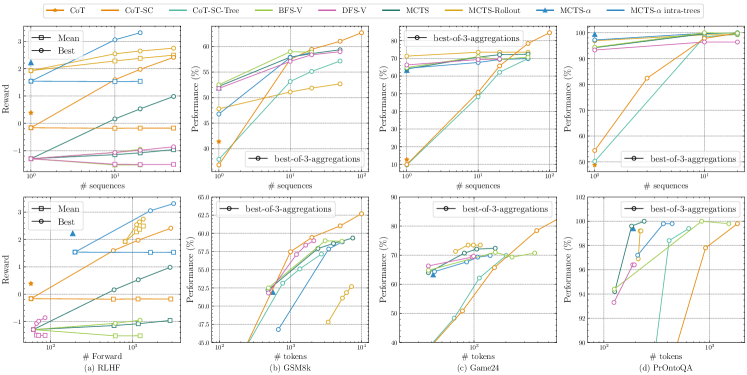
- TS-LLM achieves 100% accuracy on PrOntoQA at depth 20, outperforming all baselines including MCTS-Rollout and CoT-SC-Tree.
- On Game24, TS-LLM with MCTS-α-intra tree reaches 84.53% accuracy at depth 100, significantly outperforming CoT-SC (18.23%) and BFS-V (72.65%).
- In the RLHF alignment task, TS-LLM with MCTS-Rollout achieves a mean reward of 2.491 and a best reward of 2.746 at N=50, surpassing CoT (0.387) and BFS-V (-1.474).
- The framework successfully scales to a search depth of 64, far exceeding the 7–10 depth limits of ToT and RAP.
- TS-LLM improves performance across all evaluated tasks—reasoning, planning, alignment, and decision-making—demonstrating generalizability.
- The learned value function in TS-LLM is more reliable than prompt-based self-evaluation, as shown by consistent performance gains even with smaller LLMs (e.g., 125M parameters).
Read this paper
Open the full text in the Nubint reader and ask about any passage as you read.
Read this paper on NubintThis review was generated by AI from the original paper. Please check the paper before citing it.